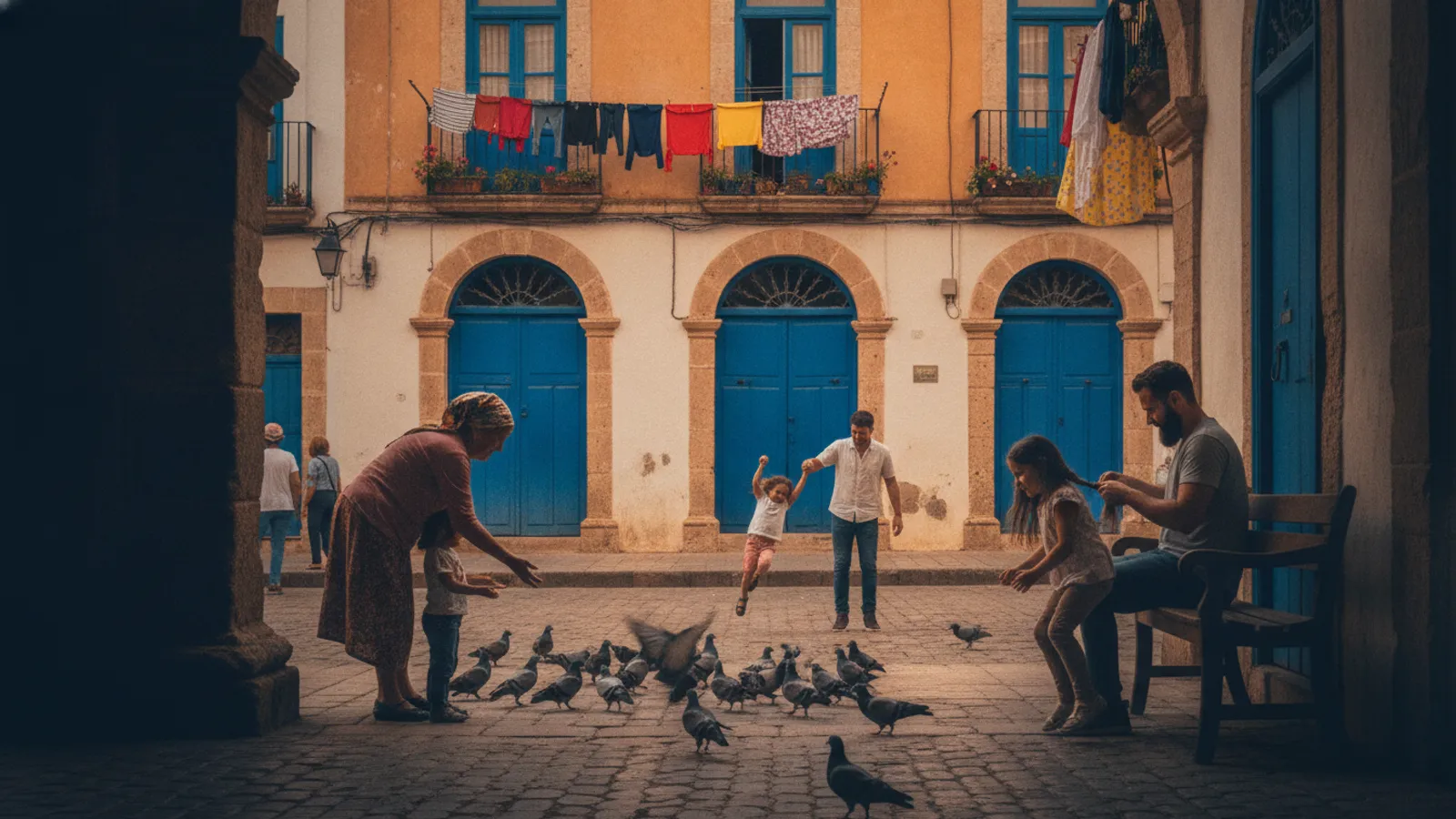
children are born, parents are made
Partnership proposal
Travel & Tourism
Real, age-filtered family content for airlines, hotel chains and tour operators.
A family is never one traveler
This isn't a generic sponsorship template. It's a partnership built for the industry that lives, every single day, with the same problem papas.academy has spent the past year building a real answer to: a family is never one traveler. It boards the plane, walks into the hotel lobby, or steps off the tour bus with a 5-year-old, an 11-year-old, and a 16-year-old — and almost no travel content tells them apart. Ours does. This is written the way we'd talk in person: no jargon, the numbers laid out plainly, and not one invented figure.
papas.academy is CEMI.ai's flagship parenting initiative, distinguished by our motto: «Los hijos nacen, los padres se hacen» — "Children are born. Parents are made." We address, facilitate and enable active, engaged parenting for every family, addressed first to fathers, built for both parents, and multilingual by design — Spanish, English, French and Portuguese.
The numbers speak for themselves — they reflect the depth, richness and appeal of papas.academy in content, diversity, format and tools. Two of the site's sections and services speak directly to the travel sector:
Destinos — 428 real destinations, 82 countries, verified
The /destinos section holds 428 real destinations, verified one by one, across 82 countries and 9 regional groupings (Dominican Republic, United States, North America & Caribbean, Caribbean, South America, Europe, Africa, Asia and Oceania, plus a cross-cutting themed layer). These aren't generic "what to see" lists: every destination carries a category (beach, mountain, cave, museum, historic site, theme park, national park, garden, and 15 more), a province or region, coordinates for the interactive map, and — what actually matters to a family — a practical guide of what to do there with kids and as a family, written in all four of the site's languages.
Three real examples, published as-is today:
- The Acropolis of Athens (Greece): the entry carries an explicit age note — "6+ years — there are steps and strong sun, bring water and a hat" — plus concrete suggestions like "find the faces of the Caryatids together" or "head down to the Acropolis Museum to see up close what stands broken above."
- Cartagena de Indias (Colombia) — a real destination Arajet flies to nonstop from Santo Domingo: the entry recommends "all ages. It gets very hot: shade, water and a cap; late afternoons are kinder for walking," with suggestions like "walk along the top of the wall looking out at the sea" or "count the balconies full of colorful bougainvillea."
- 27 Charcos de Damajagua, Puerto Plata (Dominican Republic): the entry notes that "kids aged 8 and up can do the first 7 pools with supervision," that "the guides adapt the route to the group's age and ability," and that "the natural slides are the most fun part for the little ones."
That's not generic tourist copy — it's an actionable family guide, per destination, in four languages.
Every entry also carries, as real data (not yet a live filter in the interface, but visible content on every card): a physical-difficulty rating (easy, moderate, hard, demanding, or expert) and a realistic duration — from "a couple of hours" — perfect for a long layover or an afternoon between flights — to "half a day," "full day," "weekend" or "several days" — perfect for an operator building a multi-stop itinerary.
The interactive Destinos map is filterable by: place category (23 real categories), a "great with kids" toggle (active whenever an entry carries an age note), themed chips for the pop-culture franchises present in the data (Percy Jackson, James Bond, manga/anime, Gravity Falls, horror, plus a general ★ Pop Culture chip), and free-text search across name, country, category, tags and the "with kids"/"with family" suggestions themselves. The site's own status ribbon already flags that the next layer — which exact library activities can be done at each destination — is on the published roadmap, not invented for this proposal.
The activity library — 145 entries, filterable by age and real context
The /actividades section is a separate, complementary system: 145 family-activity entries, each built on a real, consistent data schema, not a loose tag:
stages— 6 age bands, 0 to 18: Babies (0–2), Early childhood (3–5), Childhood (6–9), Preteens (10–12), Early adolescence (13–15), and Adolescence (16–18). Nearly every activity carries variations written out by stage — how the same plan changes for a 6-year-old versus a 16-year-old.context— the real context of the moment: how much time there is (15 minutes, 1 hour, half a day, full day, recurring routine), where you are (home, outdoors, city, nature, travel), what it costs (free, low cost, moderate cost), what energy is available (calm, active, training), and screen policy (screen-free, shared screen, digital native).dimensions— what the activity builds: eight developmental dimensions (reading & language, body & health, emotions & bonds, curiosity & thinking, autonomy & responsibility, creativity & play, values & character, digital life & AI), tagged as a primary dimension plus secondary dimensions.family_structures: all families, two parents at home, two homes in co-parenting, single mother, single father, blended family, grandparents & guardians — co-parenting is a first-class family structure, not an exception.
The library is filterable, live, along exactly those axes: age, available time, energy, setting, family structure, the developmental dimension a parent wants to cultivate, and screen policy — with free-text search on top. travel is one of the five real values of the setting field: part of the library is already built with the travel context in mind, not just day-to-day life at home.
A structural fit, not a market promise
We won't tell you the family-travel market is worth some figure, and we won't project how many travelers would scan a QR code — that would be exactly the kind of invented number this document refuses to use. What we can say, and what checking the site confirms: there's a structural fit between what a traveling family needs (age-appropriate content, verified, in their language) and what almost no travel-industry player produces in-house today, because it isn't their core business — it's ours. papas.academy isn't selling a travel partner an audience; it's offering an already-built, already-filterable, already-verified catalog to solve a problem the partner already recognizes in their own passengers and guests.
Three structural reasons, not projections:
- The content already exists and is already filtered. Nothing needs to be built from scratch for the partnership — 428 destinations and 145 activities are published today, with the age-and-context schema already working.
- Multilingual by design. Four complete languages — Spanish, English, French and Portuguese — cover most transatlantic and pan-American routes with no added translation work for the partner.
- The §9 editorial law as a brand-safety guarantee. Nothing fabricated, no unsourced statistics or superlatives, content aimed at families with explicit child protection built in. For a travel brand putting its name next to content for children, that published, auditable standard is exactly the neighborhood that lowers reputational risk instead of raising it.
Four illustrative scenarios
The following four scenarios are illustrative, built on real data already on the site (destinations and activities that exist today, as-is), to show how the partnership would work — they are not reported success stories or measured results, because no travel partnership is active yet.
A family with three different ages, headed to Europe
A family books a connecting flight and two weeks in Europe. Today, on /destinos, they can filter by category (say, "Historic" or "Museum") and use search to cross-reference country, pop culture and recommended age; the Acropolis of Athens entry, for instance, already carries the real "6+ years" note and concrete on-site activities for kids. A QR code on the boarding pass or in the hotel welcome folder could lead straight to that filtered entry.
The long layover
A flight with a three- or four-hour connection. The real duration: "A couple of hours" field exists in the destinations dataset precisely for this case: places and activities that fit inside a layover, not just a full vacation. An airport screen or a physical QR card could suggest, by traveler age, what to do without leaving the layover radius.
The hotel night with mismatched energy levels
A family arrives tired at a hotel; the 15-year-old wants independence, the 7-year-old wants to play. The activity library already filters, today, by context.energy (calm / active / training) and by context.setting including the value travel — so an in-room tablet or a concierge guide could surface, in minutes, a calm-energy activity for one and an active one for the other, both tagged by age and editorially verified before publishing.
A family with three different ages, flying within the Americas
A family books a nonstop flight from Santo Domingo to Cartagena de Indias, Colombia — a real airline route. On /destinos, the Cartagena de Indias entry already carries the real note "all ages. It gets very hot: shade, water and a cap; late afternoons are kinder for walking," with concrete suggestions like "walk along the top of the wall looking out at the sea," "count the balconies full of colorful bougainvillea," or "take a boat to the Rosario Islands to swim." A QR code handed out with the boarding pass, in the booking confirmation, or on the boarding-gate screen could lead straight to that entry, already filtered by destination — without the family having to figure out on their own what to do with a 5-year-old, an 11-year-old, and a 16-year-old in a walled city under the Caribbean sun.
No family is a single passenger
The same hotel booking, the same flight, the same tour brings on board a 5-year-old, an 11-year-old preteen, and a 16-year-old — with completely different tolerances, interests and energy levels. Most travel content — brochures, entertainment screens, generic destination guides — talks as if everyone were the same age. papas.academy doesn't: every destination and every activity already carries age, context, and what it builds, ready to be filtered.
What that means in practice for a travel brand:
- Before the trip. A parent planning a Singapore layover, a weekend in Bogotá, or two weeks in Europe can find, today, what to do there with their specific children — not a generic attraction list, but the entry that already tells 6-year-olds from 16-year-olds apart.
- During the flight or the stay. Age-narrated content for onboard entertainment screens or hotel tablets: the same destination entry, adjusted for whether the traveler is with an infant or a teenager.
- On arrival. A print or digital guide, specific to the destination or the hotel/airline's route, built on what's already written and verified — never invented for the occasion.
- On a short layover. The real
duration: "A couple of hours"field exists precisely for this: destinations and activities that fit inside a long connection, not just a full vacation.
Four ways to partner, sized to your route
What follows are proposed models, not existing deals or performance figures. No airline, hotel chain or tour operator has, to date, confirmed a partnership with papas.academy — this is an opening proposal, and each model gets sized in conversation based on each partner's volume and routes.
1 · Co-branded destination guides, with a QR code
A print or digital guide — hotel welcome card, seat-back insert, check-in screen — carrying a QR code that leads straight to the filtered destination entry on papas.academy: what to do there with kids of the guest's exact age, in their language. The brand kit already has the assets ready for this: six QR-code variants with the C1 logomark centered (transparent and solid backgrounds, in black, white and color), documented in brand/identity-kit.html and available in brand/qr/. The destination can be honestly labeled as a travel partner's ally — the same way we already do with our local founding allies.
2 · In-flight / in-room content by age band
A content package — text, and eventually narrated audio or video — organized by the library's same six age bands (0–2, 3–5, 6–9, 10–12, 13–15, 16–18), for onboard entertainment systems or in-room tablets: activities to do in the seat, in the lobby, or along the partner's specific route, filtered by age and by travel context.
3 · Sponsored destination entry on the map
A destination (or a collection of destinations along the partner's route) appears on papas.academy's interactive map honestly labeled "sponsored" — without changing a word of the entry's editorial content. It's the same mechanism we already use with our Local Founding Allies: honest presence on the map, never a disguised recommendation.
4 · Loyalty-program tie-in
Integrating the activity and destination filter as a loyalty-program benefit: a frequent-traveler member with kids gets access to age-filtered guides for their next destination, or to co-created promotions built around the monthly "giveaways" mechanic we already run with our founding allies.
Every one of these models can combine — just as our active founding partnerships already do — cash + in-kind contribution + venue: seats, stays or passes valued at the partner's going rate, never invented.
| Model | Format | Partner brand asset |
|---|---|---|
| Co-branded QR destination guides | Print or digital, per destination or route | Logo + QR on welcome card, seat insert, or check-in screen |
| In-flight / in-room content by age | Text, and eventually narrated audio or video, by age band (0–2 to 16–18) | Brand presence on the entertainment system or in-room tablet |
| Sponsored destination entry | Destination(s) labeled on /destinos | Honest, visible "sponsored" tag |
| Loyalty-program tie-in | Benefit inside a frequent-traveler program | Co-branding on the monthly activation, across the formats and channels we already use with our allies |
A founder no institution can replicate — and an ecosystem behind him
Carlos Miranda Levy — social entrepreneur and digital pioneer with three decades of work and impact across four continents: recognized by CNN among Latin America's Internet leaders (2000), Stanford Digital Vision Fellow, National University of Singapore Social Entrepreneur in Residence, founder of Educar.org. Today he coordinates CEMI's Enhanced Intelligences, the ecosystem of which papas.academy is the flagship parenting initiative.
And the asset no institution can replicate: the collective, shared experience of mothers, fathers and educators — years of parenting lived day to day, compared across different homes and cross-checked against evidence-based research. The 428 destinations and 145 activity entries aren't generic licensed content — they're verified and written, entry by entry, inside that same editorial standard.
Behind the founder, the CEMI ecosystem brings proven infrastructure: the AI-persona system with published authorship rules, the ailearning.global course platform, assessment expertise from Skaills.ai, and the multilingual production pipeline that already sustains the site's four complete languages.
The editorial framework
One thing, stated clearly, because it's exactly what makes this neighborhood valuable. papas.academy follows a published, non-negotiable editorial standard (our §9): every sponsor mention is always labeled; no sponsor — at any tier — decides, reviews, vetoes, or steers what we publish; and there is never sponsored advice disguised as content. A travel partner's credits would live on the sponsors page, on destination entries honestly marked as sponsored, and in event or activation content — never inside an activity, an article, or a table voice rewritten to please a brand. That wall between the brand and the editorial content isn't a limitation — it's the reason being near papas.academy is worth it. Credibility is the asset; protecting it protects you too.
The numbers we won't give you
Projections of airport traffic, "estimated reach" of guests, imaginary conversion rates, or "airlines that did X and saw Y% growth" success stories — because they don't exist and we won't invent them. This project is pre-launch, and it says so upfront. What we do offer, verifiable today with one click: 428 real destinations in 82 countries, 145 activity entries on a real, consistent data schema, and a commitment to report impact with real data and visible methodology from day one — never with inflated numbers.
Ways to contribute — not just cash
Just like our active founding partnerships, a travel-sector contribution can combine cash + in-kind + venue, valued transparently:
- In-kind: seats, stays, passes or tickets that serve families directly (for example, prizes for the monthly activation in model 4), valued at the partner's going rate.
- Venue or route: an airport, a hotel lobby, or a point along an operator's route as the physical or digital home for the QR code or co-branded guide — without ceding editorial space.
- Category exclusivity: available by tier and term — one airline, one hotel chain, one tour operator per category, per agreement.
papas.academy's overall sponsorship structure targets US$100,000 for the founding year, reachable with one exclusive Founding Sponsor or a combination of partial tiers. For the travel sector, the natural fit combines one of those tiers with the Founding Ally mechanic we already use with our local partners: cash at a founding rate + in-kind contribution + venue or joint activation, with category exclusivity and a rate frozen for 12 months.
| Tier | Investment (reference) | What it includes |
|---|---|---|
| Founding Sponsor (exclusive) | US$100,000 | Exclusive brand presence across the papas.academy ecosystem for the founding year, category-exclusivity option in travel, quarterly impact reports. |
| Principal Sponsor | US$50,000 | Featured presence on site and podcast, sponsorship of the Destinos content line, "with the support of" credit, biannual reports. |
| Travel Founding Ally (local or route-based) | Founding rate, frozen 12 months — cash + in-kind + venue mix, sized to volume | Co-branded QR guides, sponsored destination(s) on the map, co-created monthly activation, category exclusivity. |
| Friend of papas.academy | US$10,000 | Recognition on the sponsors page and footer credit line, mention in launch materials, annual report. |
The exact tier — and which of the four models above fits your route or destination portfolio best — is precisely the conversation we're proposing to open.
The next step is a conversation
We'll say it plainly and warmly: few industries understand as well as travel does that a family is never a single passenger, and few projects have built, today, a real catalog — 428 verified destinations in 82 countries, 145 activities with an age-and-context schema — built exactly to solve for that. We're not asking you to trust a projection: we're asking you to visit the site, run the filter with your own kids' or nieces' and nephews' real ages, and decide whether this serves your passengers or guests as well as we think it would.
If anything here can be adjusted to serve your brand and your route better, tell us and we'll adjust it. We'd love a 30-minute call to walk through the live site, show the filter working with real cases, and decide together with the real numbers on the table.
Next steps:
- A 30-minute call to walk through the live site and answer any questions.
- Selecting the partnership model (or combination) and investment tier.
- A partnership agreement, including the editorial-independence clause.
- A 90-day pilot with a joint review of what worked, before committing to the full term.
Carlos Miranda Levy · Coordinator of CEMI's Enhanced Intelligences
email at the foot of the online version
papas.academy/patrocinadores · cemi.ai
children are born, parents are made — and so is a family trip