The War Book That Teaches You Not to Fight (Read It Together)
By Carlos Miranda Levy · July 14, 2026
The most famous military manual in the world, read backwards: its highest idea is winning without fighting. Strategy for life — foreseeing, negotiating, choosing your battles — turned into a board game, and an author who is another puzzle. Second stop on A Journey East.
the tip in one minute — the full article is this page
Video transcript
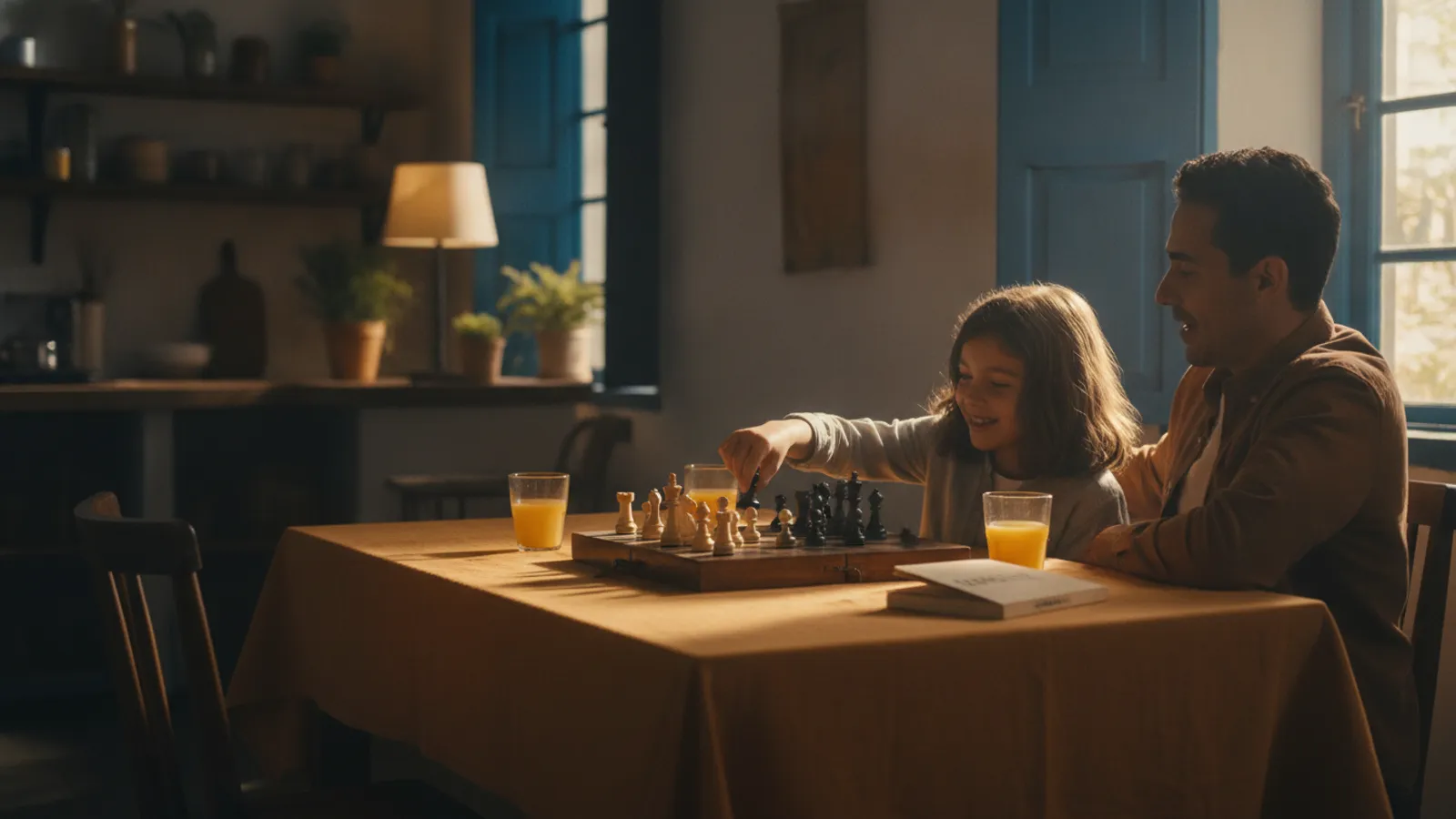
The scene, first. Someone reads a maxim aloud: winning a hundred battles is not supreme excellence; supreme excellence is subduing the enemy without fighting. Your child looks up: “wait, a book about war says the best thing is not to fight?” Exactly. The book is The Art of War, by Sun Tzu: thirteen short chapters made of even shorter maxims. The idea is to read it against the grain of what its title sells. It’s not about glorifying war or training little generals — it’s the opposite. Its highest lesson is how not to fight: to foresee, to prepare, and to choose which battles aren’t even worth having. That’s the gem. The question for your child: which fight went best for you this week… because you didn’t have it? The argument you avoided, the punishment that wasn’t needed because you negotiated first. The other thread is “know yourself and know them.” Before a game, an exam, or a hard conversation, make the two-column list together: what I know about me, what I know about the other. You’ll be surprised how much shows up. And the critical sport, the most fun: not all of the book is wise. “All warfare is based on deception,” says chapter one. Spotting which maxims have aged badly, and saying why we don’t want them, is part of the game. The author is another puzzle: was Sun Tzu one person, or ten, or a whole school of strategists? In nineteen seventy-two, at Yinqueshan, the text was unearthed on strips of bamboo. The book is ancient; the author remains a mystery. The most famous book about winning wars devotes its best page to not waging them. Teach your child to read it against the grain, and you’ll have given them a compass for every fight ahead.
The scene, first. Someone pulls out a slim little book, opens it to some maxim or other, and reads it aloud: something like winning a hundred battles is not the height of excellence — the height of excellence is subduing the enemy without fighting. Your child looks up: “wait, a war book says the best thing is not to fight?” Exactly. That’s the joke this book has been telling for almost twenty-five centuries, and almost nobody laughs because almost nobody makes it to chapter 3.
Half an hour later you’re arguing over whether the best fight you had this week was, in fact, the one you didn’t have.
The book is The Art of War, by Sun Tzu, and here’s the proposal: read it together, in little pieces, one maxim at a time — and read it backwards from what its title sells.
Alternative titles: “The War Manual That Is a Peace Manual” · “Winning Without Fighting (Read It Together)” · “13 Chapters, One Strategy for Life”
Second stop on A Journey East — very old books treated as serious toys.
An early note, and a serious one: don’t let the title scare you. This isn’t glorifying war or training little generals — it’s exactly the opposite. The Art of War is, whatever its cover might suggest, one of the best-known Chinese texts in the West — its Spanish publisher places it right alongside the Laozi — and it’s read widely well outside the military: coaches, chess players, negotiators. Its highest lesson is how not to fight — how to foresee, prepare, and choose which battles aren’t even worth having. Played well, it’s one of the most useful conversations you’ll have together. Solemnity — and saber-rattling — are forbidden by the rules of the game.
Why this format is perfect for today
The Art of War is 13 short chapters made of even shorter maxims. (Thirteen: they’re so much his own that already in the first century BCE, when Sima Qian writes about the book, a king tells its author “I have read all thirteen of your chapters.”) You don’t have to read it whole or in order: a single line fits into a dinner-table chat, a ride to school, a “five minutes before the game.” It is — two millennia ahead of schedule — another perfect capsule: you read one maxim in fifteen seconds and what follows is the conversation. Where a treatise doesn’t fit, a single line does. And one line a week, applied to real life, is a compass that sharpens itself.
It’s not a tactics class: it’s a game with contraband inside
Here’s the design secret: the activity works because nobody announces “today it’s military strategy time.” You draw a maxim at random, read it, and the instruction is always the same — this was written for armies; what does it say about a game, a test, an argument with a friend, a negotiation over bedtime? Smuggled in come the big questions: when it pays to give ground, how you really prepare, what it means to know the other side without losing sight of yourself. None of it comes through the door of a lecture. All of it comes through the door of “and how does this apply to my thing?”
The one house rule: the adult doesn’t hand down doctrine. There’s no correct interpretation you’re keeping in your back pocket. If your daughter builds a reading of the maxim you’d never thought of, don’t correct her — chalk it up as a win for her and for the method.
The gem of the book: winning without fighting
If this treatise has a signature idea, it’s the least warlike of them all, and it’s in chapter 3. In Chinese it’s twelve characters — 是故百戰百勝,非善之善者也;不戰而屈人之兵,善之善者也 — and in Lionel Giles’s English translation (1910) they read: “to fight and conquer in all your battles is not supreme excellence; supreme excellence consists in breaking the enemy’s resistance without fighting.” Foreseeing the conflict, defusing it, making it unnecessary.
A detail worth telling a child when they read the line: the original doesn’t say “convince,” it says subduing the other side’s troops without fighting. This isn’t a soft book. It’s a book that considers combat the expensive path, not the noble one.
For the table, this is gold. Question for your child: which fight went best for you this week… because you didn’t have it? The argument you avoided by seeing the misunderstanding coming. The punishment that wasn’t needed because you negotiated beforehand. The test that didn’t scare you because you showed up prepared. Here a military manual turns, without warning, into a lesson in peace — and your child discovers it on their own, which is the only way anything is really learned.
Choosing your battles (and knowing the terrain)
The book’s other great thread is scandalously applicable: not every battle needs to be fought. It lives mostly in chapter 6, the one on the full and the empty: whoever knows the place and the day of the battle can gather from very far away to fight it — and, conversely, “if we do not wish to fight, we can prevent the enemy from engaging us even though the lines of our encampment be merely traced out on the ground” (Giles’s translation). The good strategist chooses where and when — and sometimes the best move is not to show up. Translated into family life: not every provocation deserves a response, not every playground injustice is your war, not every “that’s not fair” needs to go to trial. Knowing which battle to fight and which not to is, perhaps, the hardest skill to teach and the one most needed.
And there’s “know yourself and know the other,” which is in that same chapter 3: 知彼知己,百戰不殆 — whoever knows the other and knows himself can fight a hundred battles without danger. Notice the exact promise, because it’s more honest than it’s usually quoted: it doesn’t promise winning a hundred times, it promises not being in danger. Turn it into a literal tabletop game — before a match, a test, or a hard conversation, make the two-column list: what I know about myself, what I know about the other side/the challenge. You’ll be surprised how much shows up when you sit down to look at it instead of improvising.
The house sport: which maxims have aged badly?
And here’s the critical game, which is the most fun of all: not the whole book is wise. It’s a military treatise from the ancient world, and some of its maxims sound today like manipulation, like deceit, like things we don’t want in this house — 兵者,詭道也, “all warfare is based on deception,” is in chapter 1 and is enough for a whole discussion about where strategy ends and lying begins. Spotting those maxims, and saying why we don’t endorse them, is part of the sport. You don’t read a classic to obey it: you read it to argue with it. Your child arguing back at a nearly twenty-five-hundred-year-old book, with real reasons, is worth more than any maxim learned by rote.
Bonus: an author who is another puzzle
And here’s the extra chapter the book doesn’t include — its author, who turns out to be first cousin to the one from the previous stop. About the historical Sun Tzu we know very little for certain, and it’s worth telling it with all its steps:
The oldest biography is in the Shiji by the great historian Sima Qian, compiled around 97 BCE — the same book and the same historian who gave us Lao Tzu’s biography, where Sima Qian, incidentally, writes a lovely line: “some say yes, others say no; the world does not know which is the truth.” Sima Qian places Sun Wu as a minister to King Helü of Wu, around 544–496 BCE. Some four hundred years before it was written.
The name “Sun Wu” doesn’t appear in any text before that one. And in the twelfth century, the scholar Ye Shi noted something uncomfortable: the Zuo zhuan, an earlier and meticulous chronicle of that period that names almost everyone, never mentions him — not even when narrating the battle Sima Qian attributes to him.
Today most scholars date the text to the beginning of the Warring States period, not to the lifetime of the traditional Sun Tzu; the book contains technology that didn’t exist in his supposed era. Sun Bin, an anonymous author, and an entire school of strategists have all been proposed as its true author. The sinologist Victor Mair goes so far as to call Sima Qian’s biography “essentially fictional.”
An honest note for the table: the most-repeated anecdote about Sun Tzu — the one about his first demonstration before a king — we don’t bring into this house; it has an ending that isn’t material for this series, and there’s plenty without it. (It is, in fact, in the Shiji; and it’s one of the passages that makes specialists doubt we’re reading history and not a tale.)
What we can tell is much better for the game. On April 10, 1972, construction workers accidentally stumbled on two Han-dynasty tombs at the foot of Yinqueshan, near Linyi, in Shandong. Inside, 4,942 inscribed bamboo strips. The tombs are dated between 140 and 118 BCE, so the writing predates that. And among the strips were two things at once: thirteen fragmentary chapters of Sun Tzu’s Art of Warand sixteen chapters of Sun Bin’sArt of War, a different book that had been lost for more than fourteen hundred years.
That settled a very old tangle: for centuries it had been debated whether “Sun Wu” and “Sun Bin” were the same person, because there were two books that could go by the same name. The tomb brought both of them out together and settled the confusion. And in passing it showed that by the second century BCE a text was already circulating that matches very closely the one on your table today: it’s not a late invention. Watch what the find does not do: it doesn’t say who wrote it. It proves the book, not the author.
For the dinner table, the bonus closes on the same question as the series: does the book change at all if “Sun Tzu” was one person, or ten, or a whole school of strategists across centuries? Does a book need an author to be right? The author, too, once again, is a chapter that doesn’t quite resolve. Sort it out together — documented, legend with a source, or honest unknown.
For daughters or for sons? For both. From what age?
Strategy has no gender: the eleven-year-old girl who builds the two-column list before her match and the fifteen-year-old boy who brings the parallel from his strategy video game are playing exactly the same game. Alternate the examples and you’ll see it fits just as well in either hand.
Ages 10 to 12: anchor it in the concrete — a match, a board game, a playground argument — and in the gem (winning without fighting) before fine tactics.
Ages 13 to 15: the bridge is their world — chess, sports, strategy video games — let them bring the parallel from their own game. This is also where the critical sport kicks in: which maxims smell like manipulating the other person.
Ages 16 to 18: historicity enters the picture (Sima Qian, Yinqueshan) along with the deeper debate: a manual for winning wars whose highest lesson is not to fight them. The practice card has the full variation by age.
How to do it (without overengineering it)
Randomness pays off more. Draw a maxim at random — a chapter from 1 to 13 and a line within it — or open the book wherever it falls. Formal structure doesn’t matter; the application does.
Translate, don’t explain. The question is always “what does this say about something of yours?”, never “this means that…”
Formats and editions. It’s a heavily re-translated text and the quality varies a lot, so here are three safe bets. In Spanish, the one by Albert Galvany (Trotta, Pliegos de Oriente collection): its publisher presents it as the first done directly from ancient Chinese, when earlier Spanish versions came from English. In English, the one by Samuel B. Griffith (Oxford University Press, UNESCO Collection of Representative Works), which began life as a doctoral thesis; and the old one by Lionel Giles (1910), which is in the public domain and can be read free and legally on Project Gutenberg — it’s the one we cite here. In French, the one by Jean Lévi (Hachette/Pluriel).
The polyglot twist: compare the same maxim across two translations. In a text this terse, the translator “composes” a great deal — seeing that is a micro-lesson in languages, and in healthy distrust of any too-neat quote.
The most important thing: giving room
And here’s the key that holds it all up: this activity is wu wei parenting — the same as in the first stop. Your job isn’t to steer the reading toward the “correct” conclusion; it’s to set the conditions — the book, the table, the maxim — and step aside. If your child builds, maxim by maxim, their own way of looking at their conflicts — even one that doesn’t match yours — that’s not the risk of the activity: it’s the point. We’re pointing at the moon; what actually gets built is the habit on the ground — looking at messes like a board, not like a fire. The moon can wait.
Anchor line: The war book everyone quotes devotes its best page to not fighting them. Teach your child to read it backwards — and you’ll have given them a compass for every fight that awaits them.
Start today
Get the text tonight: bookstore, public-domain PDF, or audiobook. It’s very short.
Draw a maxim at random — or open the book wherever it falls and read the first complete line you find.
Read it out loud and ask a single question: “what does this say about something of yours — a match, a test, a fight?”
Don’t hand down doctrine. If the gem comes up (winning without fighting), ask them about the best fight they didn’t have. Tomorrow, another maxim.
I proposed this stop for an uncomfortable reason: the war book everyone quotes is, on its best page, a peace book — and almost nobody reads it that way. Teaching that to a child isn’t teaching them to fight better: it’s teaching them to see the board before they move, and to ask themselves whether that match really needs to be played at all. Strategy misunderstood produces manipulators; strategy understood produces people who avoid pointless fights and show up prepared for the ones that matter. That second kind is what I want at home.
Coach Reyes — the voice of structure
Twenty-five years on the field taught me what this book says in ancient Chinese: the battle is won in the week’s training, not in Sunday’s game. “Know yourself and know the other” isn’t mysticism — it’s scouting, it’s a game plan, it’s showing up without surprises. I like that the house brings it down to two columns before a test or a game: that’s preparation, and preparation is ninety percent of staying calm. One coach’s caveat: nobody should confuse strategy with a shortcut. The book also has maxims about deception — and that’s where the house rule (do we want this one?) is worth more than the whole rest of the book.
Marina Haddad — the voice of evidence
I applaud that the article doesn’t pretend to know who Sun Tzu was. The historicity is genuinely disputed, the Yinqueshan strips prove the text’s antiquity and not the author’s identity, and all of that gets labeled “to verify” until it’s verified — that’s how it’s done. A note from my chair: when you tell a child “historians aren’t sure whether he existed,” you’re teaching them to tell apart a real text (which can be dug up and dated) from a legendary biography (which gets passed down and embellished). That distinction — document versus legend — is one of the most useful thinking tools to take away from this series.
Belkis — the practical voice
Give me what works on a Tuesday with two kids and a shift behind me, and this works: it’s free, it takes fifteen seconds, and it doesn’t need a second adult or a chessboard. But my contribution goes to “choosing battles,” which in my house isn’t philosophy — it’s survival. Not every fight of the day gets fought; you learn fast which ones to let go. Teaching my kids to see which battle is worth it and which isn’t, from early on, saves them half the grief. This book puts an ancient name on something single mothers do by instinct every single day.
Polo — the caretaker closes
This adventure’s relatives in the library: A maxim from the Art of War — the card to start tonight —, A Chapter of the Tao for the previous stop on this same journey, Debate Night for when a maxim lights up the table, and Train Together to bring “know yourself and know the other” onto the field. And the journey continues: the next stop is The Book of Five Rings — the swordsman who also painted. Safe travels — you walk better without an army.
Sources and references
All the sources below were consulted directly. The lines from the book quoted here were checked against the original Chinese and against a named translation; what couldn’t be verified wasn’t asserted.
The text, in Chinese and in translation
Sunzi, Bingfa 孫子兵法, chap. 3 “謀攻” (Attack by Stratagem) — Chinese text with Lionel Giles’s translation. Chinese Text Project. https://ctext.org/art-of-war/attack-by-stratagem · This is the source of “supreme excellence” (是故百戰百勝…) and “know yourself and know the other” (知彼知己,百戰不殆).
Sunzi, Bingfa, chap. 1 “始計” (Laying Plans) — Chinese Text Project. https://ctext.org/art-of-war/laying-plans · This is the source of 兵者,詭道也, “all warfare is based on deception.”
Sunzi, Bingfa, chap. 6 “虛實” (Weak Points and Strong) — Chinese Text Project. https://ctext.org/art-of-war/weak-points-and-strong · This is the source of choosing the place and the day, and not showing up.
Sima Qian, Shiji 史記, chap. “孫子吳起列傳” (biographies of Sunzi and Wu Qi), c. 97 BCE — Chinese Text Project. https://ctext.org/shiji/sun-zi-wu-qi-lie-zhuan · The oldest biography of Sun Tzu, and the one that mentions his “thirteen chapters.”
Sima Qian, Shiji, chap. “老子韓非列傳” (biographies of Laozi and Han Fei) — Chinese Text Project. https://ctext.org/shiji/lao-zi-han-fei-lie-zhuan · Where Sima Qian himself admits he doesn’t know who Lao Tzu was.
“Yinqueshan Han Slips,” English Wikipedia, consulted July 26, 2026. https://en.wikipedia.org/wiki/Yinqueshan_Han_Slips · Date of the find (April 10, 1972), dating of the tombs (140–118 BCE), the 4,942 strips, and the content: Sunzi and Sun Bin together.