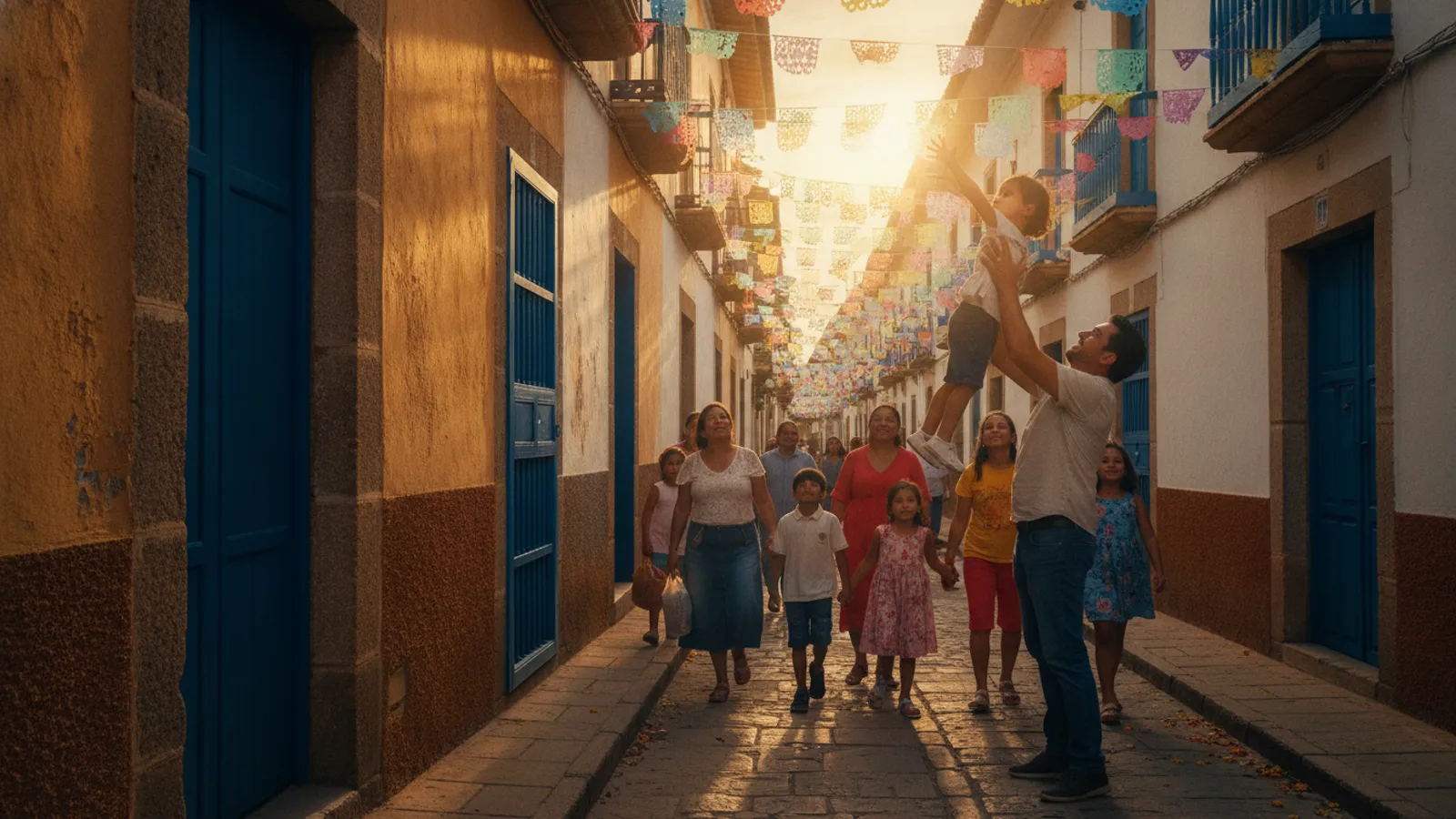
Manifesto
That’s the motto of this house and its whole thesis: you weren’t born knowing how to parent — nobody is. Parenting isn’t a talent you have or lack; it’s a practice you build, deliberately, every day, alongside your child. And «parents», in this house, means what it means: mothers and fathers.
papas.academy is born of the collective, shared experience of mothers, fathers and educators: years of parenting and of the classroom lived day to day — talked over between peers, compared across different homes, and cross-checked with evidence-based research. What we publish here didn’t come out of a manual: it came out of the daily lives of many people who raise children, held up against what science can actually support.
And here’s the honesty that defines us: experience — however many years and however many homes it adds up — does not prove formulas. What works in one particular home, with one particular child, is evidence that deliberate, committed parenting compounds — like compound interest — not a transferable guarantee. Your home is another and your child is another. That’s why this site doesn’t publish recipes: it publishes activities, adaptable systems and the permanent reminder that no two are alike.
They're many. No two daughters or sons are alike — and not even yours is the same person from one moment to the next: the breakfast one is not the school-pickup one; Tuesday's sleepy one is not Saturday's beach one. They change from day to day, hour to hour, context to context — with the sleep, the hunger, the excitement or the disappointment they carry. Raising them well demands awareness of that continuously changing persona and context, to interact with them and help them grow the best possible way — while holding steady what doesn't change: the stability, structure and clear rules and expectations that keep them safe. The rule doesn't change with the weather; the way in does. We develop it in full in this piece.
And that's why we refuse to give formulas. There is no single recipe — not even ours. What we offer is context, awareness, tools, and adaptable techniques and ideas, so each mother and father decides how to apply them at home, with the person who showed up today. That's how the whole library is built: every activity with its age variations, its cautions and its versions — raw material, not an instruction manual.
We launch on Father’s Day and speak first to dads, because committed fatherhood is the least-served conversation. But everything we publish holds equally for mothers and fathers, couples and co-parents, families of every shape. In Spanish, «papás» means both things — parents and dads — and the brand lives on purpose in that double sense. And the same going downward: «children» means daughters and sons alike — everything published here applies equally to raising a girl or a boy, at any age, and our examples alternate on purpose. What you’ll never see here: a line that diminishes mothers or fathers, that treats the other home as the enemy — or that assumes an activity is «for boys» or «for girls».
We’re part of the CEMI ecosystem and we inherit its credo: Engage, Enable, Inspire, Empower, Connect. In parenting it means: we don’t tell you what to do with your child; we hand you tools so you discover what to do — you’re the one who knows them. The assessments give back mirrors, not grades. The AI panel gives back six perspectives, not a recipe. Dependence isn’t a good educational outcome — including dependence on us.
Since there is no single formula, there is no single voice either. That's why the table exists: mothers and fathers with different parenting styles, a grandmother, a coach, a voice for the evidence — and the kids and youth themselves, because the gaze of the one being raised also teaches. Many ways of parenting sitting together, to give you a range of perspectives you choose from — never one single right answer.
papas.academy is a collaborative initiative of the CEMI ecosystem — not the work of one person. It is founded and coordinated by Carlos Miranda Levy, social entrepreneur and digital pioneer with impact across four continents (recognized by CNN among Latin America’s Internet leaders in 2000; Digital Vision Fellow at Stanford University; Social Entrepreneur in Residence at the National University of Singapore), a practicing parent of all of the above. Alongside him: the guest voices, the educators and the families who keep this from being — or sounding like — one father’s monologue.