Japan's Most Feared Swordsman Also Painted (Read It Together)
By Carlos Miranda Levy · July 14, 2026
The manual a seventeenth-century swordsman wrote about his craft, in five "rings" — and the surprise that disarms the stereotype: he also painted. The path is in the training, and your favorite hero is three people. Third stop on A Journey East.
the tip in one minute — the full article is this page
Video transcript
The scene first. Your kid comes in talking about a samurai from a video game, and you drop the quiet bombshell: “did you know Japan’s most famous swordsman was a real person… and that he also painted?” Silence. “He painted?” Yes. The book is The Book of Five Rings, by Miyamoto Musashi. Five rings, five themes: earth, water, fire, wind, and void. Five ideas, five conversations, one per lingering-at-the-table. Its flagship idea is wonderfully unmagical: there’s no talent without mileage. Musashi put it in a maxim worth the whole series — a thousand days of practice is forging; ten thousand, refining. For a child that changes something. What they admire in their idol isn’t a lightning bolt that struck him — it’s a thousand invisible days no one filmed. Naming it turns their own boring constancy into what it really is: the path. Walk through your child’s craft by rings: the fundamentals you can’t skip, earth; the part that already flows, water; what comes without thinking, void. A vocabulary for thinking about any mastery in layers. And here’s the hook that disarms the stereotype: the warrior painted. He left ink paintings kept in museums today, and he treated the sword and the brush as a single path. The question for your child: what’s your brush — the thing you practice that no one would expect of you? The perfect bonus of the series: your favorite hero is three people. The document — what he really did; the legend — what the chronicles told; and the novel — what a writer imagined. Knowing which is which makes him more interesting, not less. Japan’s most feared swordsman devoted his last book to teaching that everything is forged through training, and left paintings to prove it. Teach your child that boring constancy is the path, not its price.
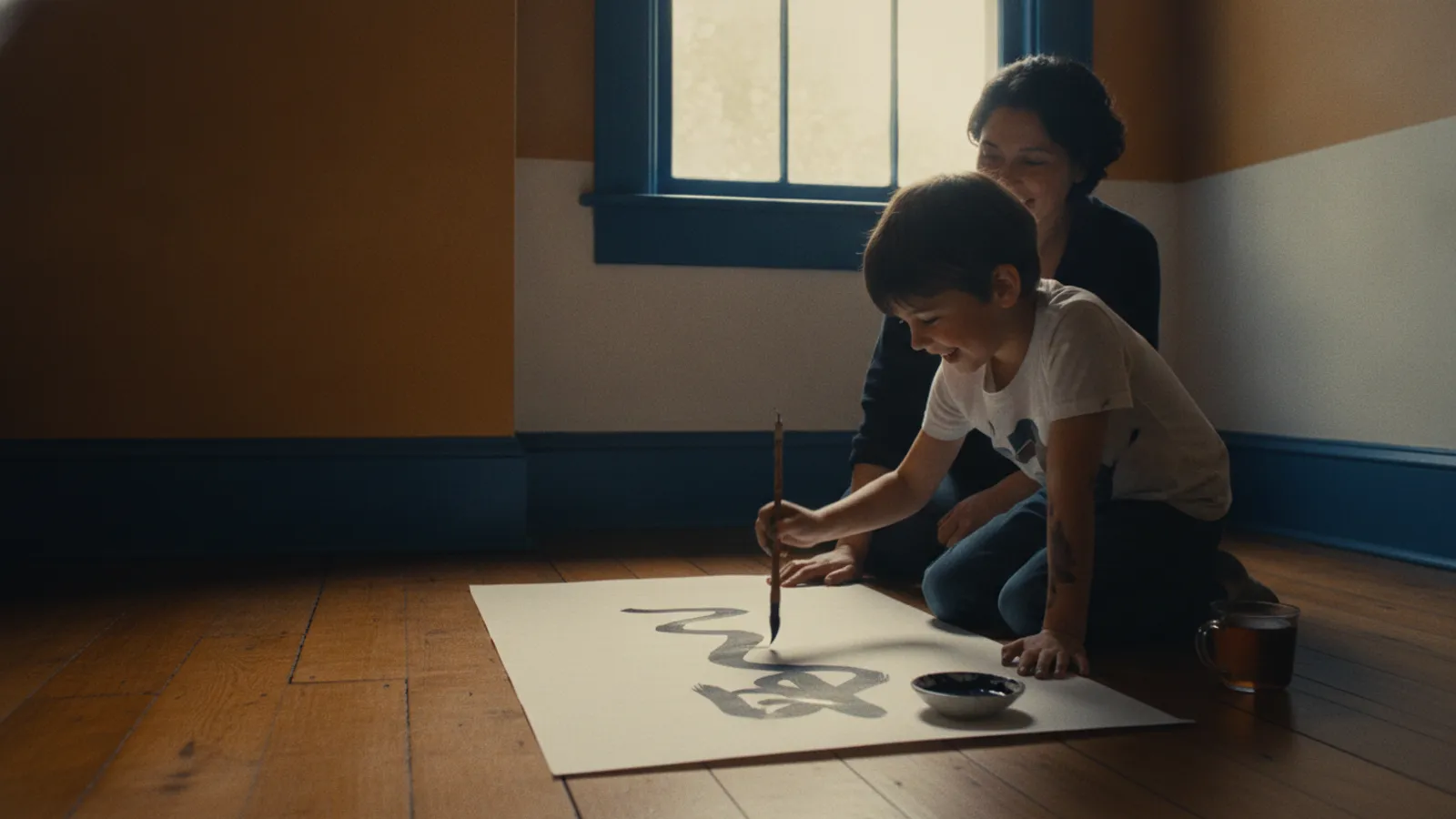
The scene, first. Your child comes in talking about a character from a sword manga, or a samurai from a video game, and you casually drop the bomb: “did you know the most famous swordsman in Japan was a real person… and that he also painted?” Silence. “He painted?” Yes — the man who won his duels wrote, at the end of his life, a little book about how you learn a craft, and he also left ink paintings that are in museums today. The warrior who trained with the sword also trained with the brush.
Ten minutes later you’re looking at what the “water ring” of their own soccer, or their own piano, would be.
The book is The Book of Five Rings, by Miyamoto Musashi, and here’s the proposal: read it together, one ring at a time — and use it as a mirror for the craft your child is already learning.
Alternative titles: “The Warrior Who Also Made Ink” · “Your Favorite Hero Is Three People” · “The Path Is in the Training (Read It Together)”
Third stop on A Journey East — very old books treated as serious toys.
An early note, and a serious one: don’t expect a book about fights. The Book of Five Rings is, above all, a treatise on how a craft is mastered — the practice, the persistence, the technique that stops being thought about from being repeated so much. Yes, a swordsman wrote it, and yes, there were duels; we tell them the way you tell a chronicle, without choreographed blood, because that’s not the point. The point is the most domestic one in the world: nobody is born knowing, everything is forged by training. Played well, it’s the conversation your child needs about their own persistence — without it sounding like you’re lecturing them on it.
Why this format is perfect for today
The book is organized into five “rings” or scrolls, and each one is a theme, not a long chapter: earth (地, where he tells his life story and gives the general lay of his school and his craft), water (水, the mental attitude and the technique that flows and adapts), fire (火, combat — and his thesis that a one-on-one fight and a battle between whole armies obey the same rules), wind (風, devoted entirely to the other schools of swordsmanship), and void (空, the essence, what’s no longer thought about because it became body). Five ideas, five conversations — one per family dinner. It’s a micro-format with its own structure: you don’t have to read the whole thing to start playing; one ring is enough.
It’s not a class: it’s a game with contraband inside
The design secret, again: nobody announces “today it’s discipline time.” You take a ring and the instruction is to translate it into the craft your child is really learning — their sport, their instrument, their video game, their drawing. What are the fundamentals — the earth — of your soccer? What part already comes to you without thinking — the void? What do you see when you watch others play — the wind? Smuggled in come deliberate practice, the humility of copying the people who are good, patience. None of it comes through the door of a lecture. All of it comes through the door of “and how is this in my thing?”
The house rule: the adult doesn’t grade. There’s no ring “done right.” You talk about it, you don’t test it.
The path is in the training
If the book has a signature idea, this is it, and it’s wonderfully unmagical: there’s no talent without mileage. Musashi wrote it down at the close of the Water scroll, in a line that in Japanese is fifteen characters: 千日の稽古を鍛とし万日の稽古を錬とす — training of a thousand days is the forging; training of ten thousand days is the tempering. And he adds: “this is something worth examining well.”
It’s worth telling a child where those two words come from, because they aren’t self-help metaphors: they’re from blacksmithing. Forging (鍛) is hammering hot metal until it takes shape. Tempering (錬) is what comes after, once the shape is there and what’s left is to refine it. A thousand days to have a shape; ten thousand for the shape to be good. It doesn’t promise shortcuts or sudden gifts: it promises that the path exists and that it’s made of dirt, walked on foot.
For a child, hearing this from the mouth of a seventeenth-century warrior changes something. What they admire in their idol — from sports, from anime, from gaming — isn’t a bolt of lightning that struck them: it’s a thousand invisible days that nobody filmed. Naming it turns their own persistence, the boring kind, the every-Tuesday kind, into what it really is: the path. Not the price of the path — the path itself.
The five rings as a conversation structure
Here’s the repeatable game. Take your child’s craft and walk through it ring by ring, one per session:
Earth: what are the fundamentals you don’t skip? The grip, the posture, the scales, the basic pass.
Water: what part already flows and adapts to whatever comes?
Fire: what happens under pressure — the game, the recital, the final? What changes when it matters?
Wind: what do they see when they watch others do the same thing they do? (Here it pays to be exact, and it’s worth a separate conversation: Musashi devoted an entire scroll to the other schools, but to criticize them — he objects, one by one, to their use of extremely long swords, brute force, rigid stances, “secrets” — and, by contrast, defines his own. In this house we do something more generous with that gesture: look at the people who do it well and learn from them. But let’s be clear about which part is Musashi’s and which part is ours.)
Void: what already comes to them without thinking? And the lovely question: how much did it cost for it to stop being thought about?
It’s a vocabulary for thinking about any mastery in layers. It works just as well for soccer, piano, and cooking — try it with everyone’s craft in the house and compare.
The surprise that disarms the stereotype: the warrior who painted
And here’s the hook that turns everything around, and you don’t have to take it on faith: you can go see it. Musashi left ink paintings that survive, and one of them — Shrike on a Withered Branch, 枯木鳴鵙図 — has been designated an Important Cultural Property by the Japanese state since April 30, 1935. It’s a hanging scroll, 125.5 by 54.3 centimeters, held by the Kuboso Museum in the city of Izumi, Osaka. In it there’s a bird with a fixed gaze high on a dead branch, and, further down, an insect slowly climbing that same branch. The man who won his duels painted a hunter waiting.
The same man who trained with the sword trained with the brush, and treated both as a single path: a craft is a craft.
The lesson for the table is enormous and not at all obvious: the person who is more than one thing is more interesting than the stereotype. Question for your child: what’s your brush — the thing you practice that nobody would expect of you? The soccer player who draws, the swimmer who codes, the gamer who cooks. Musashi gives them permission, four centuries ahead of schedule, not to be just one thing.
Bonus: your favorite hero is three people
And here’s the extra chapter that makes this stop the perfect case for the whole series. With Lao Tzu and with Sun Tzu we were playing “the author who maybe didn’t exist.” With Musashi the game flips and gets more refined: this author really did exist, and even so he comes in three layers that need to be learned apart.
Documented: Musashi died on June 13, 1645, at sixty-two. He wrote The Book of Five Rings between 1643 and 1645, retired in a cave called Reigandō, near Kumamoto, and handed it to his disciple Terao Magonojō a few days before he died. His paintings survive and one is in a museum with a catalog number. This much is established. (With two honest asterisks: the year of his birth is disputed — 1584 is what most people think today, but 1582 has also been proposed — and the manuscript in his own hand was lost: what we read today are copies. The surviving one was signed by a copyist in 1667, twenty-two years after his death. That a book this widely read about training reaches us in someone else’s copy is, in itself, a good conversation.)
Legend with a source: his most famous duel, on the island of Funajima, against a swordsman everyone today calls Sasaki Kojirō. And here’s the game, because the sources form a ladder a child can climb, step by step. There is no contemporary chronicle at all. The oldest one is a stone inscription from 1654 — nine years after Musashi’s death — commissioned by his adopted son; in it the opponent has no given name or surname: he’s called only “Ganryū,” which was the name of his school. The name “Kojirō” first appears in a record from 1672. The surname “Sasaki” doesn’t appear until 1776 — a hundred and sixty-four years after the duel. The wooden sword carved from an oar also appears in that late source, and another chronicle tells it differently. Even the date of the duel is uncertain. And the island, incidentally, is called Ganryūjima today: it kept the name of the man who lost. We tell it soberly, like a chronicle, with the dates in plain sight: there was a duel, there was an outcome, full stop. No choreography, no blood — that’s not what we’re here for.
Later fiction: almost all of the popular “character” of Musashi — the one that comes through anime, manga, and film — comes from a twentieth-century novel: Eiji Yoshikawa’sMusashi, serialized in the newspaper Asahi Shimbunbetween 1935 and 1939. Almost everything else came from there: the 1954–1956 film trilogy, and Takehiko Inoue’s manga Vagabond, which began in 1998 and openly declares itself based on Yoshikawa’s novel. It’s a great novel — but it’s a novel, not a biography. And it offers the best possible example for the table: that Musashi arrived late to the duel, that delicious detail everyone repeats, was invented by Yoshikawa. The 1654 inscription says the opposite — that the two of them arrived at the same time.
The lesson, told to your daughter or your son: your favorite hero is three people — the document (what’s established), the chronicle (what someone wrote later, and how much later), and the novel (what a writer imagined to make it a better story). Telling them apart isn’t spoiling the fun: it’s the critical skill of the century, and with Musashi you learn it by playing. The character your child loves is real, is legend, and is fiction, all at once — and knowing which part is which makes it more interesting, not less.
And there’s a fourth level, rarer and very useful, that Musashi hands us all on his own: what a person says about himself. In the Earth scroll he writes his own résumé — first duel at thirteen, another at sixteen, and “more than sixty” fights by the age of twenty-eight or twenty-nine, without losing a single one. Of those sixty-odd fights, only two are documented with any detail. You don’t have to call it a lie; you have to call it by its name: it’s the interested party’s own testimony, which is neither the same as a document nor the same as a legend. Question for the table: when you tell how it went in the game, which of the four levels are you on?
For daughters or for sons? For both. From what age?
The craft has no gender: the twelve-year-old violinist mapping her fundamentals and the twelve-year-old soccer player looking for his “void ring” are walking through exactly the same five scrolls. Alternate the examples and it fits just as well.
Ages 10 to 12: anchor it in a concrete, visible craft, and in two rings per session at most (earth and void are the easiest to feel). The pop-culture bridge is direct: the manga samurai traced back to his real source.
Ages 13 to 15: the most direct cultural bridge in the series — samurai, anime, video games — this is where the thousand-days maxim shines, and the brush (have them think about their own second facet).
Ages 16 to 18: the game of levels kicks in — document, late chronicle, novel, and what the interested party said about himself — and the “void ring” is enough for a whole conversation about any mastery. At this age, the ladder of dates for the duel (1654 → 1672 → 1776) tends to be what hooks them most. The practice card has the full variation by age.
How to do it (without overengineering it)
One ring at a time. You don’t have to read all five in a row; one is enough for a whole dinner-table conversation.
Translate it to your child’s craft. The question is always “how is this in your thing?”, never “this means that…”
Formats and editions. In Spanish it circulates in many bookstore editions and as an audiobook; any of them will do for playing, so don’t overthink it — but it’s worth knowing that almost none come from the Japanese, so it’s wise to distrust any line that sounds too neat. If someone at home reads English, the two reference versions are Victor Harris’s (Overlook Press, 1974) and William Scott Wilson’s (Kodansha International, 2002).
The polyglot twist: if you get hold of two translations, compare the same line in both. In a text this terse the translator “composes” a great deal — seeing that is a micro-lesson in languages, and in healthy distrust of any too-neat quote.
The visit, even if only on a screen: look up the image of Shrike on a Withered Branch together. Seeing the “warrior” painting a bird and a little bug climbing up a branch disarms the stereotype better than any explanation. (The museum only displays it for a few seasons a year, to preserve it; online you can see it year-round.)
The most important thing: giving room
And here’s the key that holds everything up, the same as the two previous stops: this activity is wu wei parenting. Your job isn’t to dictate how a craft is mastered — it’s to set out the book, the table, and the ring, and step aside. If your child builds, ring by ring, their own way of looking at their practice and their persistence, that’s the point, not the risk. We’re pointing at the moon; what actually gets built is the habit on the ground — looking at boring effort as a path, not as a punishment. The moon can wait.
Anchor line: Japan’s most feared swordsman devoted his last book to teaching that everything is forged by training — and he left paintings to prove it. Teach your child that their idol is three people, and that boring persistence is the path, not its price.
Start today
Look up the book tonight: bookstore or audiobook. It’s short.
Choose with your child the craft you’re going to look at: their sport, their instrument, their game, their drawing.
Take one ring — earth or void are the easiest to start with — and ask how that is in their thing.
Don’t grade it. If the thousand-days maxim comes up, let it linger. Tomorrow, another ring — and someday, the brush.
I close the first journey with Musashi for a reason: he’s the best teacher of an idea that matters a great deal to me — that almost everything is learned through training, and that sudden talent is, almost always, a thousand days you didn’t see. But I chose this book for the brush. That a man who made his living with the sword painted birds in ink — and so well that Japan declared the work a protected cultural asset — tells a child something no lecture does: you don’t have to be just one thing, and the most interesting people never are. That permission — to have a brush as well as a sword — is one of the things I most want to leave my son.
Sancho — the Squire
Ah, a knight who was also an artist! Bless me — this is right up my alley. Musashi is the most honest Quixote in the series: his wasn’t a windmill, it was a real path, walked on foot over an entire lifetime. My squire’s advice: when the child chooses their craft and starts walking through the rings, don’t load them up with the backpack of “you have to make it professional.” The adventure is the training itself, not the trophy. The squire applauds every day of boring practice the way he’d applaud a battle — because that’s what it is. And I celebrate the brush above all: may our knights always keep a second adventure tucked away.
Coach Reyes — the voice of structure
This book says in old Japanese what I’ve spent twenty-five years shouting on a track: deliberate practice, the thousand days, aren’t negotiable. I love that the house brings it down to the five rings — fundamentals, flow, pressure, learning from others, automaticity — because that’s really how you train, in layers, not all at once. With the “wind ring” I’ll allow myself a liberty and say it straight: Musashi wrote it to tear down the rival schools, not to have people copy them. I use it the other way around, because in modern sport watching the best and learning from them is half of training. It’s the chapter that’s hardest for me to teach: kids think copying is cheating, and it’s exactly the opposite. One coach’s caveat: the thousand days aren’t a punishment. If the practice turns into martyrdom, something went wrong. Musashi trained and painted — balance, not obsession.
Tomás Andrade — the voice of connection
I was an aircraft mechanic for twenty years: I know what a craft of hands is, of protocols, of repeating until the body learns. And I learned late, the hard way, that there was a second craft nobody had taught me — the craft of emotions, of telling my daughter what I feel. Musashi’s brush hits close to home for that reason. For the hands-on dads — the ones of us who are good at the technical and clumsy at the tender — this book gives us a permission slip: your second facet trains too, it’s also a thousand days, and it’s also worth it. Tenderness is a craft. It gets forged like any other.
Polo — the caretaker closes
This adventure’s relatives in the library: A Ring of Musashi’s — the card to start tonight —, Train Together to bring the five rings onto the field, Today You Teach Me so your child can teach you their craft, and A Chapter of the Tao to go back to the start of the journey. And with this stop we close the first lap of A Journey East — three old books, three puzzle-piece authors, one single game. Safe travels — and always keep a brush next to the sword.
Sources and references
All the sources below were consulted directly. The dates, the works, and the ladder of chronicles about the duel come from them; what couldn’t be verified wasn’t asserted — and that’s why this article doesn’t recommend any specific Spanish edition or name any museums beyond the one we could verify.
Musashi’s text
宮本武蔵, 五輪書 (Gorin no Sho), 水之巻, final section “後書” — original Japanese text, 日本古典文学摘集. https://www.koten.net/gorin/gen/238/ · This is the source of the thousand-and-ten-thousand-days maxim: 千日の稽古を鍛とし万日の稽古を錬とす. The same page reproduces the copyist’s colophon, dated 1667.
“五輪書,” Japanese Wikipedia, consulted July 26, 2026. https://ja.wikipedia.org/wiki/五輪書 · Content of each scroll — including the Wind scroll, devoted to criticizing the rival schools — the Reigandō cave, the handover to Terao Magonojō, and the loss of the autograph manuscript.
English editions
Miyamoto Musashi, A Book of Five Rings, translated by Victor Harris, Woodstock (N.Y.), The Overlook Press, 1974, 95 pp., ISBN 0-87951-018-8.
Miyamoto Musashi, The Book of Five Rings, translated by William Scott Wilson, Kodansha International, 2002, 160 pp., ISBN 978-4-7700-2801-3.
The painting
文化遺産オンライン (Agency for Cultural Affairs of Japan), entry for 紙本墨画枯木鳴鵙図〈宮本武蔵筆/〉. https://online.bunka.go.jp/heritages/detail/204399/1 · Important Cultural Property (重要文化財) designated April 30, 1935; Edo period; held at the Kuboso Museum in Izumi, Osaka.
和泉市久保惣記念美術館 (Izumi City Kuboso Memorial Museum of Arts), entry for 枯木鳴鵙図 in its digital museum. https://www.ikm-art.jp/degitalmuseum/num/001/0010141000.html · A hanging scroll, 125.5 × 54.3 cm; the description of the shrike and the insect on the branch.
“宮本武蔵,” Japanese Wikipedia, consulted July 26, 2026. https://ja.wikipedia.org/wiki/宮本武蔵 · Date of death (June 13, 1645, at age 62), the discussion of the birth year, and the dated list of chronicles: 小倉碑文 (1654), 沼田家記 (1672), 武公伝 (1755), 二天記 (1776).
“佐々木小次郎,” Japanese Wikipedia, consulted July 26, 2026. https://ja.wikipedia.org/wiki/佐々木小次郎 · What the 1654 inscription says and doesn’t say; the late appearance of the name “Kojirō” (1672) and the surname “Sasaki” (1776); and the attribution of the late-arrival episode to Yoshikawa Eiji.
“巌流島,” Japanese Wikipedia, consulted July 26, 2026. https://ja.wikipedia.org/wiki/巌流島 · The island’s official name (Funajima), why it’s called Ganryūjima, and the explicit warning that the date of the duel is uncertain.
“Musashi (novel),” English Wikipedia, consulted July 26, 2026. https://en.wikipedia.org/wiki/Musashi_(novel) · Serialized in the Asahi Shimbun between 1935 and 1939; historical novel; 1954–1956 film trilogy.
“Vagabond (manga),” English Wikipedia, consulted July 26, 2026. https://en.wikipedia.org/wiki/Vagabond_(manga) · By Takehiko Inoue, started in 1998, “based on Eiji Yoshikawa’s novel Musashi*.”*
Help us make it better
Did something ring false, feel missing, or feel like too much? Tell us — good comments make articles better.