The Book That Refuses to Explain Itself (Read It Together)
By Carlos Miranda Levy · July 14, 2026
A 2,500-year-old book in two-minute capsules, the sport of the chapters that "make no sense," and the bridges to anime and Star Wars. First station of Un viaje a Oriente.
the tip in one minute — the full article is this page
Video transcript
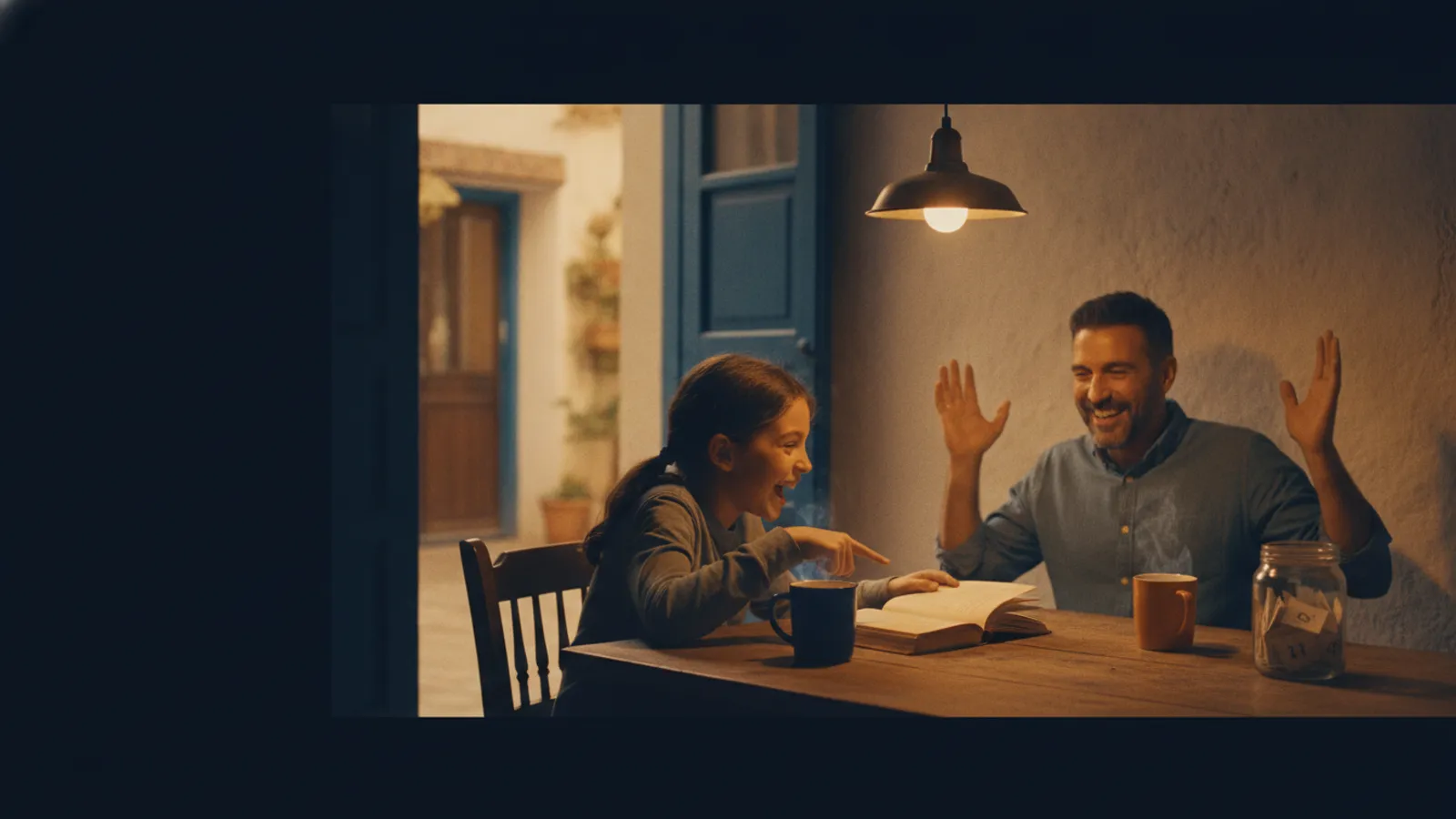
The scene, first. Any evening at the table: someone opens a small book at random and reads aloud for ninety seconds. Your daughter frowns: “that makes no sense.” And you, instead of explaining, ask: “right? So then why has it never gone out of print in two thousand five hundred years?” The book is the Tao Te Ching. Eighty-one chapters, nearly all a single page, two minutes each: two millennia ahead of its time, the perfect capsule, sized for a moment at the table. The one rule of the house: the adult doesn’t explain. Questions yes, lectures no. If your child builds a reading that contradicts yours, don’t correct them — chalk it up as a win for them and for the method. Its signature idea is wu wei: action without forcing. It’s not doing nothing, it’s acting with the current; the strength that lies in yielding, the water that, being the softest thing, ends up polishing the rock. Does it remind you of something else? Your child too. Anime, wuxia, and even the Mandalorians’ “This is the Way” are, literally, a path, a dao. Your child has spent years taking in wu wei without knowing its name. The chapters that seem to make no sense are the best in the game. The first says the Tao that can be named is not the true one, and then names it for eighty more chapters. Let your child spot the trick and win that round. And the bonus the book doesn’t include: its author. “Lao Tzu” isn’t even a name, it’s a title, “the Old Master,” and he may never have existed. The question for your daughter: does a book need an author to be right? The book refuses to explain itself. Do the same, step aside, and watch what your child builds in that space.
The scene, first. An ordinary after-dinner chat. Someone pulls out a small book, opens it at random, and reads aloud for ninety seconds — a whole chapter, since almost none run longer than a page. Silence. Your daughter frowns: “that doesn’t make sense.” And you, instead of explaining, ask: “It doesn’t, does it? So why has it been in print, unbroken, for two thousand five hundred years?”
An hour later, they’re still arguing.
The book is the Tao Te Ching, and here’s the proposal: read it together, in small bites, one chapter at a time — and really enjoy the cryptic chapters that seem to make no sense.
Alternative titles: “81 chapters, 2 minutes each” · “The game of the chapters that make no sense” · “This is the Way (of the after-dinner chat)”
First station of A Journey East — very old books treated as serious toys.
Early note, and it’s serious: don’t dismiss this as “a philosophy activity” — solemn, dense, smelling of homework. Quite the opposite: played well, it can turn into one of the most fun shared traditions you’ll ever explore together. A chapter reads in two minutes; what follows is a conversation that can be a joke, a battle of arguments, or an hour nobody noticed passing — and it almost always ends up somewhere unexpected. Solemnity is banned by the rules of the game.
Why this format is perfect for today
The Tao Te Ching has 81 chapters and almost all of them fit on a page. The whole book is about five thousand Chinese characters: less than a single chapter of an ordinary novel. It is — two and a half millennia ahead of schedule — the perfect microformat: 81 capsules exactly the size of an after-dinner chat, a ride to school, a “five more minutes and then bed.” Where a book won’t fit, a chapter will. And where a chapter fits every single night, a tradition is being built without anyone announcing it.
It’s not a class: it’s a game with contraband inside
Here’s the design secret: this activity works precisely because nobody declares “today it’s philosophy.” You read, you frown, you argue — and the big questions slip in as contraband: what’s worth more, having or being; when to push and when to let go; whether the one who talks most is the one who knows most. None of them comes in through the sermon door. They all come in through the door of “so what could this possibly mean?”
The one house rule: the adult doesn’t explain. Questions, yes. Lectures, no. If your child builds a reading that contradicts yours, don’t correct him — chalk it up as a win for him, and for the method.
Wu wei: the anchor concept (and where your child has already seen it)
If the book has one flagship idea, it’s wu wei: action without forcing. It’s not doing nothing — it’s acting with the current instead of against it; the strength that lives in yielding. And we don’t have to make this up ourselves: chapter 43 says that the softest thing in the world overcomes the hardest, and chapter 78 caps it off by saying that nothing in the world is softer than water, and yet nothing surpasses it at attacking what is firm and strong. Two chapters, two minutes, and the whole concept served up.
Does that sound like something else? It’ll sound like something else to your daughter or your son too, and that’s where the good part starts. The master who wins with no apparent effort; the disciple who loses while fighting in a rage and wins when he stops forcing it; the flow state where technique disappears. That pattern is everywhere in anime, in manga, in wuxia cinema, and on half a shelf of video games.
Now, careful — and this bit of caution is the best game in the whole article. Looking alike doesn’t prove it comes from there. We haven’t found anyone who documents that anime or wuxia actually descend from the Tao Te Ching, and we’re not going to say we have. What there is, is a resemblance, and that’s already quite a lot: recognizing the pattern and being able to name it. And that distinction — what’s documented versus what merely resembles — is exactly what this journey wants to teach. Practice it at the table; it’s learned in one evening and lasts a lifetime.
The galactic case works as a lab, because it has all three levels at once:
Resemblance (and nothing more, for now). The Mandalorians’ creed — “This is the Way,” the phrase Din Djarin repeats in The Mandalorian — literally means this is the path, and dao means path. Nice, isn’t it? Well, it’s a wordplay of ours, not a proven borrowing: the show never said it came from there. Let it stand for exactly what it is.
A critic’s reading. That the Force has a Taoist air about it isn’t this house’s invention: there are scholars who have read Star Wars in that key — Kevin J. Wetmore does so in The Empire Triumphant (McFarland, 2005), with a chapter titled “May the Tao Be with You.” It’s a published, signed interpretation. That is not the same as a confession from the creator.
Influence documented by the creator himself. George Lucas did say, in so many words, where he got things from: in a 2001 interview for the The Hidden Fortress release, he details which elements of Akira Kurosawa’s film directly inspired Star Wars. That’s no longer resemblance: that’s filiation, stated by the person who made it.
Three levels, one universe, and a perfect question for the after-dinner table: how do we know which is which? Star Wars at the table isn’t cheating — it’s the best lab material you have on hand.
The chapters that “make no sense” (the best ones in the game)
Here’s the fun heart of the matter. Proposal: before interpreting, classify. There are three kinds of nonsense, and figuring out which one you’ve got is part of the sport.
1. The ones that self-destruct on purpose. Chapter 1 opens with two twin lines: the way that can be walked is not the eternal Way, and the name that can be named is not the eternal name — and then eighty more chapters follow, naming it. Chapter 56 plays with the idea that the one who knows doesn’t speak, and the one who speaks doesn’t know — written by someone who, evidently, spoke. This is a gift for a child: the refutation is right there, within reach. Let him discover it and win that round with full honors. And then, the question back: wouldn’t the author have known that perfectly well? What kind of book contradicts itself on purpose on the very first page?
2. The coherent but provocative ones. Chapter 5 says something uncomfortable: that heaven and earth don’t act out of benevolence, and treat all creatures the way “straw dogs” are treated — and that the sage does the same with people. The image is straight from the text itself; what it means exactly is your discussion to have. Is it indifference or impartiality? This house has no answer for you. Chapters 3 and 80 defend something like anti-progress: fewer desires, fewer tools, staying in the village. Here comes the house discipline: steelman, not strawman — your child defends the position as well as he can before he earns the right to knock it down. And chapter 48 proposes a strange arithmetic: the one devoted to learning adds every day; the one devoted to the Way subtracts every day — and what gets subtracted, says the chapter, is his own doing. Subtracting doing? There’s a whole conversation in there about having more, doing more, and being more.
3. The genuinely cryptic ones. Chapter 6 speaks of a valley spirit and a mysterious female; chapter 42, of the Tao begetting the one, the one begetting the two, the two begetting the three. What are the one, the two, and the three? Honest answer: nobody is entirely sure — scholars have been arguing about it for centuries. Present it that way, without faking authority. “Nobody knows” is, for a child, one of the most liberating phrases there is: it means his hypothesis competes on equal footing.
The text is an unearthed jigsaw puzzle (and that gives permission)
A fact that changes the game: the Tao Te Ching we read today is a text assembled and reordered over centuries — and we don’t assume this, we know it, because older versions were unearthed that don’t match. Three testimonies, three surprises:
The Guodian bamboo strips. They surfaced in 1993, in a tomb in China’s Hubei province, and are dated to around 300 BCE: they are, by a wide margin, the oldest copy in existence — about a hundred and fifty years older than any other known one. They carry material from 32 of the 81 chapters (twenty-four complete, eight in fragments)… and the order bears no resemblance at all to the one we read today.
The Mawangdui silk manuscripts. They emerged in 1973 from a tomb in Changsha sealed in 168 BCE. There are two of them, and they carry all of today’s chapters — but they start from the second half: they open with what is today chapter 38. The book we know is, literally, back to front.
The “received” version. This is the one tradition settled on, associated with the commentator Wang Bi (226–249 CE) — and even this one doesn’t get off free: specialists warn that the text accompanying his commentary today carries later touch-ups, so it isn’t exactly what Wang Bi had in front of him either.
And now the part most useful for the table: the Guodian find didn’t close the discussion, it opened it. There are two opposing readings among specialists — one says those strips are a selected excerpt from a book that was already complete; the other, that they’re collections of sayings that circulated loosely and that someone combined afterward. Nobody has won that argument. Tell it that way, with both hypotheses on the table: it’s a lesson in how real thinking works, and it costs nothing to give it.
The moral: sometimes a chapter “makes no sense” because it might be two half-chapters that an editor married two thousand years ago. Interrogating the text isn’t disrespecting it — it’s reading it well.
(If you want to see the puzzle with your own eyes, there’s a Spanish edition that prints all three testimonies side by side, bilingually: see “Translations,” below.)
How to do it (without over-structuring)
For daughters or for sons? For both, and seriously. The paradox has no gender: the eleven-year-old girl who takes apart chapter 56 and the fifteen-year-old boy who brings up the anime parallel are playing the same game. A nice fact, verifiable, with a little twist built in: two of the doors into this book in our languages carry a woman’s signature, and they’re two different crafts. Anne-Hélène Suárez Girard, a sinologist, translated it directly from the Chinese into Spanish (Siruela). Ursula K. Le Guin, a novelist, made the English one many people read aloud (Shambhala, 1997) — but she herself didn’t call it a translation, she called it a version: she worked from literal translations and with Chinese specialists. That difference, said at the table, is worth a whole conversation: is translating the same thing as making a version? Which of the two would you read, and for what purpose? This book has been speaking in a woman’s voice for decades too — and in two different ways.
From what age? Ages 6 to 9, illustrated or animated versions: one image and a single question (“why does water beat stone?”). Ages 10 to 12, entry into the text — the golden age of logical traps. Teenagers: their own catalog (anime, wuxia, Star Wars) and the right to disagree with you. The practice card has the full breakdown by age stage.
In order or at random? Random is more fun: a die, slips of paper in a jar, whatever number the child calls out. The book can take any order — we’ve got two millennia of testing behind it.
Loose or guided? Start loose. If your house wants structure, the three chapter types serve as a map. But careful: the goal is to have fun, not to lecture — if you notice you’ve prepared “supporting materials,” take a breath and let it go.
Formats: print (any bookstore), audiobook for the car, and — for the littlest ones — illustrated and animated versions on YouTube: one image and a single question are enough. Free and legal? James Legge’s English translation is in the public domain and can be read in full, numbered, on Project Gutenberg. In Spanish, watch out: the translations currently in print are copyrighted, so whatever free version circulates out there is usually old, of uneven quality, or outright pirated. Better to hit the neighborhood library.
Translations: it’s worth having two — one to read and enjoy, another to compare and disagree with. In Spanish, Anne-Hélène Suárez Girard (Siruela, El Árbol del Paraíso collection, 2nd ed. 2022; a direct translation from the Chinese, with a foreword by François Jullien) to read; and Iñaki Preciado Idoeta’s Los libros del Tao (Trotta, 4th ed. 2021, 568 pages) to compare: it’s bilingual and prints side by side the Guodian copy, both Mawangdui manuscripts, and the Wang Bi version — the jigsaw puzzle from the previous section, laid out on the table. In English, Ursula K. Le Guin’s version (Shambhala, 1997) to read aloud, and D. C. Lau’s translation as a reference (there’s an Everyman’s Library edition, 1994, with an introduction by Sarah Allan).
The polyglot twist (recommended): read the chapter in a language that isn’t your mother tongue. The text is already terse and foreign; in another language it becomes even stranger — in a good way — and forces you to go slowly, which is exactly what this book rewards. Smuggled-in language practice, plus a free lesson: comparing two translations of the same chapter reveals how much the translator “composes” when the original barely says anything.
The most important thing: give space
And here’s the key that holds everything up, bigger than this book itself: this activity is wu wei parenting. Your job isn’t to steer the reading toward any conclusion — it’s to create the conditions (the book, the after-dinner chat, the question) and step aside. Stimulate without imposing. If your child builds, chapter by chapter, a reading of the world that isn’t yours — that’s not the activity’s risk: it’s its purpose. We’re pointing at the moon; what gets built is the ritual on the ground — the table, the laughter, the nightly argument. The moon can wait.
Anchor line: The book refuses to explain itself. Do the same — and watch what your child builds in that space.
Bonus: the author who maybe never existed
And here’s the extra chapter the book doesn’t include — the story of its author, which turns out to be another puzzle.
Of the author of the Tao Te Ching we know almost nothing for certain. “Lao Tzu” isn’t even a name: the majority reading is that it’s a title — something like “the Old Master” (some argue “Lao” was a surname; that isn’t settled either). And there are specialists today who hold, flatly, that a historical Lao Tzu never existed.
The oldest biography in existence was written by the great historian Sima Qian, some four centuries after the era tradition places him in. And the best part of that biography is how it’s built: Sima Qian lays three candidates on the table — a certain Li Er, from the state of Chu; a certain Laolaizi, also from Chu and a contemporary of Confucius; and a court historiographer named Dan — and doesn’t settle on any of them. He doesn’t resolve it. He leaves all three there, doubts in plain view. A historian from two thousand years ago refusing to fake certainty: first-rate material for the table.
And then there’s the legend — and it’s told as a legend, with its label attached: a sourced legend. It isn’t a document; nor is it a novel someone wrote afterward. It’s an account transmitted by a historian with a name, a body of work, and a date. That’s its exact category, and naming it out loud is half the journey.
It goes like this. According to what Sima Qian recorded, Lao Tzu was an archivist at the Zhou court; seeing the kingdom’s decline, he headed west. At the border pass, the gatekeeper — tradition calls him Yin Xi — refused to let him leave empty-handed: write down what you know, and you may pass. Lao Tzu sat down, wrote a book in two parts of about five thousand characters — the entire book you have on the table — handed it to the gatekeeper, crossed the pass, and no one ever learned what became of him.
For the after-dinner table, this bonus is pure gold in three layers: (1) the book exists, according to its own legend, because of a stubborn border guard — perhaps the most important bureaucrat in the history of books; (2) the author of the book that says the one who knows doesn’t speak… only wrote because they wouldn’t let him leave in silence; (3) and the final question for your daughter or son: does the book change at all if its author never existed — if “Lao Tzu” was many people across the centuries? Does a book need an author to be right?
The author, too, is in the end a chapter that makes no sense. Classify it together.
Start today
Get the text tonight: bookstore, library, Legge’s translation on Project Gutenberg (free and legal, in English), or an illustrated video if your child is small.
Draw a chapter by lot — a number from 1 to 81, let the child call it.
Read it aloud (two minutes, seriously) and drop a single question: “so what could this possibly mean?”
Explain nothing. Hold the silence. Tomorrow, another chapter — and if you like, with the same hot drink as always: rituals with a flavor last longer.
I proposed this activity for a simple reason: the chapters that make no sense are the best toys. A text that contradicts itself on purpose on the first page extends to a child the invitation no textbook ever does: “find my flaw.” And the connection to manga and to real life isn’t decoration — it’s the bridge a kid of today walks across on his own.
Marina Haddad — the voice of evidence
I like that this article doesn’t fake erudition: the excavated manuscripts exist, the text’s order really did change, and the exact datings carry a “verify” until they’re verified — that’s how it’s done. One note from my chair: when you tell the child “nobody knows what it means,” you’re teaching the finest scientific gesture there is — holding an open question without inventing an answer for it. That’s worth more than all of Taoism.
Sancho — the Squire
A book that defends itself like a windmill! Bless me: the perfect quest. My squire’s advice: when the knight discovers the trap in chapter 56 — the one who is silent knows, and the author talking away — don’t step on it. It’s HIS victory, won in fair combat. The squire carries the slips for the draw, serves the hot chocolate, and loses the debates with dignity. That’s how you enable an adventure.
Camila & Niko — the voice of play
Camila: at home we already live between two languages, so the polyglot twist hit close — reading a Chinese text in the other’s language is discovering that neither of us reads it the same. Niko: and as a teacher I’ll sign it — the question “so what could this possibly mean?” with no correct answer behind it is the oldest and most underused pedagogical tool in the world. We used it with a 3-year-old and one image: water beats stone. She sat there thinking. That’s where it all begins.
Polo — the caretaker closes
The relatives of this adventure in the library: A chapter of the Tao — the card to start tonight —, Reading together in silence for the wordless version, Ten words of another language for the polyglot twist, and Debate night for when chapter 80 sets the table on fire. And in the oven: around the Tao Te Ching in 80 days. Safe travels — you walk better without a map.
Sources and references
Only sources that were retrieved and read are listed. Consulted on July 26, 2026. Full report, with a verdict per claim and an inventory of the sources that could not be opened: resources/research/el-tao-te-ching-juntos.md.
History of the text and the author
Chan, Alan K. L. «Laozi.» Stanford Encyclopedia of Philosophy, first published 12/15/2001, substantive revision 10/22/2025 — https://plato.stanford.edu/entries/laozi/Argues: that “Laozi” means “Old Master” and is a title of respect; that the bulk of the text was probably put in writing from the second half of the 5th century BCE and consolidated during the 4th century BCE; that the Mawangdui manuscripts were sealed in 168 BCE and open with the Dejing (chapter 38 of the received text); that the Guodian strips (~300 BCE) contain about 2,000 characters with a different order and numerous variants; that the standard text derives from Wang Bi (226–249 CE) and Heshang Gong, and that the version accompanying Wang Bi’s commentary today carries later alterations. It also records that, for some specialists today, “Laozi is entirely legendary; there was never a historical Laozi,” and A. C. Graham’s reading of the biography as a confluence of legends.
Littlejohn, Ronnie. «Laozi (Lao-tzu).» Internet Encyclopedia of Philosophy — https://iep.utm.edu/laozi/Argues: that Sima Qian offers three candidate identities — Li Er of Chu, Laolaizi, and Dan the historiographer — and does not decide between them (“Sima Qian leaves it undecided…”; “Sima Qian likewise refuses to identify Laozi with this Dan”); that legend makes him an archivist of Zhou and that on departing he handed the pass gatekeeper, Yin Xi, “a book divided into two parts… of 5,000 characters in length. After that, no one knew what became of him”; and that, for textual criticism, the work “is a collection of smaller passages edited into sections and not the work of a single hand.”
Henricks, Robert G.Lao Tzu’s Tao Te Ching: A Translation of the Startling New Documents Found at Guodian. Columbia University Press, 2000 — https://cup.columbia.edu/book/lao-tzus-tao-te-ching/9780231118163/Argues (publisher’s description): discovery in 1993 at Guodian, Hubei; strips dated to around 300 BCE; incomplete text; “the sequence of chapters in this form of the text is totally unrelated to the sequence readers commonly see in the “standard” form”; and that it constitutes “the most conclusive evidence to date that the text was the work of multiple authors and editors over hundreds of years, rather than the achievement of a single individual.”
«Laozi Debate.»Archaeology Magazine (Archaeological Institute of America), Nov./Dec. 1998, archived — https://archive.archaeology.org/9811/newsbriefs/laozi.htmlArgues: a tomb from the late 4th century BCE; the text is “150 years older than any other known version”; it contains material from 32 of the 81 chapters (24 matching, 8 fragmentary); a totally different order. And it documents the two opposing hypotheses about what the strips are: an excerpt from an already-complete text, versus collections of sayings in circulation that were combined later.
Legge, James (1815–1897), trans. The Tao Teh King, or the Tao and its Characteristics. Project Gutenberg #216, “Public domain in the USA” — https://www.gutenberg.org/ebooks/216. Full, numbered text also on Terebess Asia Online — https://terebess.hu/english/tao/legge.htmlArgues: the check against which every chapter paraphrase in this article was verified. In the original: ch. 1, “The Tao that can be trodden is not the enduring and unchanging Tao. The name that can be named is not the enduring and unchanging name”; ch. 5, “Heaven and earth do not act from (the impulse of) any wish to be benevolent; they deal with all things as the dogs of grass are dealt with”; ch. 6, “The valley spirit dies not, aye the same; / The female mystery thus do we name”; ch. 42, “The Tao produced One; One produced Two; Two produced Three; Three produced All things”; ch. 43, “The softest thing in the world dashes against and overcomes the hardest”; ch. 48, “He who devotes himself to learning (seeks) from day to day to increase (his knowledge); he who devotes himself to the Tao (seeks) from day to day to diminish (his doing)”; ch. 56, “He who knows (the Tao) does not (care to) speak (about it); he who is (ever ready to) speak about it does not know it”; ch. 78, “There is nothing in the world more soft and weak than water, and yet for attacking things that are firm and strong there is nothing that can take precedence of it.”
Why in English: it’s the only verified, copyright-free translation. The Spanish translations currently in print are under copyright, so in this article everything about the Tao Te Ching goes in paraphrase with a chapter number — nothing in quotation marks attributed to a translation that wasn’t actually read.
Recommended editions
Lao zi.Tao Te King. Direct translation from the Chinese by Anne-Hélène Suárez Girard; foreword by François Jullien. Ediciones Siruela, El Árbol del Paraíso collection 83, 2nd ed. 2022, 200 pp., ISBN 978-84-16396-83-2 — https://www.siruela.com/catalogo.php?id_libro=2782. Its status as a direct translation is corroborated in the academic database La literatura china traducida en España, Universitat Autònoma de Barcelona — https://dtieao.uab.cat/txicc/lite/traducciones/tao-te-king_12/
Lao tse.Los libros del Tao. Tao Te ching. Edition and translation by Iñaki Preciado Idoeta. Editorial Trotta, 4th ed. 2021, 568 pp., ISBN 978-84-9879-741-1 — https://www.trotta.es/libros/los-libros-del-tao/9788498797411/Argues: that this is the edition that prints all three testimonies side by side — “the compared translation, in a bilingual edition, of the three principal texts […]: the Guodian copy, the oldest (4th century BCE), the two Mawangdui manuscripts (2nd century BCE), and the Wang Bi version (3rd century CE).”
Le Guin, Ursula K.Lao Tzu: Tao Te Ching — A Book about the Way and the Power of the Way. Shambhala, 1997. The author’s official page — https://www.ursulakleguin.com/lao-tzu-the-tao-te-chingArgues: that her work is a version, not a translation from the Chinese: “She has consulted the literal translations and worked with Chinese scholars to develop a version that lets the ancient text speak in a fresh way to modern people, while remaining faithful to the poetic beauty of the work.”
Wetmore, Kevin J., Jr.The Empire Triumphant: Race, Religion and Rebellion in the Star Wars Films. McFarland, 2005, ISBN 978-0-7864-2219-7 — https://mcfarlandbooks.com/product/the-empire-triumphant/Argues: that there is published academic reading of Star Wars in a Taoist and Buddhist key — “religious undertones from Taoism and Buddhism and the works of Kurosawa and other Asian filmmakers provide a subtext for much of the action” — with a chapter titled “May the Tao Be with You: Myth, Religion and Star Wars.” It is critical interpretation, not a statement from the creator.
The Criterion Channel. «George Lucas on Akira Kurosawa» (extra from The Hidden Fortress), 2001 interview — https://www.criterionchannel.com/the-hidden-fortress/videos/george-lucas-on-akira-kurosawaArgues: the only filiation documented by the creator himself used in this article — Lucas “details the elements of THE HIDDEN FORTRESS that directly inspired STAR WARS.”
Clarke, Lee (Nottingham Trent University). «The Buddhist and Taoist influences that underpin the Star Wars universe.» The Conversation, 12/6/2022 — https://theconversation.com/the-buddhist-and-taoist-influences-that-underpin-the-star-wars-universe-195597Argues, and this is why it’s cited: that this is a matter of parallelism, not proven influence. It offers no statement from George Lucas about Taoism; it speaks of “other possible Chinese influences” and concludes that “a Jedi would most likely think of the force in very similar terms.”
«How One Line From The Mandalorian Became a Pop-Culture Creed.» No Film School — https://nofilmschool.com/this-is-the-way-mandalorianArgues: that “This is the Way” comes from The Mandalorian (Disney+, since 2019), that Din Djarin repeats it as the mark of a creed, and that it jumped into popular culture. It does not link the phrase to Taoism or to the concept of dao: that parallel is this article’s own wordplay, and it says so here.
What this article does NOT claim with backing: that anime, manga, or wuxia cinema descend from Taoism — this was searched for and no retrievable source was found, so the claim was downgraded to “resemblance” and is labeled as such in the body; that George Lucas drew on Taoism (only critics argue this, and it says so); that a Spanish public-domain translation of the Tao Te Ching exists; and that the “don’t explain” method is backed by educational research — it’s a house rule, not a finding.
Help us make it better
Did something ring false, feel missing, or feel like too much? Tell us — good comments make articles better.