What Is Learned with the Five Senses Is Never Forgotten
By Carlos Miranda Levy · July 13, 2026
The taste of mango, the cold of dawn, the smell of the kitchen: what comes in through the senses and lights up an emotion stays. What comes in through the lecture evaporates. The full chain, and how to use it.
the tip in one minute — the full article is this page
Video transcript
Close your eyes and go back to your own childhood. What comes first isn't a sentence someone said to you: it's a smell. The dawn coffee, the bread of a kitchen that no longer exists. And behind that sensation comes the whole scene: who was there, how you felt. This is the chain almost no one explains to you. A sense lights up, that stimulus fires an emotion, the emotion makes the child engage with their whole body, and that engagement is the glue of learning. Preaching leaves no trace because it lights up no sense. Think of what actually stayed with you. Respect for what food costs, you didn't learn it in a speech: you learned it the day you planted something and waited for it to grow. Words inform; sensation forms. The whole house is a catalog of anchors. At the market with all five senses your child touches the rough pineapple, smells the basil, tastes a strange fruit for the first time. The surprise of a new flavor fixes forever where real food comes from. Watching the sunrise from a summit: the cold on your face, the tiredness of the early morning and, all at once, the burst of light. Your daughter keeps the effort and the beauty in a single memory, and learns with her body, without your telling her, that what's worth it costs. And dance in the kitchen. The song at full volume while dinner is being made. No child forgets the house where there was dancing, and that memory of the happy house is sealed with the song that was playing. But to stimulate isn't to overstimulate. The anchor works because it's concrete and because it stands out; a saturated child anchors nothing, because when everything shouts, nothing stands out. And the anchor is part of the experience, not a reward for enduring it. Your child won't be formed by what you tell them: they'll be formed by what you make them feel. Put an anchor on what you want to stay, and let the body do the work that words never could.
Close your eyes and go back to your own childhood. Almost certainly, what arrives first is not a phrase someone said to you, not a piece of advice, not a house rule. What arrives is a smell. The coffee they brewed before dawn. The fresh bread of a kitchen that no longer exists. The chlorine of a pool, the sea of one summer, rain on a tin roof. What arrives is a taste, a temperature, a texture in the hands — and behind that sensation, whole, comes the scene: who was there, how you felt, what the world was then.
It’s no accident that memory works this way, and it’s no accident that it starts with smell either. When you compare which memories odors bring back against which memories words bring back, the memories triggered by odors cluster in the earliest years — they peak between ages six and ten — while the ones triggered by words peak much later, between eleven and twenty-five (Chu and Downes, 2000). Odors don’t bring back better memories; they bring back older ones. They bring back childhood.
That’s what this text is about: why what comes in through the senses and lights up an emotion stays, and what comes in through the lecture evaporates. And what to do with that news if what you want is to raise a child who remembers — and who truly learns.
The chain almost nobody explains to you
This is the founder’s thesis, and it’s worth saying slowly because it’s an entire chain, not a loose phrase:
Sensory stimulation generates an emotional experience; emotion produces engagement; and engagement is what seals learning and formation.
Read it forward, link by link. A sense lights up — the cold of dawn, the sweetness of mango, the surprise of a new flavor. That stimulus fires an emotion: wonder, joy, a good scare, tenderness. The emotion makes the child engage — makes him be there with his whole body and not out of the corner of his eye. And that engagement is the glue: what was lived engaged gets stored; what was heard from a distance falls away.
Turned around, it explains a failure every parent knows: you explained something important ten times, patiently, with good reasons, and nothing stuck. It wasn’t that your child didn’t understand. It was that there was no emotion to fix it in place. The lecture leaves no trace because it lights up no sense. It’s information passing through, with nothing to anchor it to the body.
Let’s be clear about what this is and isn’t: it’s the founder’s position, thought through and lived, and a way of understanding parenting — not a laboratory finding this text is going to settle. The field exists and has a name: it’s called emotional memory consolidation, and it has spent decades studying how emotional activation during an experience modulates whether that experience gets stored. James McGaugh, who devoted his career to that system, sums it up like this: emotionally arousing experiences can create long-lasting memories, and the mechanism appears to serve the adaptive function of making the strength of our memories reflect their emotional importance (McGaugh, 2015). It’s worth saying right away what that work is not: it’s research that is largely animal-based and laboratory-based, not a parenting study.
And there’s a nuance that changes the tone of the phrase “emotion seals the memory.” When measured carefully, emotion doesn’t seal evenly: it redistributes. It sharpens the memory of what’s central and worsens the memory of what’s peripheral — what was at the edge of the scene gets lost more, not less (Kim, Vossel, and Gamer, 2013); that work was done with unpleasant material and with adults, so extending it to a child’s sense of wonder is on us, not on the authors. So the honest version of the chain isn’t “what was felt with emotion gets stored whole,” but “what was felt with emotion sharpens what mattered and lets the rest drop.” Which, thinking about it, is exactly what a good childhood memory does.
Why the sense and not the sermon
This is a founding principle of the house, of which this article is the long development: learning and bonding are not sealed by preaching; they are sealed by emotion and by the senses. It isn’t a pedagogical trick or a fashion. It’s the underlying reason this house never gives advice read off as a list and never believes that saying things is enough to teach them.
Think of things that did stay with you from childhood. Respect for what food costs — you didn’t learn it from a speech: you learned it, if you learned it, the day you planted something and waited for it to grow, or the day you watched someone sweat to put it on the table. Courage wasn’t taught to you by a poster: it was taught, perhaps, by a cold early morning climbing a hill in the dark, when you discovered in your body that the things worth having tend to ask for effort. The sense does the work that words cannot. The word informs; the sensation forms.
That’s why, when this house designs an activity, besides asking what it builds it asks the twin question: where is the anchor? The taste, the laughter, the sweat, the surprise, the hug. An experience without a sensory anchor is a chore; one with an anchor is a memory that also taught.
The whole house is a catalog of anchors
If you look at the activity library with these eyes, you’ll see that almost all of them hide a sensory anchor, and that’s where their strength lives:
The market with all five senses (/actividades/el-mercado-con-los-cinco-sentidos): touching the rough pineapple, smelling the basil, tasting a strange fruit for the first time. The surprise of a new flavor is exactly the kind of emotion that fixes a lesson — where real food comes from — forever.
Watching the sunrise from a summit (/actividades/amanecer-en-la-cima): the cold on your face, the exhaustion of the early start, and, suddenly, the burst of light. Your daughter stores the effort and the beauty in a single memory, and learns with her body, without you saying it, that what’s worth it costs.
Dancing in the kitchen (/actividades/bailar-en-la-cocina): the song at full volume while dinner gets made. No child forgets the house where there was dancing; and that memory — the joyful house — is sealed with the song that was playing.
Planting something you can eat (/actividades/sembrar-para-comer): hands in the dirt, the waiting, and the day the thing you planted shows up on the plate with its name. Cause and effect learned on a slow fire, without a single sermon.
Sunday breakfast (/actividades/el-desayuno-del-domingo): the same smell as always, the same dish as always, the unhurried table. That concrete flavor becomes the anchor for everything else; that’s how, grown up, one remembers “my family.”
None of these is a class in disguise. They are experiences that teach because they first move, and they move because they first come in through a sense.
Stimulating is not overstimulating
And here’s the nuance that holds up everything above, because without it this text gets misread and becomes dangerous.
None of this is a call to bombard your child with stimuli. Quite the opposite. Sensory stimulation is not overstimulation, nor constant entertainment, nor a life at full volume so he never gets bored. The anchor works because it’s concrete and because it stands out: the cold of that early morning stands out against the warmth of the bed; the new flavor stands out against the familiar. An oversaturated child anchors nothing, because when everything shouts, nothing stands out. The silence of the summit is as much a part of the memory as the light.
This — something you’d think was just household common sense — turns out to have backing, and clearer backing than we expected. A systematic review with meta-analysis of research on learning through several senses at once found that the extra stimulus helps when it matches the task and gets in the way when it doesn’t; and that interference from sound showed up in child participants, not in adults (Li and Deng, 2023). Translated to your living room: noise that has nothing to do with what’s happening is not neutral for a child — it subtracts. In parallel, a scoping review of 112 studies finds consistent associations between “household chaos” — disorganization, noise, crowding, high ambient stimulation, lack of routines — and worse outcomes in attention, self-regulation, and achievement; the authors themselves warn that these are associations and that they didn’t assess the quality of the studies, so let no one say here that noise causes anything (Marsh, Dobson, and Maddison, 2020). That’s enough to support what this text holds: the anchor needs a backdrop. A flavor stands out against silence, not against forty other flavors.
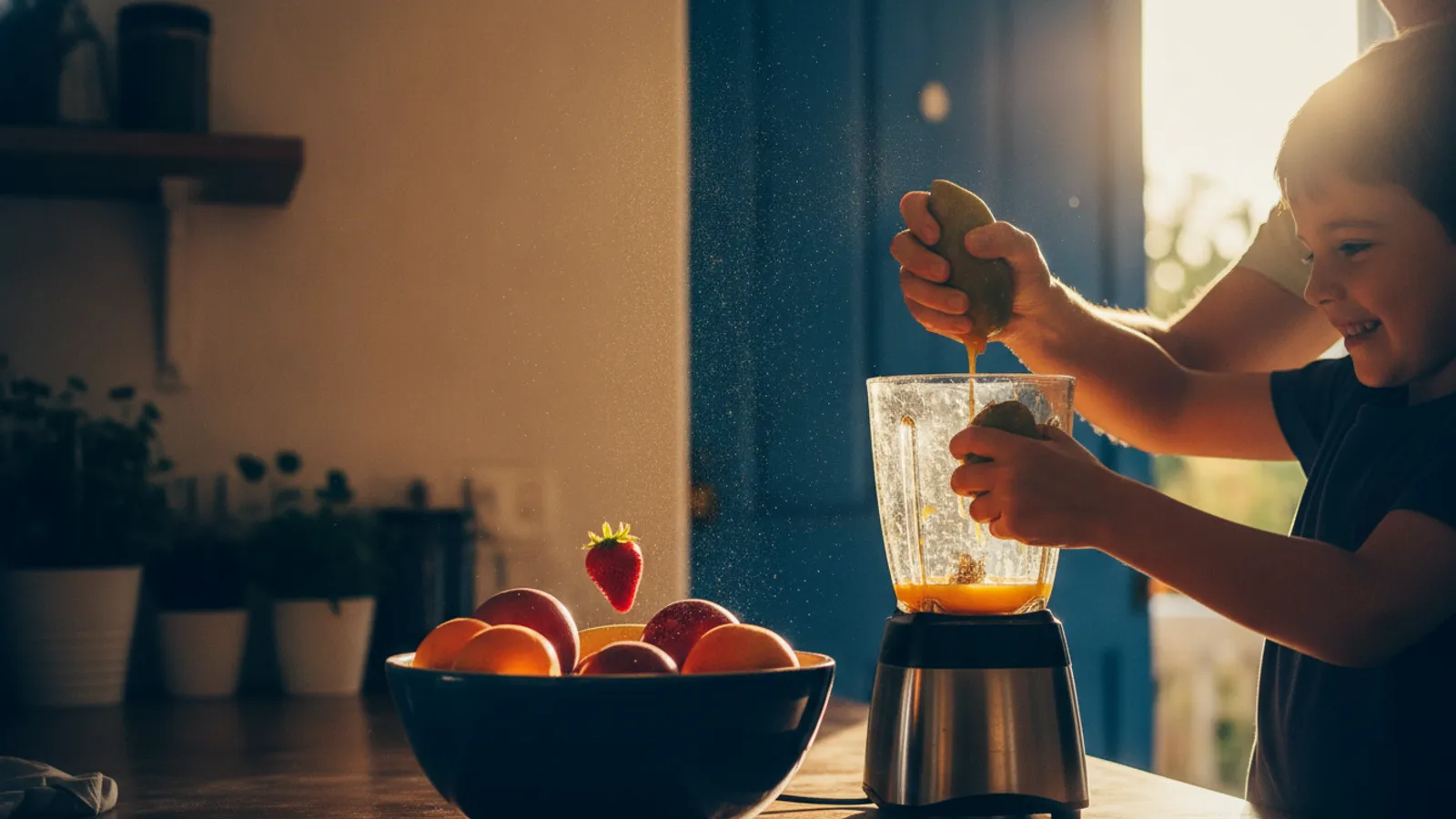
And a second line this house marks in red: the anchor is part of the experience, not a reward for enduring it. The smoothie isn’t payment for putting up with the hike; the smoothie is the hike. The moment the sensation becomes a bribe — “behave and you’ll get one” — you’re no longer anchoring a lesson, you’re running a token economy, which is a different thing and one this house doesn’t recommend. The difference is fine and it is total: the flavor doesn’t buy the company, it’s part of it.
With care: what this does and does not promise
It’s worth being honest about what this article rests on, because the terrain of emotion and memory is a serious scientific field, and it deserves respect, not decoration.
What we hold with firm footing is the practical and the lived: that an experience felt with emotion is remembered better than a dry lesson, that any adult can confirm it in their own memory, and that raising children by leaning on the senses and the emotions bears better fruit than raising them by way of lecture. That’s experience, not laboratory, and that’s how we label it.
What we will not do is translate that intuition into neuroscience headlines that sound like certainty — “the amygdala this,” “the brain that” — to give it a shine of authority that isn’t ours to claim. There is real research on learning that comes in through several senses at once: the classic proposal is that training with a single modality doesn’t take advantage of the mechanisms the brain uses to learn in the real world, and that combining modalities works better — but only if the information from each sense is congruent with the other, a condition the authors themselves put front and center (Shams and Seitz, 2008). It’s an opinion piece about perceptual learning in adults — learning to tell birds apart, recognizing voices — not a study of children or classrooms. Citing it as if it said “more senses, better school” would be exactly the abuse this text promises not to commit.
And here it’s worth drawing a hard red line, because this article’s title skirts one of the best-documented myths in education. When teachers interested in neuroscience were asked, they endorsed, on average, close to half of a list of false statements; one of them, believed by about three out of four, was precisely that “environments rich in stimuli improve preschool children’s brains”; another, believed by more than nine out of ten, was that every child learns better in “their” sensory style (Dekker, Lee, Howard-Jones, and Jolles, 2012). Both things are false, and this article states neither of them. We are not saying that stimulation builds brains: the accumulation of synapses during development appears to be under much more genetic than environmental control, the famous laboratory “enriched environments” compared rodents in solitary cages against rodents with company — deprivation versus no deprivation, not a normal child versus a stimulated child — and learning is not locked inside any window that closes at age three (Bruer, 2011). Nor are we saying your child is “visual” or “kinesthetic” and needs to be taught through their own channel: the most-cited review on the subject concluded there is no adequate evidence base for bringing “learning styles” into educational practice (Pashler, McDaniel, Rohrer, and Bjork, 2008). That these myths exist and keep repeating is no accident: they are almost always biased distortions of real scientific findings, warped along the way from the lab to the classroom (Howard-Jones, 2014).
What this article says is smaller and, we believe, more useful: that a concrete experience with an honest emotion inside it is remembered better than a lecture. A well-lived intuition doesn’t need to dress up as a study to be worth something.
What to take away
Go back to the beginning, to your own childhood smell. Someone, without knowing they were doing it, left you that anchor: brewed that coffee, baked that bread, took you to that sea. They didn’t sit you down to explain how you should remember it. They left it lodged in a sense, and the sense kept it for you for an entire lifetime.
That is what you can do for your child, and it’s simpler and cheaper than what today’s parenting industry wants to sell you. You don’t need more speeches or more toys that light up. You need real experiences, with a sense awake and an honest emotion inside: the cold, the taste, the laughter, the dirt, the song. Put an anchor on what you want to stay, and let the body do the work that words never could.
Your child won’t be formed by what you tell him. He’ll be formed by what you make him feel. So choose which senses you light up — because that is what stays.
Comments from the house
Note from Carlos
The chain is mine and I sign all of it: sensory stimulation → emotional experience → engagement → learning sealed. Learning doesn’t come from preaching — it comes when the experience sticks to an emotion, and emotions come in through the senses: the taste of the smoothie, the cold of the water, the surprise, the sweat of training. In my house we train together twice a week — cycling, swimming, running — and I assure you what that kid is archiving is not my advice: it’s the tired, happy body next to mine, kilometer after kilometer. That’s the pedagogy I’m interested in. The rest is literature — and Lucia said it better than I did: you don’t explain it, you cook it.
Nonna Lucia — thirty years of Sunday kitchens
I’ve spent thirty years running the world’s oldest memory-making machine, and it’s called a kitchen. Nobody who sat at my table remembers what I advised them; everybody, everybody, remembers the smell when they walked in. The sofrito was the sermon — it just wasn’t preached, it was smelled. I’ll tell you what I know with my hands in the dough: a child isn’t educated by what he hears in the kitchen, he’s educated by what he smells in the kitchen. Set something delicious to simmer on some ordinary Sunday, let that smell get into his bones, and you’ve planted a piece of home he’ll carry with him when you’re no longer around to cook it. That isn’t explained. It’s cooked.
Marina Haddad — the evidence
I agree with the heart of the text, and I’ll get strict with the words, which is my trade — I’m not a clinician or a neuroscientist, I’m the one who reads the people who are. What is known: yes, there’s a real field studying how emotion intervenes in whether a memory gets fixed, and yes, there’s work on learning that comes in through several senses at once. What is not known, or not well enough to promise it in your living room: the sizes of those effects, in whom, at what age and under what conditions — that’s where the easy headline lies. What that means for you: keep the modest, true version — the experience felt with emotion is remembered better than the dry lesson — and don’t bet the house on a phrase with a brain structure’s name in it. The article does well not to overpromise; let it stay exactly there.
Polo — the caretaker
If this gave you the urge to anchor something, the pantry is full, every activity with its sense switched on: “The market with all five senses” (/actividades/el-mercado-con-los-cinco-sentidos), for taste and surprise; “Watching the sunrise from a summit” (/actividades/amanecer-en-la-cima), for cold and wonder; “Dancing in the kitchen” (/actividades/bailar-en-la-cocina), for music and the body without shame; “Planting something you can eat” (/actividades/sembrar-para-comer), for the dirt and the waiting; and “Sunday breakfast” (/actividades/el-desayuno-del-domingo), for the smell that becomes “my family.” Drop by /actividades and filter by your actual week. I show you the pantry; the sense you light up — and the memory you leave — are up to you.
Sources and references
Only sources that were downloaded and read are listed. When only the abstract could be read, this is indicated.
Chu, S., and Downes, J. J. (2000). «Long live Proust: the odour-cued autobiographical memory bump». Cognition, 75(2), B41–B50. PubMed 10771279. (Abstract only.)
Bruer, J. T. (2011). «Revisiting “The Myth of the First Three Years”». Special briefing, Centre for Parenting Culture Studies, University of Kent. PDF. (A signed popular-science briefing by the author, not peer-reviewed.)
Dekker, S., Lee, N. C., Howard-Jones, P., and Jolles, J. (2012). «Neuromyths in Education: Prevalence and Predictors of Misconceptions among Teachers». Frontiers in Psychology, 3, 429. Full text.
Howard-Jones, P. (2014). «Neuroscience and education: myths and messages». Nature Reviews Neuroscience, 15(12), 817–824. Record. (Abstract only.)
Kim, J. S.-C., Vossel, G., and Gamer, M. (2013). «Effects of Emotional Context on Memory for Details: The Role of Attention». PLOS ONE, 8(10), e77405. Full text.
Li, J., and Deng, S. W. (2023). «Facilitation and interference effects of the multisensory context on learning: a systematic review and meta-analysis». Psychological Research, 87(5), 1334–1352. PubMed 36107248. (Abstract only.)
Marsh, S., Dobson, R., and Maddison, R. (2020). «The relationship between household chaos and child, parent, and family outcomes: a systematic scoping review». BMC Public Health, 20, 513. Full text.
McGaugh, J. L. (2015). «Consolidating memories». Annual Review of Psychology, 66, 1–24. PubMed 25559113. (Abstract only; an autobiographical article summarizing the author’s own research program, mostly animal research.)
Pashler, H., McDaniel, M., Rohrer, D., and Bjork, R. (2008). «Learning Styles: Concepts and Evidence». Psychological Science in the Public Interest, 9(3), 105–119. PDF.
Shams, L., and Seitz, A. R. (2008). «Benefits of multisensory learning». Trends in Cognitive Sciences, 12(11), 411–417. PDF. (An opinion piece on perceptual learning in adults.)
Full audit, claim by claim, including the sources that could not be downloaded and are therefore not cited: resources/research/estimulacion-sensorial.md.
This text is peer commentary on parenting, not clinical or educational guidance. For concerns about a specific child’s development or sensory sensitivity, that’s for a professional who knows the child — not an article.
Help us make it better
Did something ring false, feel missing, or feel like too much? Tell us — good comments make articles better.