Article
The Friday Pizza Turns Twenty
By Carlos Miranda Levy · July 13, 2026
The Friday pizza that's still alive twenty years later. Why small, cheap habits with a name of their own survive where grand plans fail — and how to start one this week.
By Carlos Miranda Levy · July 13, 2026
The Friday pizza that's still alive twenty years later. Why small, cheap habits with a name of their own survive where grand plans fail — and how to start one this week.
Video transcript
Picture the scene twenty years before it happens. It’s Friday, it’s night, and in a kitchen that doesn’t yet exist, a man in his thirties and a father in his late sixties split the same pizza as always. They know each other’s jokes. They know who steals the first slice. That Friday wasn’t scheduled that evening: it was scheduled twenty years earlier, when someone decided that Fridays belonged to the pizza. It’s not the pizza: it’s that they’re the five thousand pizzas of five thousand Fridays. That you can’t buy: you repeat it. What survives is what’s simple: cheap, short, from any week at all. The habits that last are the ones that fit into a tired day. Give it a name. Not “sometimes we go for a walk”: “the Sunday walk.” What can be named, a child can miss, defend, demand. And give it a day. “Fridays” takes the negotiation out of every week. Constancy, not intensity, is what a child reads as love. Pick one small thing. Give it a name, give it a day — and defend it the way you defend what one day you’ll miss.
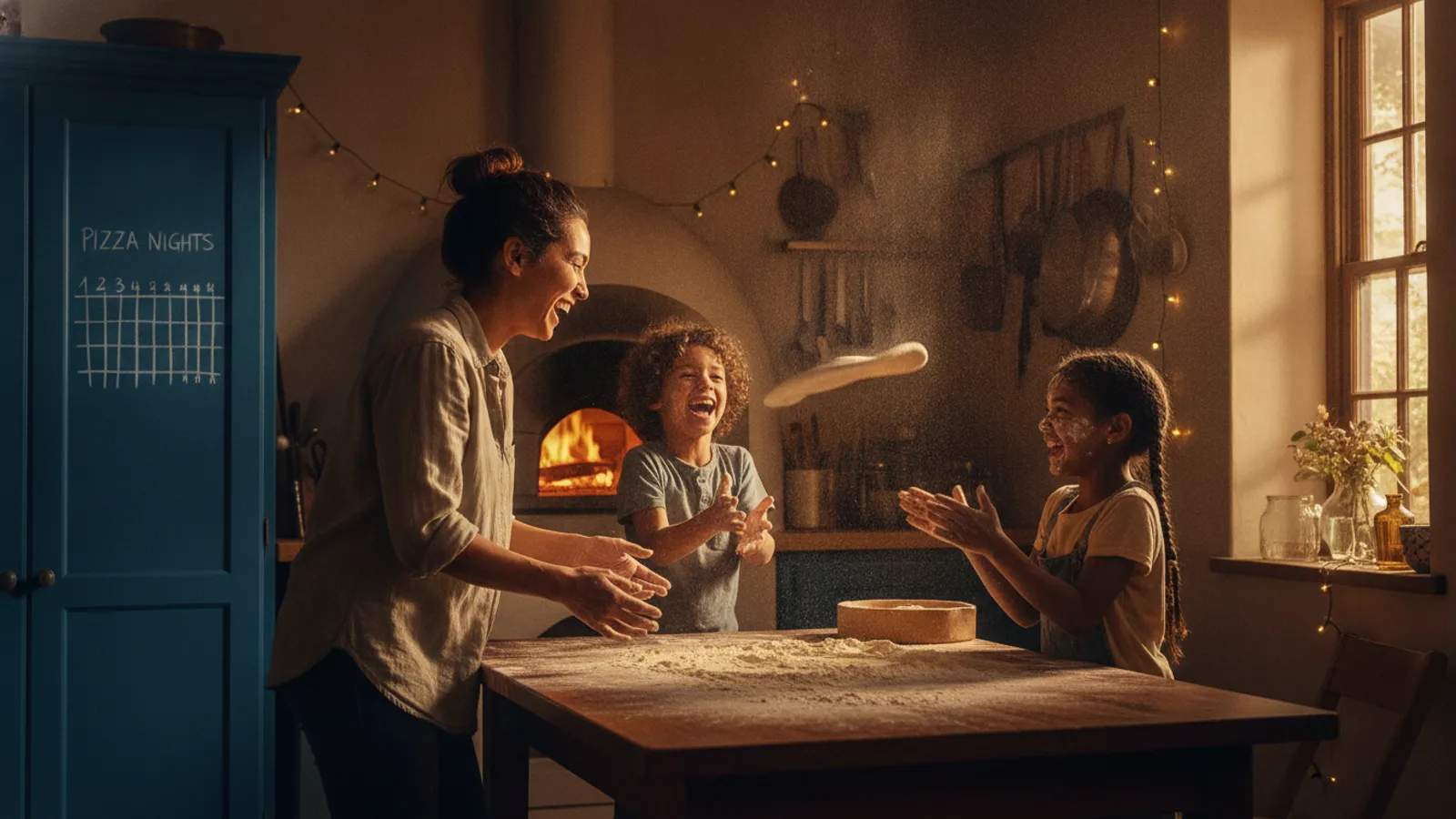
Picture the scene twenty years before it happens. It’s Friday, it’s night, and in a kitchen that doesn’t exist yet, a woman in her thirties and a father in his sixties are splitting the same pizza as always. They know each other’s jokes. They know who steals the first slice and who leaves the crust. They don’t talk about anything important, and that’s exactly why they talk about everything. That Friday wasn’t scheduled that night: it was scheduled twenty years earlier, on some ordinary Tuesday, when someone decided — without knowing they were deciding anything — that Fridays were for pizza.
That’s what this piece is about: the small habits that, without asking permission, survive the test of time. The ones still there when the kid is already a head taller than you, when they’ve changed cities, homes, lives. Not the big trips or the dates circled in red. The minimal things, repeated, with a name of their own.
There’s a mistaken intuition almost all of us share: believing that big memories are made by big events. The theme park, the party, the vacation that cost a paycheck. And yes, those do get remembered. But ask any adult what they miss from childhood, and they’ll rarely name an event. They’ll name a smell, an hour, a rhythm. Sunday ice cream. The coffee they were let taste even though they weren’t supposed to. The walk to the park that was always the same, and sacred because of it.
Simple habits survive precisely because of what look like their flaws. They’re cheap, so they don’t depend on a good financial run. They’re short, so they fit into any week, even the bad ones. And they don’t depend on age: the walk works at four and at fourteen — only the conversation changes. A habit with a name and a fixed day is portable — it travels to another house, survives a move, outlasts adolescence — because it asks nothing of the calendar beyond its usual corner.
This matters twice as much in families split between two homes. A small, named ritual travels from one house to the other without breaking; it’s one of the few things a child can carry in their backpack. What has a name survives the bad weeks — and the distances.
It’s worth noticing something about the examples we opened with, because it’s no accident. Pizza. Ice cream. Coffee. Almost all the habits that truly stick have a sensory anchor: a taste, a smell, a texture that the body files away before memory does.
This is a founding principle of this house, said briefly: learning and bonding aren’t sealed by preaching — they’re sealed by emotion and by the senses. An experience tied to a specific taste is stored differently — deeper, more stubborn — than a conversation loose in the air. That’s why the edible habit is so powerful: every Friday, the pizza stamps the seal again. The night doesn’t need to be memorable; the taste memorizes it for you.
It’s worth saying precisely what’s proven and what isn’t. What the research documents is the so-called Proust phenomenon: autobiographical memories evoked by a smell are retrieved and experienced differently than those evoked by words, images, or sounds. A broad review of that field (Hackländer, Janssen, and Bermeitinger, 2019) confirms the phenomenon while also warning that the research is at an early stage: it knows that it happens better than it knows why. No one has measured any of this in a family’s kitchen on a Friday night. That this sensory archive also works in favor of the bond between a parent and a child is this house’s reasoning, not a laboratory finding. We say it because it feels true to us and because experience backs it up — not because a study says so.
This isn’t bribing with food — that’s something else, and this house doesn’t recommend it. The taste isn’t the payment for putting up with the company; it’s part of the company. The difference is thin but total.
Here comes the most useful distinction from the founder’s brief, and it’s worth stating slowly, because it changes how you choose your family’s habits. Not every shared moment works the same way. There are three modes of encounter, and knowing which is which saves you frustration.
Face to face. The board game, the meal, the coffee. Here you look at each other; the conversation isn’t the decoration, it’s the content itself. There’s nowhere to hide, and that’s the virtue: the table forces you to show up. It’s the most intense mode and, for some children, the hardest — which is exactly why it’s worth having, but not forcing.
Shoulder to shoulder. Walking, cooking, biking, fishing. You don’t look each other in the eye: you both look forward, at the same task. And a familiar magic happens: the activity loosens the tongue. The conversations that don’t come out face-to-face come out sideways, while the hands do something else. The teenager who closes up at the table sometimes opens up entirely while chopping an onion or rowing. Shoulder to shoulder is the side door of the bond.
Mediated by a third thing. The movie, the concert, the game on TV. Here you don’t look at each other, and you don’t share a task: you share an object of attention placed in front of you. And here’s the nuance the founder underscores, in his own words:
Movie night has its place, but it’s different from a board game, where the players face each other head-on.
It has its place — let that be clear. But it’s a different mode, and it needs to be treated differently. A third thing that captures all the attention can simulate closeness without producing it: two people on the same couch, silent, watching the same thing, without having met each other all night. The mediated mode isn’t less valid; it’s less automatic. It needs its own after-talk. The movie is half; the conversation afterward is the other half. Without those ten minutes of “what would you have done?”, the shared screen looks too much like the screen that isolates.
The practical rule is simple: if your house only has mediated habits — everything’s a screen, everything’s a third thing watching for you — you’re missing the face-to-face and the shoulder-to-shoulder that build the muscle of conversation. There’s no need to abolish movie night. You need to balance the diet.
A habit that lasts isn’t decreed at a solemn family meeting. It slips into life by accident and is then protected on purpose. But there are three things almost all the ones that survive share, and none of them is complicated.
And a warning against impatience, because almost everything you’ve heard about this is false. The idea that a habit sets in after twenty-one days is a myth: it doesn’t come from any research. The study that actually measured this found a median of sixty-six days — but with a range of 18 to 254 — and its own author, Pippa Lally, when asked whether sixty-six days is a rule, says no: what her work showed is that the timeline is enormously variable. This isn’t a technicality. It’s the reason the habit has to be cheap and short: it can take much longer than you expect to stop costing you effort, and it needs to survive that wait.
Give a small thing a name and a day, protect it from excuses for a few weeks — or quite a few more — and you’ll have planted something that can still be giving shade twenty years from now.
It’s worth knowing there’s a field of research behind this intuition, and also how far it goes. Family science distinguishes between routine — the observable, repeated practice — and ritual — the symbolic representation of a collective event; it’s exactly the difference between stopping by the pizza place and Fridays being about pizza. A fifty-year review of the literature on family routines and rituals (Fiese and colleagues, 2002) found that both are associated with parenting competence, child adjustment, and marital satisfaction; the American Psychological Association, in presenting it, added a sense of personal identity in adolescence to that list and mentioned possible protective effects in non-traditional families. Now for the honest part: these are associations, not causes. The authors themselves warn that the studies used inconsistent methods and convenience samples, and that they didn’t distinguish direct effects from indirect ones. The APA put it even more clearly: it’s likely that competent parents are also more effective at creating routines — the arrow could point the other way — and no intervention studies had been done. Translated: the evidence accompanies this idea, it doesn’t prove it. The argument of this piece holds up just as well without it.
Go back to the kitchen from the start, the one that doesn’t exist yet. That woman in her thirties who knows by heart who steals the first slice — she didn’t learn to love you on an expensive trip or a big gift. She learned to love you on Fridays, in the small repeated thing, in the taste you stamped onto the calendar when she was little and didn’t understand you were building her an anchor for life.
We don’t know which of your habits will survive. No one knows in advance; it’s discovered by living it. But we do know which ones have a chance: the simple ones, the named ones, the cheap ones, the ones anchored in a sense and happening on the same day without fail. The ones that don’t depend on life cooperating.
So tonight, or next Friday, pick one small thing. Give it a name. Give it a day. And defend it the way you defend what you’ll one day miss.
It’s not the pizza. It’s that they add up to the five thousand pizzas of five thousand Fridays. That can’t be bought: it’s repeated.
Note from Carlos
In my house, the habits with names are the skeleton of the week: Tuesday and Thursday training — bike, swimming, running — and the audiobooks we share. Thirteen years of deliberate practice taught me what this piece argues: deliberate parenting compounds, like compound interest — and what compounds isn’t intensity, it’s consistency. No one remembers mile twelve of some random Tuesday; what stays is that Tuesdays were ours, and still are. My practical advice is just one thing: give them a name and a fixed day. What has a name and a day survives the moves, the bad weeks — and, when it has to, travels between two houses in the backpack.
Nonna Lucia — thirty years of Sunday tables
I am this article, so let me sign it with my hand still in the dough. Thirty years setting the Sunday table for twelve, and I’ll tell you what I learned: they don’t remember the menu, they remember that the table was there. A habit isn’t what you cook; it’s the promise that on Sunday there’s somewhere to come back to. What you all call “face to face” we simply called the table — and yes, it forces you to show up, and yes, it costs something, and that’s exactly why it’s worth it. An old woman’s warning: don’t make it perfect, make it every time. The perfect table set once a year raises no one. The modest table set every Sunday does. What repeats, belongs; and a child who belongs to something older than himself walks straighter through life.
Ulises — the voice of reunion
From the eighth seat, the one of distance, this piece reads differently, more urgently. When you see your child one weekend out of every two, the named habit isn’t a luxury: it’s the thread that keeps every reunion from starting at zero. Mine is the call that doesn’t move — same day, same time, no matter what. We almost never say anything memorable; that was never the point. The point is that it rings. Consistency tells the child the one thing they need to know: I’m still here, even when I’m not. And I’ll sign the face-to-face / shoulder-to-shoulder distinction with a field note: over the phone, what travels best isn’t looking at each other — it’s doing something in parallel across the distance, listening to the same audiobook and talking about it after. Shoulder to shoulder also crosses the miles.
Polo — the caretaker
If this piece made you want to plant a habit, the pantry has options, one of each mode: “Cooking Saturday’s Menu” (/actividades/cocinar-el-menu-del-sabado), shoulder to shoulder and with a taste anchor built in; “Friday Library Night” (/actividades/biblioteca-los-viernes), a fixed rhythm with a name of its own; and “Movie Night with an After-Talk” (/actividades/noche-de-pelicula-con-sobremesa), for the mediated mode done right — the movie is half, the after-talk is the other half. And if you don’t know where to start, stop by /como-estamos: first we look at how your week is actually going, and from there comes the habit that really fits you. I’ll show you the pantry; the recipe — and the day — are yours to choose.
Only sources that were consulted and read directly are listed here. Where only the study’s abstract could be read, that is noted.
Two clarifications that feel like part of this piece’s honesty. The first: much of this literature is correlational. It documents that families with rituals and routines tend to do better on several measures; it doesn’t prove that the ritual is the cause. The second, about family meals — the terrain where exaggeration is most common: when Musick and Meier put that relationship through the most demanding causal test available — nearly eighteen thousand adolescents, fixed-effects models — much of the association vanished once family background was accounted for; what survived was small, and none of it persisted into adulthood. And Snuggs and Harvey’s review of reviews found that interventions to promote family meals produce mixed results. We say this for a concrete reason: if your week doesn’t allow for eating together, you’re not failing anyone. The value of the habit doesn’t depend on it being dinner.
The distinction between the three modes of being together — face to face, shoulder to shoulder, and mediated — is a contribution from the founder and isn’t taken from any research. We looked for literature that would support or refute it and didn’t find any. We offer it for what it is: a tool for thinking, born of experience.
Did something ring false, feel missing, or feel like too much? Tell us — good comments make articles better.