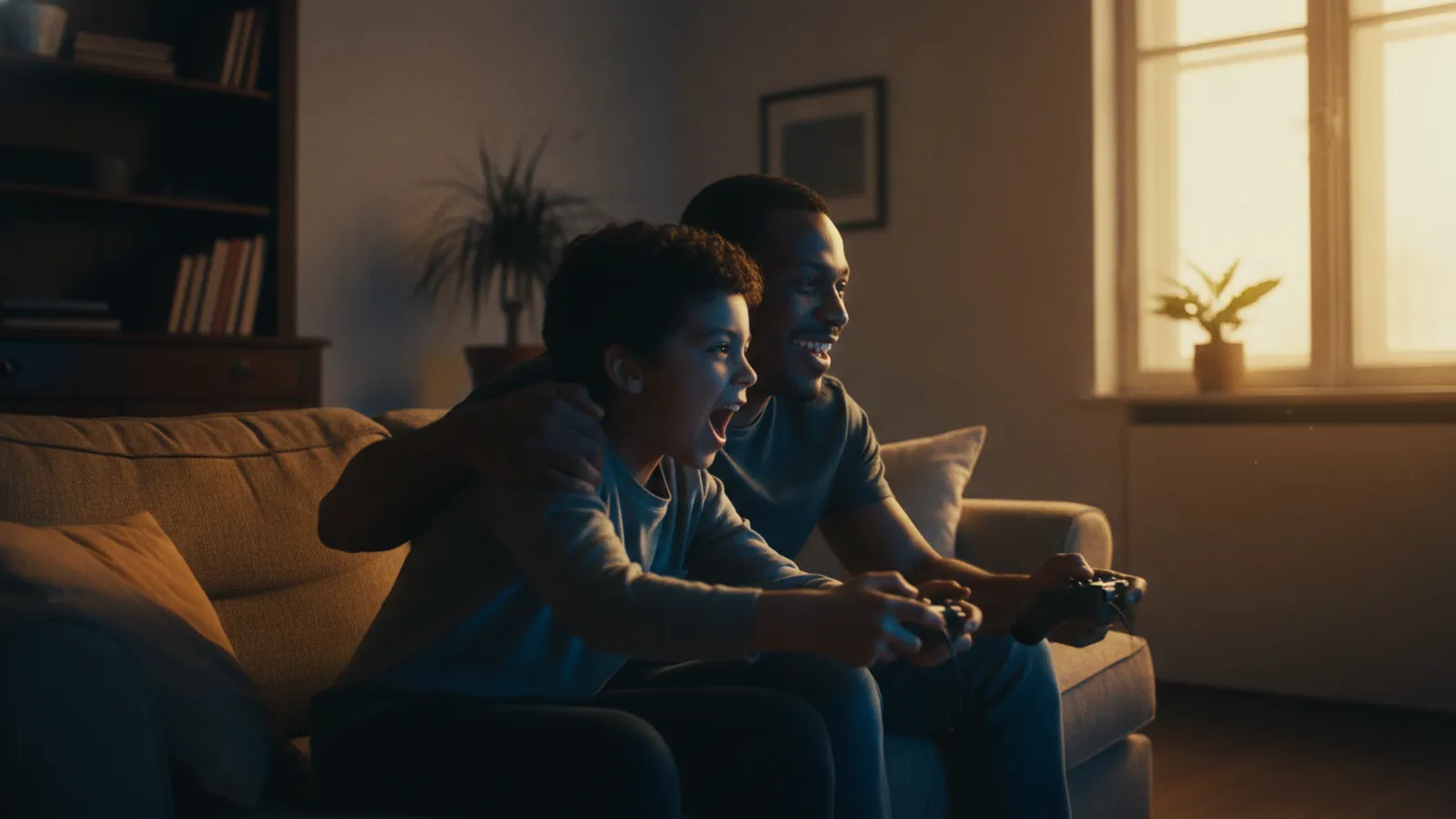
Your child's emotions in the digital world happen in the brain and in the heart — not on the skin. The virtual is real, and treating it as fake locks you out of half their life.
the tip in one minute — the full article is this page
Video transcript
Your child is crying over something you can’t see: a friend who switched servers, a character they built for months and lost. And you feel the most reasonable and most mistaken four words a parent can say rising up: “but it’s not real.” It is real. The friend exists — a person with a mother and a name on the other side of the screen. The conversation happened. The only thing missing is the body in the same room. We’re calling an entire relationship unreal over a detail of geography. And above all, the emotion is real. Your child’s sadness is exactly the same substance you’d cry with for someone moving far away. Emotions happen in the brain and the heart, not in the body or the skin. That’s why “that’s not real” isn’t a correction: it’s a door slammed shut. It tells the child their feeling is miscalibrated and not to bring you these things. And they learn the lesson instantly: next time it hurts, they don’t tell you. There are three losses a parent tends not to see. The first: the friend who leaves. An online friendship can be daily, long, intimate. When it ends, it isn’t a tantrum. It’s grief. The second: pride in a virtual achievement. Behind it are hours of practice and a goal reached, exactly what we celebrate off-screen. If your face lights up for the goal and goes dark for the digital win, your child learns which of their efforts counts. Real doesn’t mean without limits. Recognizing the reality of the virtual doesn’t take your authority away, it gives it to you: the one who says “tell me what happened, I can see it hurt” stayed inside — and from inside you can talk about who they play with and how much. So next time, don’t ask yourself whether it’s real. You already know: the proof is that they’re crying. Ask yourself the only thing that matters: will they keep telling me, or am I teaching them not to?
Your child is crying over something you can’t see. A friend who switched servers and won’t be back. A character they built for months and lost. A group that left them out of a match. And you, who love them, feel the four most reasonable and most wrong words a parent can say in that moment rising to your mouth:
“But it’s not real.”
It is real. We’re going to devote this article to why — and to what you stand to lose if you don’t understand it.
Where the Real Lives
Pause on the phrase for a second. When we say “it’s not real,” what are we referring to? The friend exists: they’re a person with a mother and a name, on the other side of a screen, in another city or another country. The conversation happened. The group really did leave them out. The only thing missing is the body in the same room. We’re calling an entire relationship “unreal” over a detail of geography.
And it’s worth knowing what that world is really like, because it’s almost never the one we imagine from outside. The reference review on adolescents and digital life sums it up this way: today most teenagers are online “typically connecting with friends and family they already know offline,” and a synthesis of 37 studies found they use digital communication for friendship’s usual tasks — hanging out, building intimacy, showing affection (Odgers and Jensen, 2020). It isn’t a parallel world populated by ghosts: it’s largely the same people from school, the neighborhood, and the family, at a different hour and through a different channel. And where it isn’t, it’s still not a small thing: in the United States, 57% of teens have made a new friend online, and one in seven says they have a close friend they met that way (Pew Research Center, 2015 and 2018). Among those who belong to an online group, majorities say that group has made them feel more accepted (68%), has helped them sort out what they think about important things (65%), and has helped them get through hard moments in their lives (55%). These are American surveys from a few years back, not an X-ray of Caribbean families today — but the order of magnitude is what it is.
And above all: the emotion is real. Your child’s sadness isn’t an imitation of sadness. It isn’t fake sadness because the friend was on a screen. It’s exactly the same substance you’d cry with over someone who moves far away. Pain doesn’t check whether the bond met adult requirements before it hurts.
This is the founder’s thesis, in his own words, and we present it as what it is — a position, thought through and lived, not a laboratory finding:
Emotions happen in the brain and in the heart, not in the body or on the skin.
Read it slowly. What it says is that the physical medium doesn’t decide the truth of the experience. A hug consoles because the brain reads it as closeness and safety — and a message at the right moment, from the right person, can do something similar. The skin is a channel, a wonderful one, but it isn’t the only one, and it isn’t the one that certifies that something “counts.” What counts is certified by the emotion it produced.
And now for the part where this site gets uncomfortable with itself, because it’s the right thing to do. That sentence is a position, not a neuroscience headline — and we need to say why. For twenty years a much-cited idea circulated: that social rejection “hurts” by activating the same circuit as physical pain. It came from a famous 2003 experiment in which participants were excluded from a virtual ball-tossing game (Eisenberger, Lieberman, and Williams). But the strong reading of that finding did not survive. In 2013, a group of pain researchers showed that the overlapping regions aren’t pain-specific, so the overlap proves nothing (Iannetti and colleagues). And in 2014, a study with finer methods separated the two: the brain patterns of physical pain and social rejection can be distinguished with 92% and 80% accuracy, and a classifier trained on one performs at chance on the other; rejection, they conclude, “does not hijack the pain matrix” — it has its own (Woo and colleagues).
So we’re not going to sell you neuroscience that doesn’t hold up. The academic discussion about emotion and the body is still alive, and this site isn’t going to settle it in one article. What did stay firm from that 2003 experiment — and it’s exactly what this piece needs — is the other finding, the one nobody disputes: fully grown adults, playing a trivial computer game, with two supposed players who didn’t even exist, reported real, measurable distress within minutes when the ball stopped coming to them. None of it “counted.” It hurt anyway. That’s all the proof needed: your child’s emotion over something virtual is real, and treating it as if it weren’t has consequences.
The Four Words That Close the Door
Here this article joins hands with its companion piece, “We Don’t Have a Screen Problem.” That one asked something hard of you: to stop policing the screen and start competing with it, to enter your child’s world instead of patrolling its borders. This one asks you not to undo that work with a single sentence.
Because “that’s not real” isn’t a correction. It’s a door slammed shut. It tells the child three things at once: what you feel is mismeasured, the place where you live half your life doesn’t count, and don’t bring me these things. And the child learns the lesson instantly — children are lightning-fast at that: the next time something hurts them in that world, they won’t tell you. Not because it stops hurting, but because they already know that in this house, that pain has no market value.
That’s the channel the other article asked you to open at age five so it would still be open at fifteen. Four words close it.
Three Losses a Parent Tends Not to See
They’re worth naming, because they’re invisible from outside and enormous from inside:
The friend who leaves. An online friendship can be daily, long, intimate — sometimes more honest than the schoolyard ones, because it was built with words alone. And it’s not rare or marginal: one in seven teens says they have a close friend they met online (Pew, 2018). When that friendship ends, what you see in your house isn’t a tantrum. It’s a loss, and it behaves like one. We don’t have a study that measures this — we looked, and there isn’t one — but you don’t need one to recognize a face.
The pride in a virtual achievement. Finishing something brutally hard, ranking up, building something others admire. Behind it are hours of practice, tolerated frustration, and a goal achieved — exactly what we celebrate when it happens off-screen. If your face lights up for the goal and goes dark for the digital achievement, your child learns which of their efforts “count.”
The conflict that wounds. Being left out of a chat, humiliated in a match, shut out by a group. There’s no need to argue over whether it hurts “the same” as the schoolyard — it hurts for real, and that’s enough. Sometimes worse, because it doesn’t end when the bell rings: it rides in the pocket all the way to the pillow.
Real Doesn’t Mean Without Limits
Now for the balance, because without it this article gets misread.
Saying the virtual is real does not mean saying everything virtual is good, or that you enter it without judgment, or that it makes no difference where your child spends their hours. On the contrary: it’s because it’s real that it has to be taken seriously — and taking something seriously includes taking care of it. A real friend, you ask who they are. A real pain, you attend to. A real world, where your child lives part of their life, is a place you want to know, not ignore.
Notice the trick: acknowledging the reality of the virtual doesn’t take away your authority — it gives it to you. The parent who says “that’s not real” placed themselves outside and lost the conversation. The one who says “tell me what happened, I can see it hurt” stayed inside, and from inside you can talk about who you play with, how much, what’s okay and what isn’t. The same reverence for the real that asks you to console the loss authorizes you to set limits: you don’t take care of things that don’t matter.
That’s the bridge between the two articles. Presence beats the screen — and part of being present is not ridiculing the world where your child is also somebody.
What to Take Away
The next time your child cries over something you can’t see, don’t ask yourself whether it’s real. You already know: the proof is that they’re crying. Ask yourself something else — the only thing that matters in that moment: will they keep telling me, or am I teaching them not to?
Because the day something truly serious happens to them in that world — and serious things happen to this generation in that world — the only difference between finding out and not finding out will be whether, years earlier, when they were crying over a friend who switched servers, you sat down beside them or told them it wasn’t real.
The virtual is real because the emotion is real. And your child’s emotions don’t get turned away at the door because of the place where they were born.
Comments from the House
Note from Carlos
Emotions happen in the brain and in the heart, not in the body or on the skin. I’ve said it so many times it gets quoted back to me — and I stand by it. I’ve lived and worked on four continents: a good part of the relationships that matter to me have been sustained, for years, through a screen, and it would occur to no one to call them less real. With my son I confirm it in the most honest laboratory there is: the video games we develop together. What’s felt there — the frustration, the pride, the burst of laughter — is exactly as real as the table where we tell each other about it afterward. The medium doesn’t decide the reality of the experience. Presence does.
Nonna Lucia — the tradition
I raised four children with the Sunday table and a hand on the shoulder, and my first impulse is to distrust this — I confess it. But I’ve watched my grandchildren laugh and cry with people I can’t touch, and my daughter provides from far away through a screen and these children feel her near. So I correct myself: it isn’t the skin that makes the affection, it’s the constancy. Fine, the virtual is real. But being real doesn’t excuse it from good manners: there too one greets, one cares, one answers.
Marina Haddad — the evidence
I agree with the heart of the text, and I’ll get strict about the words, which is my trade and not a clinician’s — I’m not one. “Emotions happen in the brain and the heart” is a beautiful position, not a neuroscience headline; the debate on emotion and the body remains open. What is well supported for your living room: exclusion and loss genuinely hurt, body present or not. Hold on to that and you don’t need to promise more.
Polo — the caretaker
If this moved you, the pantry has places to go next: “Video Games on the Same Team” (/actividades/videojuegos-en-el-mismo-equipo), to know that world from inside and not from the doorway; “The Conversation That Comes Too Early” (/actividades/conversaciones-demasiado-tempranas), which is where the big subjects fit — loss, belonging — without watering them down; and the /panel, if you want six perspectives on a concrete situation before reacting. I show you the pantry; you write the recipe.
Sources and References
Only sources that were retrieved and read are listed here. Consulted on July 26, 2026. Full report, with the inventory of claims and those left uncited: resources/research/la-realidad-de-lo-virtual.md.
Eisenberger, N. I., Lieberman, M. D., & Williams, K. D. (2003). “Does Rejection Hurt? An fMRI Study of Social Exclusion.” Science, 302(5643), 290–292. doi:10.1126/science.1089134 — https://doi.org/10.1126/science.1089134Holds: that excluding someone from a virtual ball-tossing game — with two supposed players who were actually a program — produces significant self-reported distress within minutes, and activates regions associated with distress. Its strong reading, the one where social pain “is” physical pain, is superseded by the two references below; what the article uses is the behavioral finding, which nobody disputes.
Iannetti, G. D., Salomons, T. V., Moayedi, M., Mouraux, A., & Davis, K. D. (2013). “Beyond metaphor: contrasting mechanisms of social and physical pain.” Trends in Cognitive Sciences, 17(8), 371–378. doi:10.1016/j.tics.2013.06.002 — https://pubmed.ncbi.nlm.nih.gov/23796880/Holds: that the patterns treated as the “pain matrix” are largely non-specific, so overlapping regions don’t permit the conclusion that social distress is experienced as physical pain.
Woo, C.-W., Koban, L., Kross, E., Lindquist, M. A., Banich, M. T., Ruzic, L., Andrews-Hanna, J. R., & Wager, T. D. (2014). “Separate neural representations for physical pain and social rejection.” Nature Communications, 5, 5380. doi:10.1038/ncomms6380 — https://doi.org/10.1038/ncomms6380Holds: that in 60 participants, the brain patterns of physical pain and social rejection can be distinguished with 92% and 80% accuracy, that a classifier trained on one performs at chance on the other, and that rejection “does not hijack the pain matrix” but has its own affective representations.
Odgers, C. L., & Jensen, M. R. (2020). “Annual Research Review: Adolescent mental health in the digital age: facts, fears, and future directions.” Journal of Child Psychology and Psychiatry, 61(3), 336–348. doi:10.1111/jcpp.13190 — https://doi.org/10.1111/jcpp.13190Holds: that most teens today connect “typically with friends and family they already know offline,” and that — per a synthesis of 37 studies the review reports — they use digital communication for friendship’s usual tasks: hanging out, building intimacy, showing affection.
Lenhart, A. (2015).Teens, Technology and Friendships. Pew Research Center — https://www.pewresearch.org/internet/2015/08/06/teens-technology-and-friendships/Holds: that 57% of American teens aged 13 to 17 have made a new friend online; 64% of them on social media and 36% while gaming, with a large gender contrast (57% of boys made friends gaming, versus 13% of girls).
Anderson, M., & Jiang, J. (2018).Teens’ Social Media Habits and Experiences. Pew Research Center — https://www.pewresearch.org/internet/2018/11/28/teens-friendships-and-online-groups/Holds: that 15% of teens have a close friend they met online, and that among those who belong to an online group, majorities say they feel more accepted (68%), understand better what they think about important topics (65%), and have gotten through hard times with that group’s help (55%).
On the weight of this evidence. The two Pew reports are self-reported, American surveys from 2015 and 2018 — predating much of today’s landscape. They’re used as an order of magnitude, not as precision, and they don’t describe Caribbean families. The social-exclusion literature is laboratory-based and with adults. And there are two things this section does not say: that every online relationship is healthy — the same world contains bullying, deception, and exploitation, and that’s what the situation files are for — nor that physical touch is dispensable. Saying that emotion doesn’t depend on the medium isn’t saying skin doesn’t matter.
What this article does NOT cite, on purpose. Two studies would have been better anchors than the ones used, and they aren’t cited because we couldn’t retrieve their text: Williams, Cheung, and Choi (2000) on being ignored online — 1,486 participants from 62 countries — and Abrams and colleagues (2011), the only one to apply that paradigm to children aged 8–9 and teens aged 13–14. Nine different routes were tried for both; all returned a paywall, captcha, or block. This house’s rule is that we don’t cite what we haven’t read, even when reasonably sure of what it says. They’re noted in the report as priority candidates should they ever become accessible.
Help us make it better
Did something ring false, feel missing, or feel like too much? Tell us — good comments make articles better.