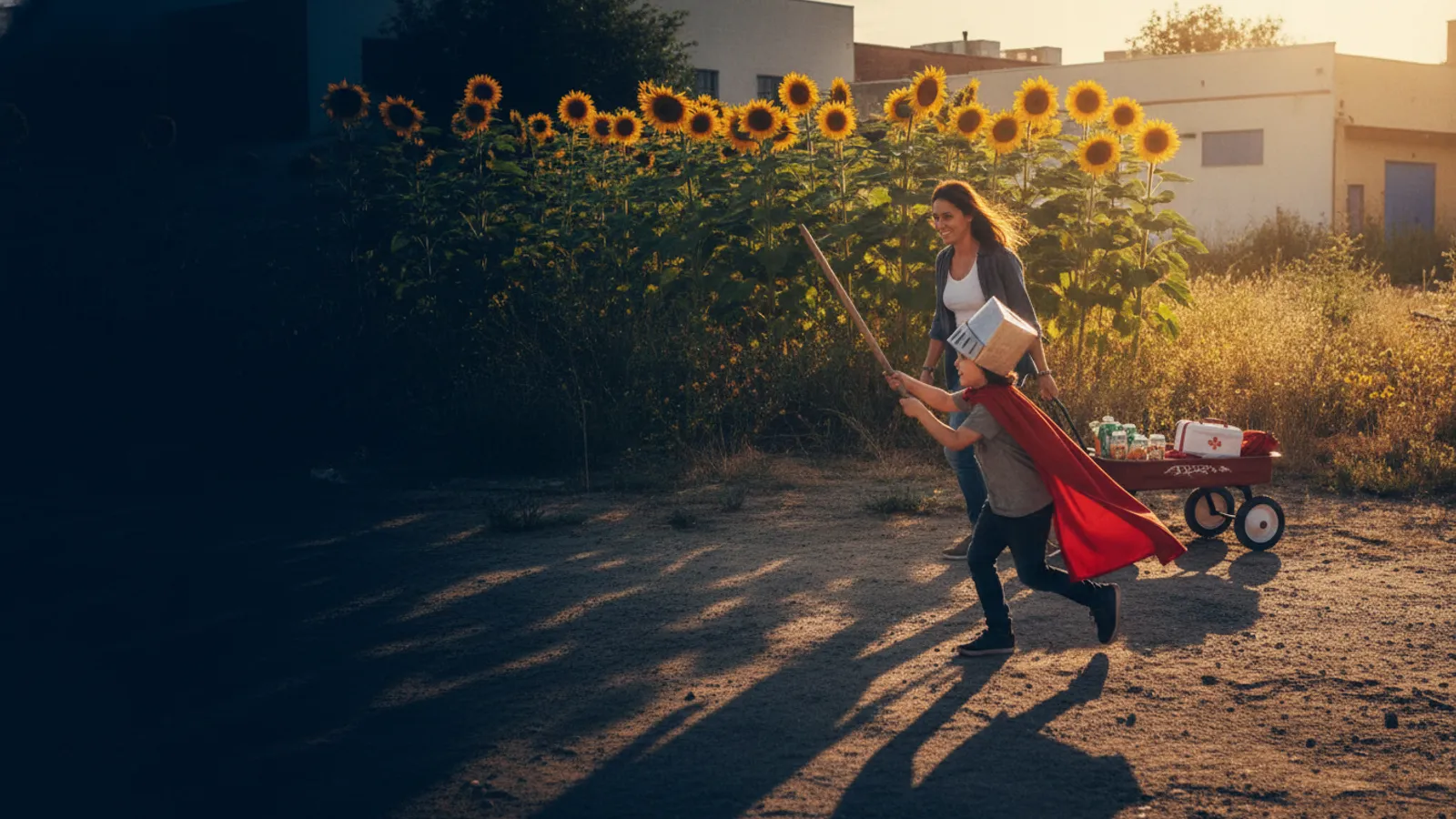
Your child walks in with a cardboard sword and an impossible plan. You can shrink the dream down to the reasonable — or go get your own sword. On enabling the adventure without lying about the windmills.
the tip in one minute — the full article is this page
Video transcript
Your child walks into the kitchen with a cardboard sword and an impossible plan. He's going to build a rocket, dig a tunnel to the other side of the planet starting from the backyard. He says it in total seriousness, and looks at you, waiting — not for permission: for enlistment. And there, in a quarter of a second, you decide what kind of parent you'll be. You can start shrinking the plan until it fits inside the reasonable, like almost everyone does. Or you can do something else: you can go get your sword. Because the child is Don Quixote, and he isn't crazy. What he has isn't delusion: it's the refusal to shrink the world down to the size of the sensible. That seriousness that treats the impossible as a to-do list is where the people who change things come from. The parent is Sancho, and Sancho chose to ride. He didn't explain to his knight that the giants were windmills and stay home: he saddled up, loaded the provisions, and rode alongside. Enabling isn't clapping from the couch; it's getting into the game. But Sancho isn't a flatterer: he names the windmills. You can ride along on the rocket adventure and at the same time tell him cardboard won't hold up to fire. He holds the dream with one hand and points at the windmill with the other. Don't lie to him just so he'll dream. And yes, sometimes the squire gets off the horse and says no. Some adventures don't get enabled because they aren't safe, and there enthusiasm gives way to protection. Enabling has limits, and knowing them is part of the trade. A Sancho-parent's job is that our Quixotes never have to take it back: that the dream matures instead of dying of realism. That the child who was going to dig all the way to China becomes the geologist who truly understands what lies beneath the backyard. This site isn't your Sancho. The squire in your child's adventure is you, because you know the knight and you're the one who stays. So when he walks in with the cardboard sword and the impossible plan, you already know what's being decided. Go get your sword.
Your child walks into the kitchen with a cardboard sword and an impossible plan. They’re going to build a rocket. They’re going to be the best in the world at something they discovered this morning. They’re going to dig a tunnel to the other side of the planet, starting in the backyard. They say it with total seriousness, without a drop of irony, and they look at you expecting — not permission: enlistment.
And there, in a quarter of a second, it gets decided what kind of parent you’re going to be. Because you can do what almost everyone does, which is, with the best of intentions, start shrinking the plan until it fits inside the reasonable. Or you can do something else. You can go get your sword.
The Child Is Don Quixote, and He Is Not Mad
We’ve grown used to reading Don Quixote as the poor old man who mistakes windmills for giants: a joke, a delusion, a warning about what happens when you take dreams too seriously. But look at your child with the cardboard sword and you’ll see that reading falls short. What the child has isn’t delusion. It’s something far more valuable and far more fragile: the refusal to shrink the world down to the size of the sensible.
The child takes the rocket seriously. And that seriousness — that capacity to treat the impossible as a working agenda — is exactly the material out of which the scientists, the founders, the ones who actually change something, later come. It isn’t a flaw that life will go on correcting. It’s a force that life will go on spending, with our help or in spite of it. The question isn’t whether your child is right about the rocket. It’s whether their seriousness deserves a squire.
It deserves a squire.
The Parent Is Sancho, and Sancho Chose to Ride
Here is the heart of the founder’s thesis, in his own words:
We parents must be the Sanchos of our Quixote children — and enable them.
Sancho, read generously, is the most beautiful thing in the book: the companion who, half out of affection and half out of credulity, enables his knight’s madness. Look at what Sancho does, because it’s the exact opposite of watching from the bench. Sancho doesn’t explain to Don Quixote that the giants are windmills and stay home. Sancho saddles up, loads the provisions, learns the trade, and rides. He enters the adventure instead of commenting on it. He rides alongside, and — this is the decisive part — he stays.
And it’s worth not idealizing him, because Cervantes doesn’t idealize him. Sancho doesn’t ride out of pure nobility: he’s talked into it. Don Quixote “told him so much, persuaded him so much, and promised him so much” that the farmhand accepted, among other things for the promise that on some adventure he might win “an isle” of his own and end up its governor. Sancho leaves his wife and children for that. He’s a squire with his own self-interest tucked in his saddlebag — and even so he stays until the very last page. To me that seems better news than the saintly version: it means that to be somebody’s Sancho you don’t have to be pure. It’s enough to mount up and not get off.
That’s what enabling is. It isn’t applauding from the couch while the child plays alone. It’s getting into the game: learning the rocket’s rules, finding the cardboard, holding the ladder. It’s the difference between the parent who says “how nice, keep playing” and the one who asks “where do we start?”
And this is also the hardest pillar of this house’s creed. Our creed — NEVER HELP: Engage, Enable, Inspire, Empower, Connect — has one word that costs us parents more than any other: Enable. Not doing it for the child. Not solving it for them. Enabling them: giving them what they need so the adventure is theirs. Sancho is that word turned into a story. That’s why we tell it through the most beloved companionship in the language.
And it turns out enabling has a technical name and fifty years of research behind it. It’s called scaffolding, and the researchers who described it defined it in almost the same words as this essay: the adult controls the elements of the task that, for now, exceed the learner’s reach, so the learner can focus on the ones already within grasp and get to the end under their own steam. Holding the ladder, not climbing it for them. The first function of that adult, in the authors’ own list, isn’t correcting: it’s recruiting — hooking the other person’s interest in the enterprise. First you saddle up. And there’s more: among primary-school children, the degree to which parents encouraged independent problem-solving, choice, and participation in decisions — rather than dictating the outcome from outside — was associated with more self-regulation, more competence, and better grades. The adventure has to be theirs. That isn’t sentimentality: it’s what makes it work.
Sancho Is No Flatterer: He Names the Windmills
Now, careful, because this is where this article stakes its honesty.
Enabling the adventure is not lying about reality. And Sancho — the real one, not the caricature — was never a yes-man. Sancho argues. Sancho negotiates. Sancho tells his knight, to his face and from the saddle, that those things over there are windmills: “Take note, your grace, that what appear over there are not giants but windmills, and what look like arms are the sails” (Part One, Chapter VIII). He tells him before the blow, not after. And when the knight ignores him and charges anyway and ends up rolling on the ground, Sancho doesn’t walk away or fold his arms: “Sancho Panza rushed to help him, his donkey running as fast as it could” — and only then, already helping him up, does he allow himself the “didn’t I tell your grace?” That’s the trade’s complete order: warn before, pick up after, reproach last and without letting go. The rule that saves this idea from turning into permissive parenting fits in one line:
Enable the knight; don’t lie to him about the windmills.
You can ride along on the rocket adventure and tell your child that cardboard doesn’t hold up to fire. You can take their plan to be the best in the world seriously and tell them, without cruelty, how many hours sit behind a “best in the world.” You don’t pull them off the horse: you adjust their course. The white lie — “yes, tomorrow you’ll reach China through the backyard” — isn’t love, it’s abandonment with a kind face: it leaves them alone in front of a crash you saw coming and kept quiet about.
The honest squire does both things at once, and that simultaneity is the whole trade: they hold up the dream with one hand and point at the windmill with the other. The child doesn’t need to be lied to in order to dream. They need someone who believes in the adventure enough to tell them the truth from inside it.
And this isn’t just moral elegance: inflated enthusiasm has a cost, and it charges it to the wrong child. In an experiment with 240 children aged eight to twelve, the ones with the lowest self-esteem sought out less challenge after receiving exaggerated praise for a drawing — while for the ones with high self-esteem, the opposite happened. The difference between the experiment’s two sentences was a single word: “incredibly.” That’s the real size of the white lie. One extra adverb, and the child who had the least confidence to begin with understands that now they have to live up to “incredible,” and picks the easy task instead.
And yes, the squire sometimes dismounts and says no. There are adventures that don’t get enabled — the ones that cause harm, the ones that aren’t safe — and there the enthusiasm yields, without theatrics, to protection. Enabling has limits, and knowing them is part of the trade, not a betrayal of it.
May Our Quixotes Never Have to Recant
We need to talk about the ending, because the book has a bitter one. Don Quixote dies sane. He recovers his judgment, renounces his books, and declares himself the enemy of his own adventures: “I am no longer Don Quixote de la Mancha, but Alonso Quijano… I am now the enemy of Amadís of Gaul and of the whole infinite horde of his lineage; all the profane histories of knight errantry are hateful to me now” (Part Two, Chapter LXXIV). And he dies of good sense a few pages later. Reading it this way — sanity as surrender, the knight cured of his dream, and the cure killing him — is a reading of mine, not a verdict from Cervantes scholars; the book allows for others. But it’s the reading that interests me as a parent, and that’s why I hold to it.
Here is the line this whole essay is about:
A Sancho-parent’s job is to make sure our Quixotes never have to recant — that the dream matures instead of dying of realism.
Because there are two ways for the adventure to end. One is that it grows: the child who was going to dig all the way to China becomes the geologist who truly understands what’s under the backyard; the impossible plan settles, with the years and an honest squire alongside, into a life with direction. That’s not a recantation. It’s a maturation. The dream didn’t die: it grew up.
The other way is that the dream surrenders. That by force of “be realistic,” of windmills named without tenderness, of squires who never mounted up, the child learns that dreaming was an embarrassment to be cured of. That they arrive at twenty already reconciled to the small, the enemy of their own Amadíses. That — and not the failure of any rocket — is what a Sancho-parent exists to prevent.
We can’t guarantee the adventure reaches its destination. No squire can. What is in our hands is that the dream not die of premature realism for lack of company. That if it changes one day, it changes because it matured, not because it grew ashamed.
The Horse Is Yours
One last thing, which is almost a confession from this house. This site is not your Sancho. The squire of your child’s adventure is you — it has to be you, because you’re the one who knows the knight, the one who can ride, the one who stays. We stay in the stables: we saddle the horses, keep the provisions at hand, maintain the trade. But the adventure is yours to ride.
We chose this pair for a reason. According to the Instituto Cervantes, Don Quixote has been translated — in whole or in part — into more than one hundred and forty languages and linguistic varieties since 1612. Four centuries of people translating, into every language they can think of, the story of a man who took something impossible seriously, and of the neighbor who decided to go along with him. There’s something in that we all recognize ourselves in.
As the house guide says — and we leave it here for what it is, a wink:
“Every parent is a Quixote… and every child too. I just saddle the horses.”
So when your child walks into the kitchen with the cardboard sword and the impossible plan, you already know what gets decided in that quarter of a second. Not whether they’re right. Whether they ride alone, or with you alongside.
Go get your sword.
Comments from the House
Note from Carlos
This idea was born out of a conversation about Sancho himself: the squire who saddled the donkey knowing how stories about knights end — and stayed until the last page. That’s what we are, or should be: the Sanchos of our Quixotes. Not the adult who corrects the dream from the doorway, but the one who enters the adventure, negotiates with the knight, and doesn’t lie to him about the windmills. The Coach is right about his part, as he almost always is: enthusiasm without structure doesn’t survive the first blow — in my house the adventure has a training schedule too. But the order of the factors matters: first you saddle, then you train. A dream nobody enabled never even gets far enough to need discipline. May our Quixotes mature their dream — instead of watching it die of realism.
Virgilio “Coach” Reyes — the structure
Twenty-five years standing at the edge of a court taught me something this very pretty text is missing: enthusiasm enables the dream, but what makes it survive the first blow is structure. It’s not enough for the knight that you ride beside him; he needs training, repetition, a plan for the week. I’ll walk the hard stretch with you — but I won’t run the race for you, or for your child. Saddling the horse is the beginning. Teaching him to ride every day is what doesn’t show in this essay, and it’s half the job.
Sancho, “the Squire”
At last somebody reads me as I deserve, and not as the fat fellow who talks nonsense. Yes: I rode by choice, not by deception. But let nobody confuse the squire with the flatterer — I told my master those were windmills, and I told him mounted, not from the doorway. That is the art: I don’t defend the parents’ sanity or the children’s fantasy, I defend the boy’s quest. I enable it and I negotiate it. Let him dream all he likes; the windmills I name for him myself, with affection and on time.
Polo — the caretaker
If this essay gave you the urge to saddle up, the pantry has places to start: “Planting Something to Eat” (/actividades/sembrar-para-comer), a long adventure with real windmills — patience, the harvest that sometimes doesn’t come — for accompanying without lying; “The Conversation That Comes Too Early” (/actividades/conversaciones-demasiado-tempranas), for taking him seriously as a thinker; and /sistemas, if you want to see how a dream becomes a sustained practice. I show you the stables; the horse you ride yourself.
Sources and References
Every source in this list was consulted directly in its original text before being cited. The Quixote quotations are verified against the Centro Virtual Cervantes edition, chapter by chapter. Where the essay is reading or judgment — the ending as surrender, the limits of enabling — it’s stated as such and carries no borrowed backing.
Cervantes, M. de.Don Quijote de la Mancha, Part One, Chapters VII and VIII. Centro Virtual Cervantes edition, Instituto Cervantes. → chapter VII · chapter VIIIHold: that Sancho is recruited with promises — “he told him so much, persuaded him so much, and promised him so much” — among them the promise of winning “some isle” and ending up its governor, and that this is why he leaves his wife and children (chap. VII); that Sancho names the windmills to his face and before the blow, and that afterward “Sancho Panza rushed to help him, his donkey running as fast as it could” before allowing himself the reproach (chap. VIII).
Cervantes, M. de.Don Quijote de la Mancha, Part Two, Chapter LXXIV. Centro Virtual Cervantes edition, Instituto Cervantes. → chapter LXXIVHolds the ending as quoted: he recovers his judgment, declares himself “Alonso Quijano,” renounces the books of chivalry — “I am now the enemy of Amadís of Gaul and of the whole infinite horde of his lineage” — and dies shortly after. Reading that ending as surrender is the author’s interpretation, not a consensus among Cervantes scholars.
Instituto Cervantes (2015).El Instituto Cervantes inaugura «Quijotes por el mundo», con 185 ediciones en 56 lenguas [press release, April 21, 2015]. → cervantes.orgHolds the figure stated: translated “in whole or in part” into more than 140 languages and linguistic varieties since 1612. The same release describes its place as “the world’s second [most translated book] after the Bible, according to some theses” — because of that caveat from the institution itself, this essay does not publish the superlative.
Wood, D., Bruner, J. S., & Ross, G. (1976).The Role of Tutoring in Problem Solving. Journal of Child Psychology and Psychiatry, 17, 89–100. → PDFHolds the definition of scaffolding used above: the adult “controls those elements of the task that are initially beyond the learner’s capacity” so the learner can concentrate on the ones they already master; and the first of the six tutor functions is recruiting the learner’s interest. A study with 30 children aged 3 to 5 in a building task; the tutor was an experimenter, not a parent, and the authors present it as systematic description, not hypothesis testing.
Grolnick, W. S., & Ryan, R. M. (1989).Parent Styles Associated With Children’s Self-Regulation and Competence in School. Journal of Educational Psychology, 81(2), 143–154. → PDFHolds what’s stated about enabling: parental support for autonomy — defined as encouraging independent problem-solving, choice, and participation in decisions, as opposed to dictating outcomes from outside or pressuring — was positively associated with autonomous self-regulation, teacher-rated competence, and grades. It’s correlational, not causal; 64 mothers and 50 fathers of children in grades 3 through 6; in that sample, no significant relationships were found for paternal involvement.
Brummelman, E., Thomaes, S., Orobio de Castro, B., Overbeek, G., & Bushman, B. J. (2014).“That’s not just beautiful—that’s incredibly beautiful!”: The adverse impact of inflated praise on children with low self-esteem. Psychological Science, 25(3), 728–735. → PubMed 24434235Holds the inflated-praise finding: in an experiment with 240 children aged 8 to 12, exaggerated praise reduced challenge-seeking in those with low self-esteem and increased it in those with high self-esteem; the difference between the two conditions was a single word, “incredibly.” Measures inflated praise, not lies about a plan’s feasibility: they’re cousins, not twins.
Help us make it better
Did something ring false, feel missing, or feel like too much? Tell us — good comments make articles better.