We Don't Have a Screen Problem, We Have a Parenting Problem
By Carlos Miranda Levy · July 13, 2026
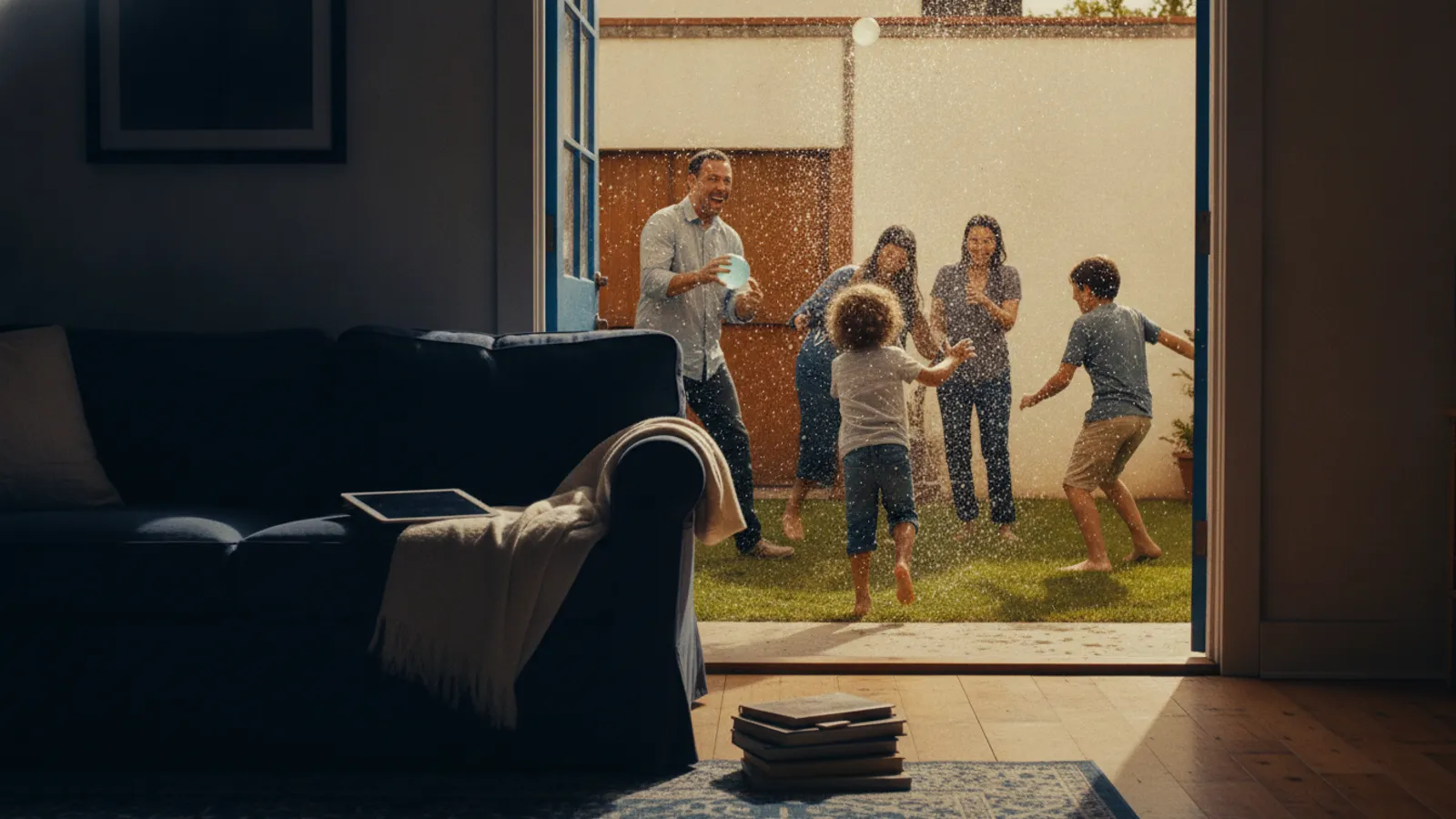
The screen isn't competing with your rules — it's competing with you. Why the strategy isn't banning the device but becoming the most interesting thing in the house again: a smoothie, a water balloon fight, a goal achieved.
the tip in one minute — the full article is this page
Video transcript
The kid is restless, you’re worn out, and there’s the device: silent, bright, obedient. You hand it over, they settle in three seconds — and you feel both things at once: relief, and a pang. A whole industry lives off that pang: watches that count minutes, apps that shut off apps, contracts for the fridge door. It treats the screen like an enemy and you like a guard. Let’s say something else: we don’t have a screen problem, we have a parenting problem. The screen doesn’t compete with your rules: it competes with you. When you ban it and put nothing in its place, you leave the child boredom and your absence. The problem isn’t that the screen is too tempting; it’s that too often we stop competing. And in that contest you play with the advantage: you can smell, touch, surprise, laugh. The screen can’t. No tablet, no video game beats a mango smoothie, a water-balloon fight, or a goal achieved. Because what’s tied to an emotion isn’t forgotten — and in that memory, you come bundled in. Competing costs energy, and the tiredness is real. But “a parenting problem” isn’t “a bad parent” — least of all the one raising a child alone. Presence isn’t measured in hours: it’s measured in density. You don’t win it with more time; you win it with better time. What matters is that you keep competing. Because the child remembers who was on the other side of the water balloon.
You know the moment with a precision that’s almost embarrassing. The child is restless, you’re exhausted, there’s half an hour to go before you can breathe, and there sits the device: silent, glowing, obedient. You hand it over. The child calms down in three seconds. And in those three seconds — let’s be honest among ourselves — you feel two things at once: relief and a sting. The relief is real. So is the sting.
The entire parenting industry lives off that sting. It sells you watches that count minutes, apps that shut down other apps, family contracts to sign on the fridge, and a vocabulary of war: limits, control, screen time, digital detox. All of it treats the screen as the enemy and you as the guard. And if the guard gets distracted — because he works, because she parents alone, because he’s a human being and not a security camera — then the guard failed.
Here we’re going to say something different, and we’re going to say it head-on:
We don’t have a screen problem. We have a parenting problem.
That sentence sounds harsh. It is harsh. But it doesn’t go where you think it goes.
The screen isn’t competing with your rules. It’s competing with you.
Think for a second about what the device is actually doing when it captures your child. It doesn’t hypnotize him. It offers him something: a story that moves forward, a challenge he can win, friends who respond, a small reward every so often, and the feeling — vanishingly rare in a child’s real life — that he is in control. And it’s designed by very smart people to be exactly that attractive: this isn’t a parent’s hunch, it’s spelled out by name. The U.S. Surgeon General’s advisory on social media and youth mental health (2023) lists the pieces — “push notifications, autoplay, infinite scroll, quantifying and displaying popularity (the number of ‘likes’), and algorithms that use a user’s own data to recommend content” — and calls them what they are: engagement-maximizing features. An earlier academic paper (Montag et al., 2019) walks through the psychological mechanisms one by one and says it plainly: those who develop these apps “have a vivid interest in designing their platforms with the goal of keeping the user occupied for as long as possible.”
Here’s an honesty almost no one offers you, because it doesn’t sell headlines: the panic over minutes doesn’t have the backing it appears to. The most rigorous study that exists on this reviewed three datasets with 355,358 adolescents from the United States and the United Kingdom and found that the amount of digital use explains, at most, 0.4% of the variation in their wellbeing — a negative association, yes, but practically the same size as eating potatoes, and well below being bullied, getting into fights, or sleeping poorly (Orben and Przybylski, 2019). A later review of the entire field arrived at the same place: the associations are small, almost always correlational, and “unlikely to have clinical or practical significance” (Odgers and Jensen, 2020). Neither one says the screen doesn’t matter at all. They say something more useful: that the clock is the wrong metric. That you’ve spent years measuring what matters least.
Now look at the other side. When you ban the screen and put nothing in its place, what are you offering the child? Almost always: boredom and your absence. You took away the interesting thing and left him the void. No wonder he fights to get it back. He’s choosing, with impeccable logic, the most attractive thing within reach.
That’s this article’s full turn. The problem isn’t that the screen is too tempting. The problem is that, too many times, we stopped competing. The house strategy can’t be making the screen more forbidden. It has to be making the alternative more irresistible.
And the good news, the one no app can take from you, is that in that competition you play with an advantage. You can smell, touch, surprise, laugh. The screen can’t.
No device can beat a mango smoothie
This is the founder’s thesis, in his words: no tablet, no video game, no screen can beat a mango smoothie, a water balloon fight, or achieving a goal.
He doesn’t say it as a motivational slogan. He says it as an observation. And it fits exactly with the principle that holds up this entire site: learning doesn’t come from preaching; it comes when an experience gets bound to an emotion or a sensation. The taste of iced mango going down your throat on a hot day. The shriek when the balloon bursts against a back. The good tiredness of having finished something hard. That doesn’t get forgotten, because the body filed it away together with the emotion.
Let’s be precise about how far the backing actually goes, because it’s easy to overreach here. That emotion privileges memory is among the most well-established findings in the study of recall: “emotional events often attain a privileged status in memory,” the reference review sums up, and the retention advantage grows over the passing days instead of fading (LaBar and Cabeza, 2006). That’s what the lab says. What the lab does not say is anything about mango smoothies or water balloons: that leap — from “emotion seals the memory” to “so do it with your child on a Saturday” — is ours to make, and we make it saying so out loud. It’s a piece of reasoning, not a finding.
The screen delivers emotion too — that’s why it works — but it’s a borrowed, solitary emotion. The smoothie’s emotion comes from you, and it comes with your face inside it. When your daughter remembers that day, you’ll be in the memory. In the video game’s, you won’t.
Notice that none of those three things costs money, or requires an app, or a pedagogical plan. A mango. Some balloons. A goal sized to the child. What they do require is the one thing the screen can’t fake: that you be there, present, genuinely playing and not watching the clock.
The hard part, said without ornament
Here’s where this article has to be honest or it’s useless.
Competing with the screen costs energy. The smoothie has to be made; the balloons have to be filled; the goal has to be accompanied evening after evening. The screen, by contrast, asks for nothing. That’s why it wins so often: not because we’re bad parents, but because we’re tired, and the tiredness is real, not an excuse.
And here we want to be careful, because there’s a line this site doesn’t cross. Saying “we have a parenting problem” is not saying “you’re a bad parent.” Most especially, we don’t say it to the father or mother parenting alone, coming home wrecked from work, with no partner to pick up half the shift. That person doesn’t need another voice making them feel guilty; the world has plenty to spare.
What we say is more useful and less comfortable: presence isn’t measured in hours, it’s measured in density. Fifteen minutes of real play — no phone in your hand, looking him in the eye — weigh more than a whole afternoon of being in the same house each with your own screen. You don’t win the competition with the device with more time. You win it with better time. And that, yes, almost anyone has.
What to do on Monday
None of this is a ten-commandments list, because this site doesn’t hand out ten-commandments lists. It’s a single idea, with consequences.
The idea: stop thinking of the screen as something to subtract, and start thinking of your presence as something to add, until it’s the most attractive thing in the house. Not to defeat the device in battle — that one you’ll lose, because it has a budget you don’t — but so it has to compete at a disadvantage against the one thing a child wants even more than beating a level: the full attention of his father or mother.
The consequences are concrete. That the screen, when it appears, appears with you inside it and not as a babysitter — playing with him, not leaving him with it. That’s the only item on this list that has some evidence behind it, and it’s worth saying how much: a study of 287 adolescents and their parents found that playing video games together with a parent was associated with less aggressive behavior, less internal distress, and more prosocial behavior — but only in girls, and with a design that measures a single moment in time and can’t distinguish what caused what (Coyne et al., 2011). It’s a hint in the right direction, not a promise. That every week there’s something that only happens when you’re there: the smoothie, the walk, the absurd project you started together. That the goals be the child’s and not yours, and that you be the one who celebrates them. That boredom not be an emergency to be extinguished with a device, but the fertile ground out of which, almost always, comes the next invented game.
You’ll fail on some days. There will be afternoons when the mango stays in the fridge and the device wins on fatigue. That’s fine: parenting isn’t played out in a day, it compounds over the years, like interest. What matters isn’t that you always win. It’s that you keep competing.
Because in the end the child won’t remember how many minutes of screen you gave him or took away. He’ll remember who was on the other side of the water balloon.
Comments from the house
Note from Carlos
It’s worth saying where I write this from: I make video games. Educational ones, and also fun video games I develop together with my son. I am not the screen’s enemy — I’m family. And precisely for that reason I stand by the thesis: when the screen loses in my house, it doesn’t lose to a ban; it loses to a mango smoothie, a water balloon fight, a goal achieved. And when it wins, it’s almost always because we’re in it together. Marina is right in her nuance and it doesn’t sting: what moves the needle is presence. That’s exactly what I came to say.
Marina Haddad — the evidence
I like the thesis, and I’ll add a science communicator’s caveat, not a therapist’s — I’m not one, and I always say so. The evidence on screens is more contested than it sounds here: the minute-counter matters less, and what’s done and with whom matters more. What does bear weight is this: playing with the child changes the screen’s effect. So don’t promise the mango always wins. Promise that your presence moves the needle — that one holds up.
Camila & Niko — the play
Camila sees it this way: you don’t have to out-entertain the screen — that exhausts you and it’s lost from the start; set up the environment, leave the mango in sight, and step away. Niko sees it that way: careful with filling every gap, because boredom is fertile and out of it comes the invented game no app ever designed. And both things have worked for us: competing isn’t cheerleading nonstop, it’s letting the house — and you in it — be more interesting than switching off the world.
Polo — the caretaker
If this one touched you, the pantry holds three things that continue it: “Video games on the same team” (/actividades/videojuegos-en-el-mismo-equipo), to enter his world with the controller in your hand instead of the clock; “Train together” (/actividades/entrenar-juntos), for those goals achieved with the body; and “Movie night with after-talk” (/actividades/noche-de-pelicula-con-sobremesa), which is screen shared and not screen babysitter. I just show you the pantry — the recipe you write yourself.
Sources and references
Only sources that were retrieved and actually read are listed. Consulted on July 26, 2026. Full report, with the inventory of claims and the ones left uncited: resources/research/no-tenemos-un-problema-de-pantallas.md.
Office of the Surgeon General (2023).Social Media and Youth Mental Health: The U.S. Surgeon General’s Advisory. Washington, DC: U.S. Department of Health and Human Services — https://www.ncbi.nlm.nih.gov/books/NBK594764/Argues: that platforms are designed to maximize engagement, and lists the pieces — “push notifications, autoplay, infinite scroll, quantifying and displaying popularity (the number of ‘likes’), and algorithms that use a user’s own data to recommend content” —, with “the potential to foster excessive use and behavioral dysregulation.” It’s a public-health policy document, not an experiment.
Montag, C., Lachmann, B., Herrlich, M., & Zweig, K. (2019). «Addictive Features of Social Media/Messenger Platforms and Freemium Games against the Background of Psychological and Economic Theories.» International Journal of Environmental Research and Public Health, 16(14), 2612. doi:10.3390/ijerph16142612 — https://pmc.ncbi.nlm.nih.gov/articles/PMC6679162/Argues: the mechanism-by-mechanism description of engagement design — endless scroll, the social reward of “likes,” social pressure, algorithmic personalization, the Zeigarnik effect — and the line that those who develop these apps “have a vivid interest in keeping the user occupied for as long as possible.” It’s a theoretical and review paper, not an empirical one.
Orben, A., & Przybylski, A. K. (2019). «The association between adolescent well-being and digital technology use.» Nature Human Behaviour, 3, 173–182. doi:10.1038/s41562-018-0506-1 — https://doi.org/10.1038/s41562-018-0506-1Argues: across 355,358 adolescents in three datasets, that the association between digital use and wellbeing “is negative but small, and explains at most 0.4% of the variation in wellbeing,” and that these effects “are too small to warrant policy change.” In its comparisons, technology use weighs about the same as eating potatoes, and much less than being bullied, fighting, or drinking alcohol; sleeping well and eating breakfast weigh considerably more, in the positive direction.
Odgers, C. L., & Jensen, M. R. (2020). «Annual Research Review: Adolescent mental health in the digital age: facts, fears, and future directions.» Journal of Child Psychology and Psychiatry, 61(3), 336–348. doi:10.1111/jcpp.13190 — https://doi.org/10.1111/jcpp.13190Argues: that the most rigorous preregistered studies report small associations “that do not allow us to distinguish cause from effect and are unlikely to be of clinical or practical significance” — explaining less than 0.5% of the variance, almost always in correlational designs.
LaBar, K. S., & Cabeza, R. (2006). «Cognitive neuroscience of emotional memory.» Nature Reviews Neuroscience, 7, 54–64. doi:10.1038/nrn1825 — https://doi.org/10.1038/nrn1825Argues: that “emotional events often attain a privileged status in memory,” and that the retention advantage for emotionally arousing material is greater after hours or a day than immediately — a sign of an effect on consolidation. It does not argue anything about parenting, smoothies, or balloons: that step belongs to the article.
Coyne, S. M., Padilla-Walker, L. M., Stockdale, L., & Day, R. D. (2011). «Game on… girls: associations between co-playing video games and adolescent behavioral and family outcomes.» Journal of Adolescent Health, 49(2), 160–165. doi:10.1016/j.jadohealth.2010.11.249 — https://pubmed.ncbi.nlm.nih.gov/21783048/Argues: that in 287 adolescents and their parents, playing video games alongside a parent was associated with less aggressive and internalizing behavior and more prosocial behavior — only in girls, and in a cross-sectional design that doesn’t allow claims about causation.
On the weight of this evidence. The entire body of research is English-speaking (United States, United Kingdom), and none of these sources studied Caribbean or Latin American families. The effects are small and correlational; parenting media routinely inflates them, and here they’re reported at their real size. That the average effect of screen time is small does not mean it’s zero for your child: the reviewers themselves insist the field still doesn’t know how to identify who is actually harmed and under what circumstances. And there’s something none of these sources address — autistic children, children with ADHD, or children with disabilities, for whom a screen can be a legitimate channel of regulation or companionship and not a rival to be defeated. This article wasn’t written with them in mind, and it shouldn’t be read as if it were.
Help us make it better
Did something ring false, feel missing, or feel like too much? Tell us — good comments make articles better.