Don't Teach Them Anything (Leave It to the Professionals)
By Carlos Miranda Levy · July 14, 2026
The most contradictory piece of advice in the house: don't teach them to swim — get in the water. Why technique belongs to the professionals and the irreplaceable role is another one entirely: the sparring partner. With the tricks, the stories, and the lane right next to theirs.
the tip in one minute — the full article is this page
Video transcript
The most contradictory advice in this house, and I mean it: don’t teach it yourself. Leave the technique to the professionals. Skills evolve. Today’s swimming isn’t the swimming of thirty years ago. What you learned may be, without your knowing it, the old version — and teaching it with all the love in the world can do more harm than good. Patience is a professional resource. The lesson with Dad ends far too often in an argument and shouting. Coaches get paid for exactly that: for the time, the patience, and the thousand repetitions. And muscle discovery can’t be rushed: every skill needs calm practice until the aha moment when brain, body, and reflexes wire themselves together — the coach’s natural habitat, and the worst ground for the bond between parents and children. And now your role — the one no one else can fill: the sparring partner. Swim beside her, lane to lane. Ride your bike with him. And in those unstructured moments something happens that no coach can give: your tricks, your stories, your way of loving it. The coach teaches the technique. The sparring partner teaches that this is something you enjoy together. Watch out for the hidden whistle: if the game fills up with instructions, you’ve gone back to being a coach in a sparring partner’s costume — and the child notices before you do. You delegate the technique; never the presence. A father’s place isn’t the whistle. It’s the lane beside them.
This article is about to give you a piece of advice that sounds terrible, and it means it seriously:
Don’t teach them anything. Let the professionals do it.
Breathe. Yes — teaching your daughter to ride a bike is one of the most special bonding moments there is, and nobody here is coming to take it from you. But there are plenty of things better left in the hands of someone who teaches for a living, and the reasons are better than the advice sounds. Let me point out a couple — and then I’ll tell you about the one role no one but you can fill, which is where all of this is really headed.
Reason 1: skills evolve (and your version may be the old one)
Trades and skills change over time. Even sports. Twenty-first-century swimming is not the swimming of the final years of the twentieth: it wasn’t just the rules that changed — the technique itself changed.
Two examples you can check yourself. The first: in the seventies a backstroke swimmer took two or three underwater dolphin kicks on the turn; a decade later, some swimmers were covering about twenty-five meters that way before taking their first stroke. The 100-meter backstroke final at the 1988 Seoul Olympics was the tipping point — the sport’s own governing body recounts that the race “resulted in an almost immediate rule change to limit backstroke starts to ten meters,” a limit later extended to fifteen. The second: since January 1, 2010, competition swimsuits can only be made of textile fabric, with caps on thickness, permeability, and buoyancy — the end of the polyurethane suits. In twenty years, where you swim from, how much you swim underwater, and even what you swim in all changed. And that’s just one sport: take any direction, any field, and you’ll find the same situation.
What you learned — with all the love you learned it with — may be, without your knowing it, the previous edition. Teaching it to your child isn’t a gift: it can be a disservice that a coach will later have to un-teach. Love doesn’t update technique.
Reason 2: patience is a professional resource
Let’s be honest, just between us: most of us are parents, not teachers. We have limited time and — more importantly — limited patience. And we all know the script of the lesson with mom or dad: it starts with excitement, moves on to instructions, rises in tone, and too often ends in an argument, shouting, back-talk — and a frustration planted on both sides that cost more than the lesson was worth.
It’s not a flaw in you. It’s a mismatch of roles: you’re asking the most delicate bond of your life to do the job of a professional relationship designed for exactly that — to absorb the repetition, the mistakes, and the plateaus without anyone taking it personally.
Reason 3: muscle discovery can’t be rushed
And here’s the deep reason. Any skill, in any trade, needs practice — not just to reach excellence: to even develop and be executed properly. And it isn’t only muscle memory. There’s something that comes first, something I like to call muscle discovery: the aha moment when your brain, your body, your nerves and your reflexes get clear on how something works — and wire themselves to do it.
That moment can’t be explained or transferred: it can only be practiced until it arrives. It takes time. It takes repetition. It takes a patience most of us don’t have at seven o’clock on a Tuesday evening.
“Muscle discovery” is my own name for it, nobody else’s — but the neighboring phenomenon has in fact been studied, and it confirms the part that matters here: that time can’t be compressed. In an experiment with a complex motor skill, consolidated improvement didn’t show up at twelve hours after training, not even when those twelve hours included a night’s sleep: it showed up at twenty-four hours. The authors’ conclusion is that task complexity determines how long you have to wait. Translated to your Tuesday: it’s not that your child isn’t listening to you. It’s that it hasn’t happened to him yet.
And guess what? Teachers, coaches and trainers get paid for exactly that: for that time, that patience and that practice. It’s literally their product. Buy it — and keep for yourself the part that isn’t for sale.
A caveat, so this argument doesn’t get warped along the way: none of this means practice is everything. A meta-analysis that pooled the major studies on deliberate practice found that it explains around 18% of the variation in athletic performance and 21% in music — a lot, and nowhere close to everything. And the famous “10,000-hour rule” isn’t a scientific finding: it’s a popularization label a journalist put on a study that never proposed it. We’re not buying elite performance here. We’re buying the repetitions a child needs for something to click for him, ones you don’t have to be the one to supply.
A clarification this advice needs: “professional” doesn’t mean “expensive”
Before we go on, the line that saves this article from being country-club advice: a professional is anyone whose role is to teach — not anyone who charges a lot. The city sports school. The town hall program. The school team. The neighborhood club. The cousin who competes in a federated league and loves to explain. Almost everywhere there’s more teaching available and accessible than we think; finding it is part of the job. The point of this article is to free up your role, not to empty your wallet.
The role that is yours: the sparring partner
Because here is the heart of it, and it’s the opposite of checking out: what truly matters is sharing experiences, bonding, and passing on the expert or anecdotal advice — the best of what you know and what you feel.
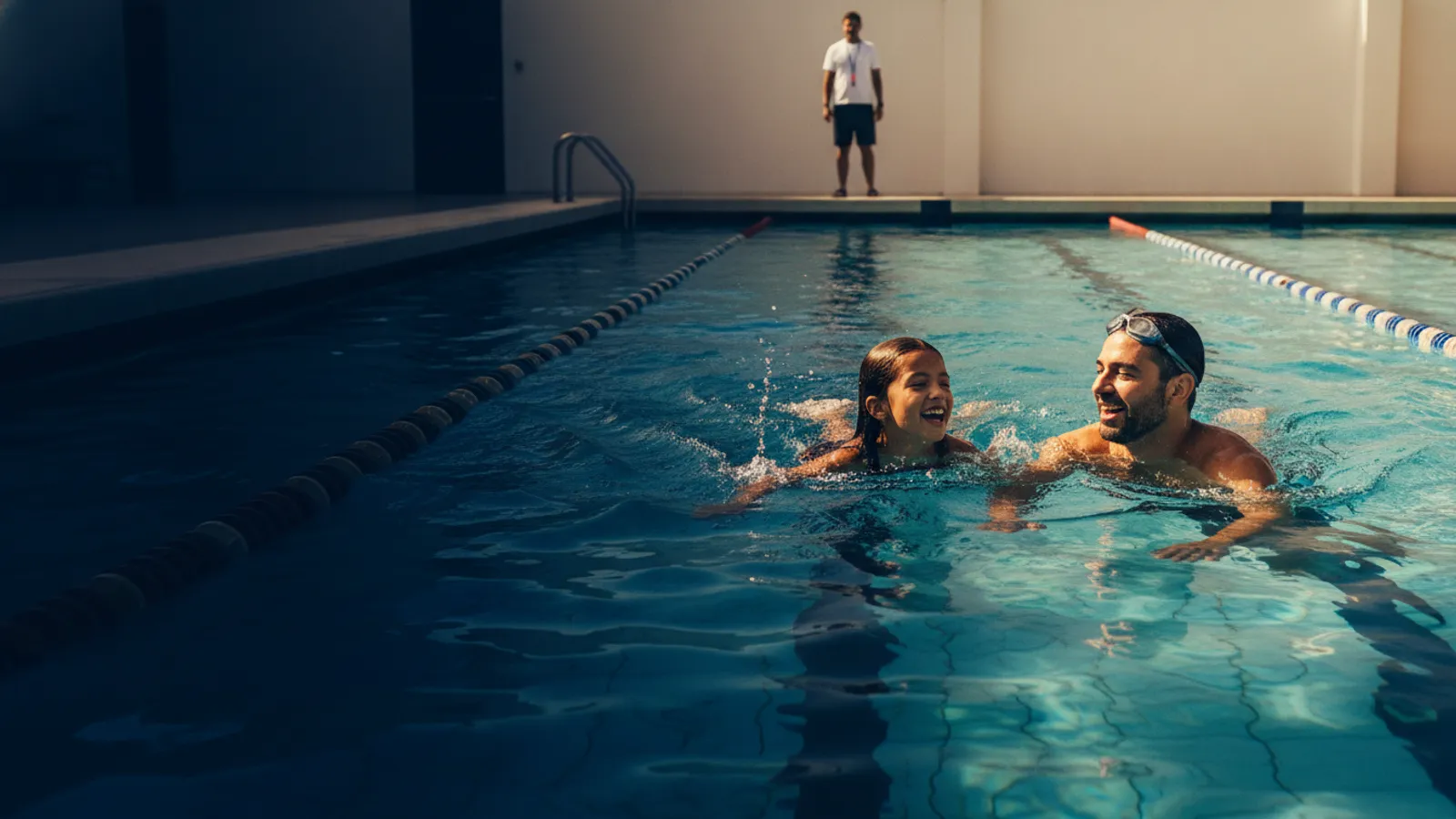
Instead of being the teacher, the trainer, the coach — be the sparring partner. The one who swims alongside her, lane to lane. The one who plays tennis with him, point by point. The one who rides the bike next to them, sings the duet, plays four-handed, acts in the same scene. And in those relaxed moments, with no structure, no lesson plan — that’s where your tricks go, your preferences, your stories, your particular way of loving that sport or that craft. Without burning a single minute of the bond on generic technique that a third person — trained, skilled, and paid for it — delivers better.
Look at it coldly and the casting is obvious: the coach can be anyone qualified. Only you can be the sparring partner. You’re not delegating what matters — you’re keeping what can’t be replaced.
And it’s not just me saying it: the kids say it. When two youth-sport researchers reviewed what a young athlete asks of their parents, the result read almost like a script for this article — that parents avoid giving technical or tactical advice, and that their comments focus on effort and attitude rather than performance or outcome. The same authors hold that the parenting style that works best in sport is the one that supports the child’s autonomy, and that in two-parent households, the first thing is for both parents to know how the other plays — because the emotional climate is built by the two of them together, not in shifts. When you see your daughter come out of the water looking for you with her eyes, she isn’t looking for a stroke correction. She already has someone for that.
The bike, the borderline case
So what about the bike? The sacred ritual of the parent letting go of the seat?
Yours. That moment is pure bonding and no one takes it from you. But even the bike gets better with clear roles — and with a golden rule that comes from a real wound (the author’s; see his note below): never lie about letting go. The “I won’t let go” that lets go wins a bike and loses something more expensive. “I’ll let go when you’re ready — and I’ll tell you” teaches riding AND teaches that your word bears weight. Both things, or neither is worth anything.
Start this week
Make the honest list: what are you “teaching” that ends in tension every single time? That’s the first thing to move to a class, team or club — look for the neighborhood option, not the catalog one.
Reconvert that same activity into a sparring court: Saturday’s pool with no stopwatch, the pickup game with no tactics.
Save your tricks for the loose moments — you give better advice from the next lane than from the edge.
And if you notice you slipped back into correcting mid-game: whistle away. Laughter’s in charge.
Anchor line: The coach teaches them technique. The sparring partner teaches them that this is meant to be enjoyed in good company. Anyone can supply the technique — the lane right next to theirs is yours.
Comments from the house
Note from Carlos — the author
I have my own issues with this topic, so I’m declaring the conflict of interest :-p. I remember the feeling of betrayal: me asking “mom, don’t let go,” and then “mom, are you there? are you there?” — and the moment of realizing I was on my own, the panic, and the crash. Yes, I learned to ride a bike. And I also learned something else that took me longer to name. That’s why the golden rule of the bike is serious: if you’re the one teaching, your word is part of the safety equipment.
Virgilio “Coach” Reyes — the professional confirms
Twenty-five years getting paid for exactly what this article says: the patience of the thousand repetitions. And I sign it with one precision from my side of the court: when a parent brings me the kid, I supply the technique — but the parent who stays to watch, who asks how it went, who plays the Sunday pickup game without correcting a single thing: that one is doing the half of the job I can’t do. I’ve seen the reverse too: the coach-parent in the stands, shouting instructions over mine. To that one I say, kindly, what this text says — whistle away. There’s already one on the court.
Sancho — the Squire
Why, this article is my biography! The squire never taught his knight to joust — that’s what the books of chivalry and the masters of arms are for. The squire saddles up, joins the campaign, shares the bread and the stories by the fire, and loses the practice duels with exemplary dignity. Be the sparring partner, says the author. I say: be the squire — it’s the same trade, and it’s the only one that stays until the last page.
Belkis — the engineer of scarcity
Two notes from a real week. One: “professional” in my neighborhood is called the city sports school and the schoolteacher who stays an extra hour — free or nearly so; the section that clears this up isn’t a detail, it’s half the advice. Two: the sparring partner is the part that actually fits in my calendar — I can’t pay for or supervise three classes a week, but the Sunday splash-about is sacred and costs nothing. A perfect split for the households where time and money are both counted.
Polo — the caretaker closes
The courtmates of this practice: Train together and Swim together for the lane next door, Today you teach me for the reverse role — let her teach you what she learned in class — and Coffee for two for the after-the-game wind-down. And the card for this practice: Be their sparring partner, not their coach. Below I left where every fact in this piece came from — that’s what I keep the keys for. See you at the pool — I don’t correct strokes either.
Sources and references
Every source on this list was consulted directly in the original text before being cited. What in the article is reasoning or personal experience — the patience mismatch, “muscle discovery,” the bike’s golden rule — is said as such and carries no borrowed backing. The full audit is in resources/research/se-su-sparring.md.
Nation, C. (2023).Backstroke Legends | Suzuki & Berkoff return to the podium in Fukuoka. World Aquatics, July 29, 2023. → worldaquatics.com
Argues, in the governing body’s own words, that the 100m backstroke final at Seoul 1988 “resulted in an almost immediate rule change to limit backstroke starts to ten meters,” a limit later extended to fifteen.
Mortenson, J. P. (2023).How the Underwater Dolphin Kick Evolved Over Time and Revolutionized the Sport. Swimming World Magazine, January 20, 2023. → swimmingworldmagazine.com
Argues the evolution of the technique: from two or three underwater kicks in the seventies to about twenty-five meters in the eighties, and its later extension to other strokes. This source dates the ten-meter ban to 1991, while World Aquatics describes it as immediate to 1988; that’s why the article doesn’t state any specific year for the rule.
Swimming World Magazine (2009).FINA Confirms Jan. 1, 2010 as Swimsuit Restriction Implementation Date, July 31, 2009. → swimmingworldmagazine.com
Argues that the new swimsuit approval requirements have been in force since January 1, 2010, with material restricted to textile fabric and caps on thickness (0.8 mm), permeability, and buoyancy (0.5 N).
Harwood, C. G., and Knight, C. J. (2015).Parenting in youth sport: A position paper on parenting expertise. Psychology of Sport and Exercise, 16, 24–35. → PDF
Argues what’s claimed about the parental role: that young athletes ask that their parents “avoid giving technical or tactical advice” and comment on “effort and attitude rather than performance or outcome”; that the optimal parenting style is authoritative or autonomy-supportive; and that in two-parent families the emotional climate is co-built by both. It’s a position paper reviewing literature, not a primary study; the evidence it summarizes comes from youth sport, weighted heavily toward tennis, with modest qualitative samples. Extending it to piano or drawing is the author’s own reasoning.
Macnamara, B. N., Hambrick, D. Z., and Oswald, F. L. (2014).Deliberate Practice and Performance in Music, Games, Sports, Education, and Professions: A Meta-Analysis. Psychological Science, 25(11), 1608–1618. → PDF
Argues the figures behind the caveat: deliberate practice explains 26% of the variation in games, 21% in music, 18% in sports, 4% in education, and less than 1% in professions. The authors conclude that “deliberate practice is important, but not as important as has been argued.” It also documents that the “10,000-hour rule” was coined by Gladwell, not by the researchers.
Macnamara, B. N., and Maitra, M. (2019).The role of deliberate practice in expert performance: revisiting Ericsson, Krampe & Tesch-Römer (1993). Royal Society Open Science, 6(8), 190327. → PMC6731745
Argues that the foundational study defined deliberate practice as practice designed by a teacher — “the teacher designs practice activities that the individual can engage in between meetings with the teacher” — even though it measured solitary practice; and that in its re-examination, both elite groups exceeded 10,000 hours and still performed differently.
Lugassy, D., Herszage, J., Pilo, R., Brosh, T., and Censor, N. (2018).Consolidation of complex motor skill learning: evidence for a delayed offline process. Sleep, 41(9), zsy123. → PubMed 30215814
Argues what’s said about timing: in a complex motor skill, consolidation only became evident at 24 hours after training, and not at 12 even when those 12 hours included sleep; the authors conclude that task complexity determines the required interval. It’s a fine-grained laboratory motor task, not learning to swim; and the field of motor consolidation has open debates. “Muscle discovery” remains the author’s own coinage, not a term from this literature.
Wood, D., Bruner, J. S., and Ross, G. (1976).The Role of Tutoring in Problem Solving. Journal of Child Psychology and Psychiatry, 17, 89–100. → PDF
Doesn’t support “don’t teach” — it supports the opposite, which is why it’s here: it defines scaffolding as the adult who “controls those elements of the task that are initially beyond the learner’s capacity” so the learner can concentrate on the ones they do master. The evidence supports splitting the role, never disappearing from it. Study with 30 children aged 3 to 5; the tutor was an experimenter, not a parent.
Help us make it better
Did something ring false, feel missing, or feel like too much? Tell us — good comments make articles better.