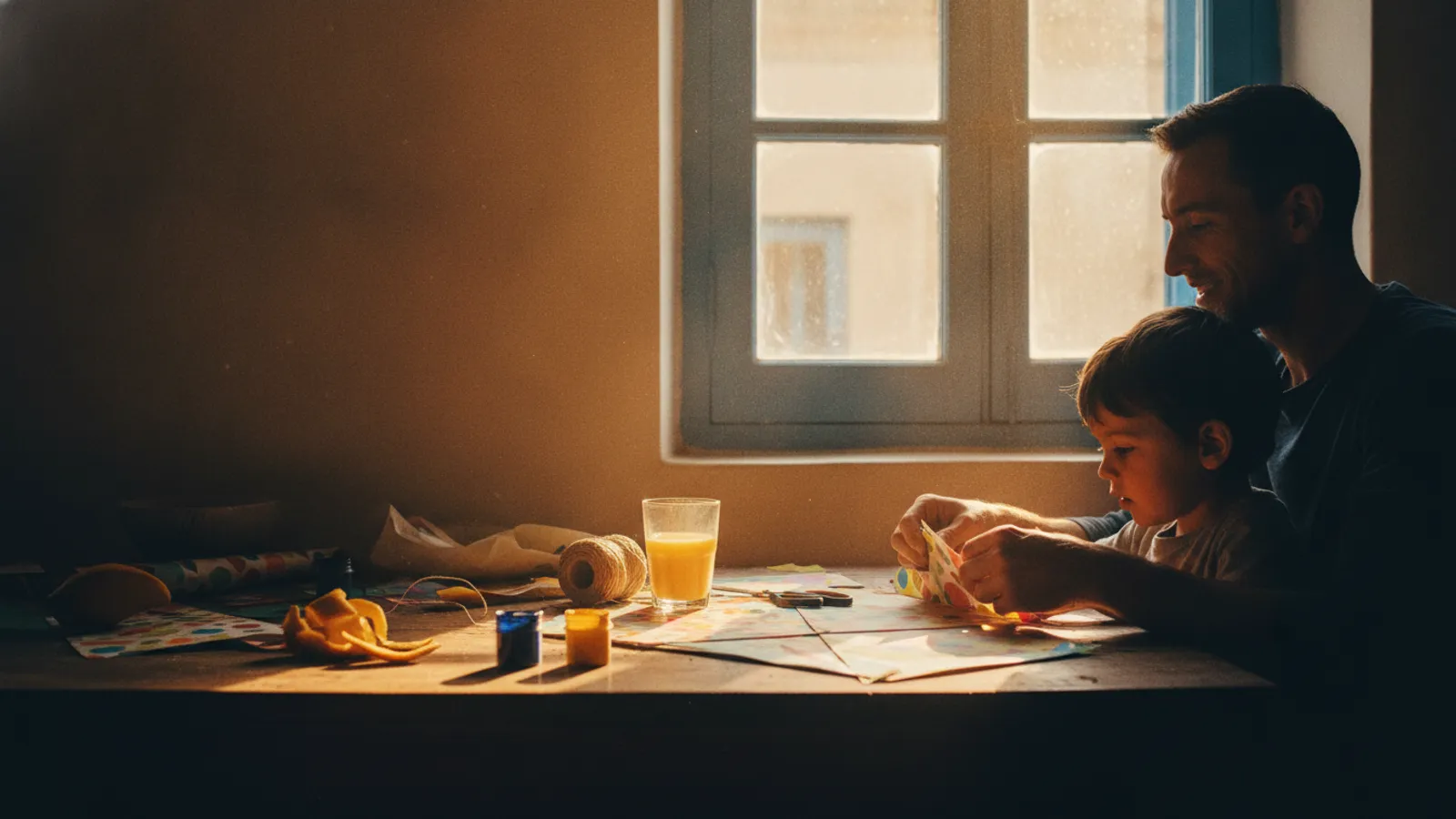
Filter by today’s reality — the age, the time, the energy, your kind of family — and find something to start this very afternoon. Every card explains what it builds and how it changes with age.
the library — filters and activity cards — is in Spanish for now
A night where the roof is made of cloth and the phone has no signal. You get a little cold, you cook badly, you laugh a lot — and the next morning the world smells of smoke and watery coffee. Unforgettable.
Nothing to book, no three-hour drive: a tent ten meters from your bed. Your own house seen from outside, at night, is the strangest and most thrilling place in the world.
A puddle, a flashlight, a glass of water in the sun: the three oldest and most free toys in the world. Pouring, sinking things, chasing your own shadow — the first physics comes in through wet hands.
He picks the goal, you set the rules of the game: a clear jar, fixed contributions, and a visible path to that something he truly wants. Delayed desire is a muscle — and it can be trained.
Sitting across the board and thinking three moves ahead: chess teaches you to look before you act and to lose without falling apart. A game is a silent conversation between two minds.
Getting up while it's still dark, climbing a hill by flashlight, and reaching the top just as the sun peeks out. The cold, the effort, the silence — and suddenly the light. Some things only the early riser who sweats gets to see.
The practice hours behind the wheel with your son are among the last great shared tasks of parenting: you in the fear seat, him taking control — literally.
A story you listen to together — in the car, in the kitchen, before bed — becomes a world you share and hundreds of conversations that would never have happened otherwise.
Turn up the volume while you cook or clean up, and the kitchen becomes a dance floor. No child forgets the house where there was dancing — or learns that the body is something to be ashamed of.
A place full of books, visited on a fixed rhythm with a single rule: he chooses. Readers aren't made with assignments — they're made with sovereignty.
Not a spin around the block: the journey. Ride to a faraway spot and back — or not back, and someone picks you up. Legs that burn, the downhill earned by the climb, and the magic of getting there under your own power.
Walking through the downpour belting out the universal rain songbook — from «Singin' in the Rain» to «Ojalá que llueva café» — off-key and proud and laughing. The cheapest musical in the world, and you're the cast.
Signing up together for a local race — a 5K, whatever — and training weeks for it. The nerves at the starting line, the number pinned to your chest, and the sweaty hug at the finish are never forgotten.
Fifteen minutes, paper, and a sealed envelope with an opening date: "for me, one year from now." Writing to yourself teaches something no adult can explain — that the person you'll be will read the person you are.
Writing a real letter, on paper, and waiting days for the reply. In the age of instant messaging, the slowness of the mail is exactly the lesson — and the thrill.
Becoming detectives of the fake: doctored photos, trick headlines, AI-made videos. You play at doubting with method, not with fear — and it hooks you like a riddle.
There's a house with people living in it that crosses your city's sky several times a week, and you can see it with the naked eye. An app tells you when, you step out onto the balcony — and there it goes, moving among the stars.
The kitchen is a laboratory: the oil that won't mix with water, the purple cabbage that changes color, the yeast that breathes. Experiments you can see, smell, and sometimes eat.
One dish of the week is decided, prepared, and served by the child — with your help shrinking each time. The kitchen is the cheapest autonomy lab there is.
Pick a country on the map and cook its dish: find the recipe, track down the unusual ingredient, taste new flavors. A trip around the world that begins and ends in your kitchen.
Rocks, leaves, bottle caps, stickers, toy insects: when a child collects, they learn to classify, compare, and care for what's theirs. A treasure box is an encyclopedia they made themselves.
A treasure box of caps, cardboard tubes, sticks, and tape — and the challenge to build something that works or something that doesn't exist. The cheapest maker workshop in the world fits in a shoebox.
Treating a child as someone capable of thinking is the prophecy that most reliably fulfills itself. Fifteen minutes on a "grown-up" topic, at their level but without watering it down.
Drawing what's in front of you —a cup, a shoe, the tree on the corner— not to make it come out pretty, but to learn to really look. Fifteen minutes that slow the world down.
An afternoon building together the budget for an imaginary independent life: rent, food, electricity, transport. The teen discovers the price of the world — and, along the way, everything home was giving them for free.
Want your son to open up emotionally? Show him how: don't answer «fine» on autopilot. If you're tired, say so — with the four safety phrases: it's not about you, it's normal, I'm handling it, and I already feel better for telling you.
Does «how did it go?» only get you a «fine»? Flip the flow: tell them your day — who showed up late, what challenge you had, what made you laugh. Without asking anything back. One day, in a pause: «Dad, you know what happened today?».
Writing a story where the two of you are in charge and the AI obeys: you ask for a dragon that's scared of socks and watch what nonsense it invents. Laughing together at the result is the hook.
Someone in the house falls ill. Instead of keeping the child away, give them a real role in the care: carrying the soup, the blanket, the glass of water. Caring for another is learned by caring.
Before the presents come in, the toys he no longer uses go out — and he hands them over himself, in person, to whoever will enjoy them. Generosity isn't preached: it's practiced by letting go of something of your own.
It's raining outside; inside, a fortress of sheets, chairs, and cushions goes up and lasts all afternoon. Bad weather, turned into the best plan of the week.
Pick a language nobody at home speaks and learn ten words together: hello, thank you, water, friend. Not to master it — to discover that the world can be greeted in many ways.
Five minutes on Sunday looking through the week's photos together and telling them aloud. Family memory isn't kept in the phone: it's kept by telling it.
Thousands of photos lost in the phone aren't memory: they're a messy drawer. Rescuing and organizing the family archive together is traveling to the past and learning not to lose it.
A fixed date, you and your teen, at the same table in the same café: no siblings, no agenda, no interrogation. One hour a month that holds up the conversation through the hard years.
The songs sung only in your house — the inherited ones, the invented ones, the one you made up for brushing teeth. A secret repertoire that your daughter will sing to her own children.
A basket full of ordinary household objects — a wooden spoon, a brush, a funnel, a lid — and a baby who investigates at their own pace, with you nearby and quiet. The cheapest laboratory in the world.
A notebook that comes and goes with the child between their two homes: drawings, jokes, the anecdote of the week. Their two worlds, stitched together by the child himself.
An unhurried breakfast, everyone at the table, made by everyone and with no clock running. The simplest ritual in the world, and the one that glues childhood memories together best.
A whole day where the default answer is yes: to the weird breakfast, the far-off park, the absurd plan. With limits agreed beforehand — because a yes with no edges isn't a gift, it's neglect.
A jar of water and glitter that, when you shake it, takes exactly as long to settle as a tantrum takes to pass. An anchor for the storms — his, and sometimes yours.
«Go to the colmado and bring back bread and a carton of eggs.» The first errand alone — or almost — is a rite of passage: trust made into a task, and the street made into a teacher.
A big sheet of paper on the wall and a question for everyone: what do we want to do, learn, see? Drawing each person's dreams on a single map — and discovering which ones can be started on Saturday.
Walking the neighborhood like explorers and drawing it like cartographers: the colmado, the tree good for shade, the house with the barking dog. His world, mapped by his own hand.
A morning at the market isn't a shopping trip: it's a sensory expedition. Smelling the basil, touching the rough pineapple, tasting what the vendor offers, asking about everything.
Don't let the toy stores or the influencers choose: put out a range of options, watch which one your daughter or son responds to — and water there. Passion is the brain wired to intention, purpose, and emotion. Fandom is a gym in disguise.
No walking room by room in silence until you hate art. You go into a museum to hunt: the strangest piece, the scary one, the one you'd trade your bedroom for. Little time, lots of play.
A child who can say "I'm frustrated" hits less than one who only knows how to scream. Naming emotions, day by day, hands him the map so he doesn't drown in them.
Going for a walk with no destination and at her speed: the speed of stopping at every ant, every railing, every puddle. A walk where the agenda is set by the one who's half a meter tall — and you just come along.
The day of the first cell phone isn't a purchase, it's a ceremony. Before turning it on, write the house rules together — on one sheet, signed by you both. A rite you remember.
The first ride on the bus with no adult alongside is a huge leap: reading the route, paying, getting off at the right stop. You prepare it with rehearsals, you don't throw them into it cold — and you trust.
The grandmother in another country, the uncle who emigrated, the cousin you barely see. Keeping the bond with faraway family alive with short, frequent messages — the voice, not just the birthday video call.
A notebook where the house recipes get written down, by hand and with oil stains: grandma's soup, dad's rice, the dessert that only comes out right here. A book no publisher can print.
Swimming is barely ten percent of a river. The other ninety: damming a pool with stones, sending leaf-boats downstream, feeling the cold water push against your legs and figuring out why.
Saying goodbye well matters as much as reuniting. A fixed, short, warm close — the same one every time — turns the "see you soon" into a promise, not a loss.
The first hour after days apart almost never goes the way you dreamed it. A fixed re-entry ritual — the same one, always — spares the child the work of finding you again.
The elderly man who lives alone next door barely sees anyone. Visiting him with your child — bringing soup, hearing his stories, running an errand for him — weaves community and gives the child a borrowed grandfather.
Not "taking the kid to practice": the two of you training, with a fixed schedule, real goals, and the same sweat. Twice a week changes the body; two years changes the relationship.
From "where's the baby… here he is!" to hide-and-seek across the whole house. The same game, twenty years of versions — and the lesson that what goes away comes back.
A challenge for teens: discover your own city as if you didn't know it. A new neighborhood each time, a photo or map mission, real public transport. The thrill of walking the world on your own legs and your own judgment.
Put the camera in her hands and let her look at the world at her height: her photos are a map of what matters to her. You'll see your house, your neighborhood, and yourself as you never had before.
Going from watching videos to making them: a short film, a tutorial, an invented newscast, a fake trailer. With a phone and an idea, your child understands from the inside the language he lives immersed in.
An hour with the roles reversed: your child is the teacher and you're the real student — with real questions, real clumsiness, and his patience put to the test. Nobody comes out of that hour the same.
Not the little plant in the window: the patch of shared earth with the neighbors, where what your child sows someone else harvests and what someone else left he waters. Dirt under the nails and a lesson in community that isn't preached.
Being for a while the villain, the robot, the scolding grandma, a scared chicken: the game of improvising characters is theater without a stage. Slipping into someone else's skin is a rehearsal of empathy disguised as laughter.
A fair deal: he makes you a list of his music and you make him one of yours — and you both listen all the way through, no mocking. Music is the door to a teen's inner world that questions don't open.
Not playing a game: inventing one. A name, rules, how you win, and the tastiest part — fighting over and fixing the rules when something turns out unfair mid-match.
A warm downpour, clothes that don't matter, and official permission to get soaked: jumping puddles, shouting under the water, laughing your heart out. Rain is free, it falls everywhere, and almost nobody makes the most of it.
Pots for drums, spoons for sticks, a jar of rice for a maraca: the whole kitchen turns into an orchestra. Making music, not just hearing it. Loud, yes — and one of the memories that stick.
The truth no toymaker wants you to know: the box entertains more than whatever came inside it. A big piece of cardboard is a car, a spaceship, a house, a secret.
Moving means leaving a whole world: the house, the room, the smell. Saying goodbye to the old house with a ritual — and a box the child packs himself — turns the uprooting into a passage, not a loss.
A box sealed with pieces of today — objects, photos, prices, predictions — and an opening date years away. The family sending itself a package across time.
Sticks, plastic or paper, string, and a tail of fabric strips: building the kite is half the game; the other half is running with it until the sky takes it. A universal classic no store can improve on.
"When do I see Dad?" isn't a fact: it's anxiety. A calendar the child touches and marks turns the invisible wait into something with shape, close and his own.
The death of the dog or the cat is usually a child's first real grief. Saying goodbye well — with ritual, with truth, and without rushing the sadness — teaches him to love and to lose.
"Say you're sorry" forced out teaches nothing. A real apology — acknowledge, repair, change — is learned above all by watching you say sorry to him when you're wrong.
Every birthday, the same questions on camera: what do you want to be?, your favorite food?, what did you learn this year? An archive of his changing voice that becomes a treasure over the years.
The household group chat as a living school of netiquette: here you learn to write with warmth, not to forward everything, to read tone. It's taught with memes, not sermons.
A celebration on no calendar: Pancake Day, Backwards Night, the anniversary of the day the dog arrived. A family's own traditions are its secret glue.
The monster in the closet, the dark, the noises. Instead of denying the fear ("there's nothing there"), give him a tool — a flashlight, a ritual — to face it with his own hands.
Turning the worst hour in the house into a relay race: stations, music, and a team that gets out the door on time. Mornings don't get better with more yelling — they get better with better design.
Three random slips of paper — a pirate, an umbrella, a volcano — and off you go inventing a story that ties them together. You play it in the bank line, in the car, before bed. Imagination costs nothing.
Sit the family elder in front of a recorder and a grandchild with questions. Their voice telling their life is a heritage with an expiration date — and recording it is an act of love with a microphone.
One fixed night a week, the table fills with cards or pieces and nobody gets up until it's over. You learn to win without humiliating and to lose without breaking — by playing.
Writing a note to someone who almost never gets one: the trash collector, the teacher, the guy at the colmado. Seeing the person's face as they read it teaches him that thanks changes something real.
Your child comes home hurt because he fought with his best friend. The temptation is to fix it yourself. What matters is walking with him so he fixes it himself — and resisting the urge to call the other house.
The day your child gets his own house key is an enormous rite of passage disguised as an errand. Trust made metal: "this home is yours too, and I trust you to look after it."
The day your child cooks a whole dish alone — for the whole family, start to finish — is a rite of passage you can eat. Feeding others with what you made changes something inside.
Recording a show: made-up news, interviews, a story done in voices. A microphone (or the phone) turns your child into host, scriptwriter, and star.
Being present on the days you don't see him, without invading the other house. Fine, steady threads — a shared audiobook, the Wednesday note — that keep your presence alive across the distance.
"How was it? Did you eat? What about homework?" kills any call. Sharing an activity through the screen — not a questionnaire — is what makes a child want to answer the next day.
An afternoon opening the family box of photos, letters, and old objects, with the grandparents telling the stories. Your child discovers that their history began before they did.
A bucket of suds, sponges for everyone, and one unwritten rule: nobody finishes dry. The chore that's a game and the game that's a chore — the best-kept secret of sunny Saturdays.
Half an hour, each with their own book, on the same couch, no phones and no talking. It isn't reading to your child: it's reading beside them. Silent company is a form of conversation too.
No stock phrases, no forced smiles: every night, at the table or in bed, each person shares one good thing and one hard thing from the day. Real gratitude, not the greeting-card kind.
Take your child to the places where your life happened: where you rode your bike as a kid, the tree of your summers, where you asked someone out, your go-to restaurant. Before you were their Dad or Mom you were someone — show them where.
The money that comes in gets split across three clear jars: spend, save, and give. Seeing money from the inside — and deciding for themselves — teaches more about finance than any talk.
Finding your way the old-fashioned way: a paper map, a compass, and the mission to arrive without a voice saying "turn right." The thrill of being a little lost and finding your way alone is a muscle GPS let wither.
Stepping into a town market is a trip through all five senses: the smell of ripe fruit and spices, the loud colors, the taste of the cheese sample, the haggling, the people who actually look you in the eye as they sell to you.
Not from the edge: in the water with them. Learning to swim is one of the few skills that can one day save their life — and one of the few fears best crossed hand in hand.
One topic, two sides drawn by lot, and a golden rule: argue well for what you don't believe. The dinner table turned into the best thinking gym your child will ever have.
Lying down to look at the sky is the oldest activity in the catalog and still undefeated: free, no gear, and it manufactures the best questions of the year.
The movie is half of it; the conversation afterward is the other half. Shared screen, not babysitter screen.
A park, a little silence, and eyes that learn to see. Watching birds is the secret game of patience: whoever stays still and quiet is rewarded with a flash of color the hurried one will never see.
From a square of paper comes a crane, a jumping frog, a box. No glue, no scissors: just folds and patience. The magic of flat paper becoming an animal hooks incredibly fast.
Flour, water, salt, yeast, and a whole morning. Kneading tires you out, the wait drives you mad, and the smell from the oven forgives it all: few activities teach so much about patience with such an edible ending.
Fishing is ninety percent waiting and ten percent a shout of excitement. That ninety percent — two quiet people watching the water, with nothing urgent — is exactly what your child needs with you.
Not taking him to the field: playing on the field. An informal neighborhood pickup game, with improvised teams and rules negotiated by shouting. Sweat, a goal celebrated like the end of the world, and laughter till you're doubled over.
Dipping your fingers into the paint and leaving a mark: cold, gooey, one color becoming two. Before any technique, art comes in through touch. They get messy, and that's the whole point.
The empty beach, windy and umbrella-free, beats the crowded one. Without the bustle the good stuff appears: tide pools full of creatures, the engineering of a castle that can hold off the wave, the vastness that quiets anyone.
A list, a real amount, and real decisions: it's enough or it isn't. Financial education isn't taught — it's managed.
Their first real venture — washing cars, selling what they make, a stall at the market — with real money on the line and you as silent partner. The day they earn their first bill of their own, something changes in their face forever.
Take a first-aid course together with certified instructors, and practice at home what they teach there. It isn't just another class: it's telling your child "I trust that you can be the one who helps."
Going from playing video games to making them: with colored blocks, a cat that moves when you tell it to. The moment the character obeys for the first time is pure magic.
The first time your child stays home alone for a while is a leap of trust for both of you. It's built in doses —fifteen minutes, an hour— with rehearsals and agreements, not all at once.
One day a year to remember together the grandfather, the aunt, the loved one who left: their food, their stories, their music. Shared grief isn't sadness: it's keeping love alive.
The broken toy doesn't go in the trash: it goes to the workshop. Opening it up, understanding it, and fixing what broke teaches that the world isn't disposable — and that you can fix it.
The most contradictory advice here: don't teach them yourself — leave technique to whoever's paid for the patience. Your role is better: the sparring partner. Swim WITH her, ride WITH him — pass on your tricks in loose moments, no shouting.
Cilantro in a can, tomatoes in a bucket, a plantain if there's a yard. Caring for something alive that ends up on the plate is a full course in patience and cause-and-effect.
Climbing a hill is charged in legs and sweat, and paid back at the top with the view. But the magic is in the path: every rock, every bend, every tree earns the name your child gives it.
Making a figure walk on its own, frame by frame: you move it a little, you shoot, you repeat. When they hit play and the clay comes to life, the child's face says it all.
A sheet, a lamp, and your hands: a theater is born where a dog, a dragon, and a whole story fit on the wall. Darkness, for once, is the stage.
A tiny plant that closes its leaves when you touch it — and opens them again. Children never tire of testing it. How long since you've seen one? That's the activity right there: looking at the ground again, this time with your child.
Every cushion in the house, an impossible tower, and the collapse as the happy ending. Your child's best toy has been forgotten on the couch for years.
The big challenge of adolescence: several days walking, everything you need carried on your back, no going home each night. Legs that can't take any more, an exhaustion you push through, and a summit that tastes of what it cost to reach.
Japan's most famous swordsman boiled his craft down to five rings —earth, water, fire, wind, void—. You take one as a lens for your sport, your instrument, or your game: the way is in the training. And he painted too.
A 2,500-year-old book in two-minute capsules: one chapter of the Tao Te Ching per after-dinner talk — and then argue about why today's "makes no sense." Played well, it becomes one of the most fun traditions in the house.
Fold a few sheets, divide them into little boxes, and tell a story with drawings and speech bubbles. It doesn't matter if they draw "badly": the comic belongs to the child who has something to tell and doesn't yet have the words for it.
Inventing a song about the dog, about what happened today, about nothing: change the words of a familiar one or make one from scratch. Laughing as you sing the silly thing you composed is the prize.
Ask AI for what no pencil can reach: an elephant made of clouds, your house on the moon. The surprise of seeing what they imagined appear opens the best conversation about what is and isn't real.
The world's most famous military manual, read inside out: the supreme victory is winning without fighting. You draw a Sun Tzu maxim by lot, translate it into life —negotiating, foreseeing, choosing battles— and debate which ones aged badly.
The destination is the excuse; the car is the activity. Hours of shared playlist, gas-station snacks, landscape running past the window, and conversations that only happen when nobody can get up and leave.
Enter their digital world as a squadmate — not an inspector. A controller in your hand changes the whole conversation about screens.
Half a day seeing with their own eyes that mysterious place you go off to every day. For a child, a parent's work is a black hole — until the day they set foot in it.
Not sending the child off to "do volunteer work": both of you go, both of you sweat, both of you get tired. An afternoon handing out food, cleaning a beach, or painting a school teaches more about who we are than a year of talks.
missing something here? The library grows with what parents ask for and with what the guest voices bring.