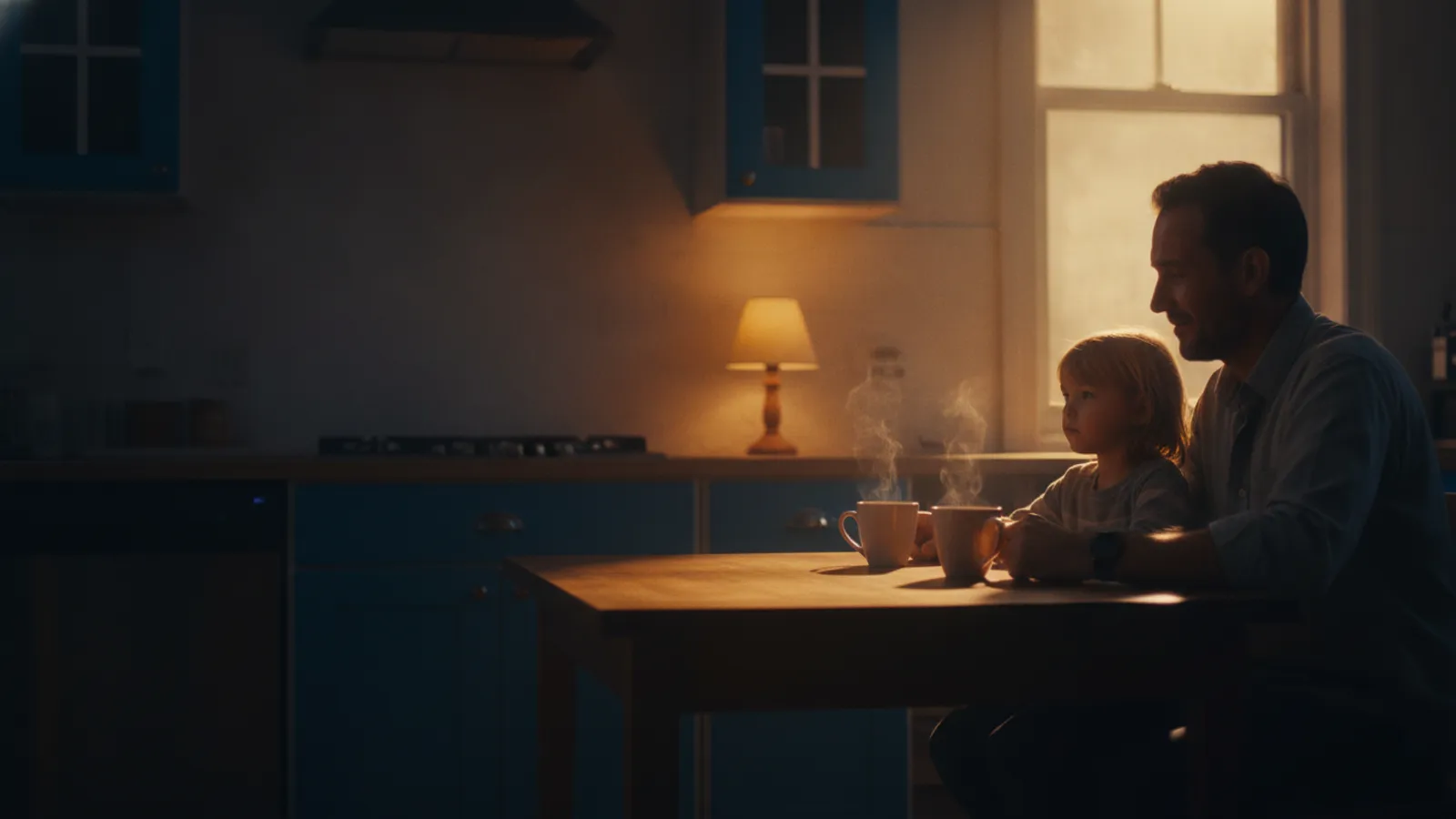
If your child asks how you're doing, don't say "fine" on autopilot. Tell the truth at child size — with the four safety phrases — and you'll have shown them the way to open up. With its dose: sharing isn't dumping.
the tip in one minute — the full article is this page
Video transcript
“How are you, Dad?” “Fine.” Automatic. Years later we wonder why the teenager answers “fine.” If you want your child to open up, show them how: retire the automatic “fine.” If you come home tired, say so. But saying “I feel bad,” flat, is frightening. Emotion needs its seatbelt: four phrases, and all four matter. “It’s not about you.” The first thing a child does with your emotion is wonder whether they caused it. Defuse that. “It’s normal.” Getting tired and frustrated is standard equipment for being alive, not a breakdown. “I’m handling it.” They don’t need you to be fine; they need to know someone is at the wheel. “I already feel a bit better for telling you.” The whole lesson in one line: sharing relieves. But careful: sharing isn’t unloading. Emotions yes, burdens no; the full venting is for the adults in your life. And one day, at the kitchen table: “Dad, can I tell you something?”
There’s a question children ask that almost no adult answers truthfully:
—How are you, Dad?
—Fine, sweetheart.
Automatic. You didn’t even think about it. You could be coming off the worst day of the quarter, with tiredness in your bones and your head stuck on three problems — “fine.” And later, years on, we wonder why the teenager in the house answers “fine” when we ask how he’s feeling.
He learned from the best.
The mirror works both ways
In the previous piece we talked about how you open the channel of facts: stop asking about his day and tell him about yours. This is the second door, the deeper one: the channel of feelings. And the mechanics are exactly the same, because children don’t learn from what we tell them to do — they learn from what they see us do.
If you want your child to tell you how he feels, tell him how you feel.
There’s an entire field that studies this, and it’s worth saying precisely what it shows and what it doesn’t. The review by Eisenberg, Cumberland, and Spinrad — the foundational text of emotion socialization — organizes the matter into three pathways: how parents react to their child’s emotions, how they talk about emotions, and how they express their own. That third pathway is exactly what this article proposes. But the authors themselves write, with a frankness we appreciate: “the relevant literature is inconclusive and most of the research is correlational.” There’s initial support that parents’ practices affect their child’s emotional and social competence, and that the process runs in both directions. There’s no proof that saying “I’m tired today” produces a child who opens up.
So what follows isn’t a validated protocol. It’s a reasoned practice, in the direction the evidence suggests, with the brakes the evidence does document.
The next time he asks how you’re doing — or even if he doesn’t ask — don’t say “fine” on autopilot. If you’re tired, say so: “I’m tired today.” If you’re stressed, say that too: “I had a day with a lot going on and I’m a little tense.” Naturally, without drama, in the same tone you’d use to say it’s raining.
The four phrases that make it safe
Here’s the heart of the matter, because saying “I’m stressed” bare can scare a child. An adult’s emotional confession needs to come with its seatbelt on. There are four pieces, and all four matter:
“It’s not because of you.” The first thing a child does with a parent’s emotion is wonder if he caused it. Defuse it explicitly: “it has nothing to do with you — it’s a work thing.”
“It’s normal.” Getting tired, frustrated, worried: you’re showing him that uncomfortable emotions are part of the standard equipment of being alive, not a breakdown. “It happens to everyone; today it was my turn.”
“I’m taking care of it.” The difference between sharing and worrying is showing the wheel: “I already know what I’m going to do — tonight I sleep early and tomorrow I’ll sort it out.” The child doesn’t need you to be fine; he needs to know someone is steering.
“And I already feel a little better for telling you.” The luminous close, and maybe the most pedagogical of the four phrases: sharing relieves. You’ve just shown him, live, what opening up is for. That’s the path you wanted to show him — and he’s just seen you walk it.
Two warnings about these four phrases, because this house prefers to be trustworthy rather than forceful. The first: the formula doesn’t come from any study. It’s a practical synthesis, cooked up at home. There’s no research that has tested it as a package.
The second: two of the four pieces have a relative in the literature, and it’s worth knowing which.
Of the first — “it’s not because of you” — what’s documented is children’s self-blame in a different and harsher context: parental separation. A review by the Department of Justice Canada summarizes the study by Healy, Stewart, and Copeland this way: children in families with more hostility between the parents after divorce tended to blame themselves more, and that self-blame was associated with a lower sense of competence, more psychological symptoms, and more behavior problems. That a child might also wonder if he caused his father’s bad mood on an ordinary Tuesday is a prudent extension of that — it’s not a finding, it’s a piece of reasoning. And we don’t cite any figure for how many children blame themselves, because none of the ones circulating could be read in a source we managed to open.
Of the third — “I’m taking care of it” — the relative is closer. In research on conflict between parents, the distinction that matters isn’t whether there was conflict but what kind: destructive conflict (aggression, hostility, stonewalling) is linked to worse outcomes, and constructive conflict — cooperation, problem-solving, support, and working toward closure — to better ones. The summary of that field fits in one sentence: it’s not whether parents argue, it’s how. Again with honesty: that’s literature about arguments between parents, not about a parent telling his child he had a hard day. That the “someone’s steering” signal works the same way in both cases is our analogy. But it’s a good analogy, and it’s the reason this piece is number three and not number one.
Of the second and the fourth we found nothing. They remain what they are: judgment calls.
The dose: sharing is not dumping
And now the warning, with the same weight as the method — more, actually, because this is the best-supported part of the whole article: over-sharing stresses. Your child can know you’re tired; it’s not his to know that you’re not making ends meet, that your relationship with your boss is falling apart, or the details of an adult conflict. Those burdens are neither his to solve nor his to carry — handing them to him isn’t openness, it’s shifting onto him a weight that puts him in a role that isn’t his.
Here there really is evidence, and it deserves to be stated with its exact measures. Lehman and Koerner studied 62 adolescents and their recently divorced mothers: almost all the mothers had talked to them about their financial worries, but they varied in how much detail they gave — and financial hardship was related to the daughters’ distress also through that path, that of having been told. And the meta-analysis by Hooper and colleagues, across twelve studies and almost 2,500 people, finds an association between having carried adult roles in childhood and symptoms in adulthood: real, consistent, and small (r = .14), measured retrospectively, by recall besides. In other words: the warning is justified; the alarmism isn’t. You’re not gambling with your child’s mental health over one bad Tuesday. You’re choosing what kind of weight you let him carry every day.
The practical measure: emotions at child size, causes as a headline, never in detail. “I’m stressed about work stuff, I’m already handling it” — complete. The particulars go to the adults in your life. You share to model the path of openness — not to have a nine-year-old confidant.
And a second measure almost no one mentions: frequency. If every day you show up with a hard emotion to tell, the exercise reverses and the child starts monitoring you. Good days count too — “today I’m happy, something I’d been trying for weeks finally worked out” — and they should be the majority. You’re modeling the full range, not the complaints channel. This last point is this house’s judgment call: we looked for support and didn’t find it, and we’d rather tell you than invent it.
What you’ve just taught him
When this practice becomes the normal climate of the house, the child learns a whole package that no lecture teaches:
That emotions have names — tired, frustrated, nervous, excited — and not all with the same word. Naming precisely is, we believe, the first step toward managing them; whether that first step has been measured is another matter, and we found no one who had measured it.
That feeling bad is neither an emergency nor a shame: the adults he admires most also get tired and frustrated.
That emotions get managed: they come with an “I’m taking care of it,” not a shipwreck.
And that sharing them relieves — the lesson that one day, at fifteen, at the kitchen table, is going to come back to you as a “Dad, can I tell you something?”
That day you’ll know that the channel you opened with “I’m tired today” was exactly this one.
This house’s limits, stated clearly: this is peer experience and reasoned practice, not psychological advice. The four-phrase formula is ours, not the literature’s. And there’s a line no article can draw for you: if what you’re carrying isn’t tiredness but sustained anguish, depression, or a crisis that won’t let up, your child isn’t the recipient for it — and neither is an article. That calls for professional hands, for you first. Taking care of yourself is also part of raising a child. Here we walk alongside you; we don’t diagnose you.
Comments from the house
Note from Carlos — the author
If your child asks how you’re doing, don’t answer “fine” on autopilot. If you’re tired, say so; if you’re stressed, the same. Just make sure he understands clearly that it’s not his fault, that it’s normal, that you’re taking care of it — and that you already feel better for sharing it. That shows him the way.
Tomás Andrade — the one who learned the language the hard way
I came from a school where men reported breakdowns in machines, never in themselves. Learning to say “today I’m frustrated” in front of my daughter was harder than any avionics certification — and more useful. Now she checks my engine: “Dad, are you tired or sad?” Nine years old. A better translator than me.
Nonna Lucia — the generation of silence
In my day parents weren’t tired or worried: they were “fine” until one day they got sick from being so fine. My mother called it dignity; today I know it was loneliness. A father telling his children “I’m tired, give me ten minutes and I’m all yours” — that’s not weakness. That’s a table where people can actually live.
Marina Haddad — the voice of evidence
Two notes from my chair. First: the field that studies this exists — emotion socialization, how parents model handling emotions — and this draft does well to leave the claims under review until the research is run. Second, and more important: the dosage section isn’t decoration — the line between modeling emotions and turning the child into a confidant for adult burdens is exactly where this practice turns harmful, and I’m glad to see it flagged in red. There the literature really does exist, and it’s worth reading before publishing.
Only sources we were able to download and read appear here. What we couldn’t verify isn’t cited — and in this article that includes important pieces: the four-phrase formula doesn’t come from any study, and the frequency rule (“good days should be the majority”) is our own judgment call. The full report, with everything that was searched for and not found, is at resources/research/cuentale-como-te-sientes.md.
Eisenberg, N., Cumberland, A., & Spinrad, T. L. (1998). “Parental socialization of emotion”. Psychological Inquiry, 9(4), 241–273. DOI 10.1207/s15327965pli0904_1 · PubMedArgues: that the emotion socialization framework exists and that one of its three pathways is the adult’s own emotional expression. It’s a review and theoretical model, not an experiment; the authors state outright that the literature “is inconclusive” and “mostly correlational.”
Hurrell, K. E., Houwing, F. L., & Hudson, J. L. (2017). “Parental meta-emotion philosophy and emotion coaching in families of children and adolescents with an anxiety disorder”. Journal of Abnormal Child Psychology, 45(3), 569–582. DOI 10.1007/s10802-016-0180-6 · full textArgues: describes Gottman’s meta-emotion framework — parents who “see their child’s negative emotions as opportunities for closeness and teaching,” validate and label them, versus those who dismiss them. It’s a secondary source: we couldn’t access Gottman, Katz, and Hooven’s (1996) original work, and so we don’t cite it as if we’d read it.
Warmuth, K. A., Cummings, E. M., & Davies, P. T. (2020). “Constructive and destructive interparental conflict, problematic parenting practices, and children’s symptoms of psychopathology”. Journal of Family Psychology, 34(3), 301–311. DOI 10.1037/fam0000599 · full textArgues: the distinction between constructive conflict (with cooperation, support, and work toward resolution) and destructive conflict, and the field’s synthesis: it’s not whether parents argue, it’s how. In their own data the effect on the child’s symptoms wasn’t direct — it ran through parenting practices. It’s about conflict between parents, not about a parent telling his own day: the analogy with “I’m taking care of it” is ours.
Healy, J. M., Stewart, A. J., & Copeland, A. P. (1993). “The role of self-blame in children’s adjustment to parental separation”. Personality and Social Psychology Bulletin, 19(3), 279–289. — cited via Department of Justice Canada (2001), The Early Identification and Streaming of Cases of High Conflict Separation and Divorce: A Review (2001-FCY-7E), textArgues: that children in families with more hostility between the parents after divorce tended to blame themselves more, and that self-blame was associated with a lower sense of competence, more symptoms, and more behavior problems. We couldn’t access the original study, only the official review that summarizes it — and we say so because citing without having read is exactly what this house doesn’t do.
Hooper, L. M., DeCoster, J., White, N., & Voltz, M. L. (2011). “Characterizing the magnitude of the relation between self-reported childhood parentification and adult psychopathology: A meta-analysis”. Journal of Clinical Psychology, 67(10), 1028–1043. DOI 10.1002/jclp.20807 · PubMedArgues: a small but reliable association (r = .14; 12 studies, N = 2,472) between having carried adult roles in childhood and adult symptomatology. Retrospective, self-report measurement.
Lehman, S. J., & Koerner, S. S. (2002). “Family financial hardship and adolescent girls’ adjustment: The role of maternal disclosure of financial concerns”. Merrill-Palmer Quarterly, 48(1). TextArgues: that family financial hardship relates to adolescent daughters’ distress also through the path of the mother disclosing her money worries to them, and that mothers varied in how much detail they gave. 62 daughters and their recently divorced mothers; correlational; mothers and daughters only.
Help us make it better
Did something ring false, feel missing, or feel like too much? Tell us — good comments make articles better.