Don't let the toy stores or the influencers decide: lay out options, watch which one your daughter or son responds to — and water there. Why fandom is a cognitive gym, and why the dusty piano is fine too.
the tip in one minute — the full article is this page
Video transcript
Who decides what your daughter or your son is passionate about? If you don’t water it by their side, the toy stores and the influencers decide. Passion isn’t a whim: it’s the brain wired to intention, purpose, and emotion. First move: expose, don’t impose. Set out a varied menu — the library, a sport, an instrument, your cousin’s fandom. Small samples: a borrowed book before a whole collection. The menu is yours; the choice, never. Second: watch the response. What does she return to on her own, without anyone reminding her? What does he talk about in the car? What does he doodle in the margins? That — not what you dreamed — is the signal. Third: water where it sprouted. When something catches, take your support there: the books on it, the class on it, your genuine interest in it — even if you were hoping for the microscope. And fourth: accept the dust. What didn’t catch is left in peace — no drama and no invoices. The instrument gathering dust isn’t a failure: it’s information. And the “useless” fandom? It’s a gym in disguise: whoever masters the full genealogy of the Greek gods is memorizing, associating, and structuring ideas — exactly the muscles that later lift mathematics. Passion isn’t billed. It’s watered.
There’s a muscle almost no educational plan mentions and that decides more than almost all of them: the muscle of getting passionate. The capacity for something to matter to you so much that the whole brain lines up behind it — memory, attention, purpose, emotion, all pulling in the same direction. That muscle, like any other, develops with exercise.
And here’s the uncomfortable question: in your daughter’s or your son’s life, who decides what it gets exercised on? Because someone decides. If it isn’t you with a menu of options, it will be the megacorporations, the influencers, the toy store, the seasonal ad campaign. The algorithm has a plan for your child’s attention. The question is whether you have a better one.
And this isn’t parental paranoia. The American Psychological Association’s task force on advertising and children reviewed the evidence and concluded two uncomfortable things: that children under seven or eight don’t recognize the persuasive intent of an ad, and that preference for a product can appear after a single exposure and gets reinforced with repetition — preferences that later turn into requests that do move parents’ purchases. In other words: on the other side of the menu there’s a professional. The least you can do is have someone watching on yours.
The practice: expose, observe, water
The proposal is simple to state and takes a lifetime to execute:
Lay out options. Deliberately varied, in small samples: the library, a sport, an instrument, the comic book, the science kit, the museum, the cousin’s fandom. You set the menu; the choice isn’t yours.
Watch which one they respond to. The measuring instrument is your attention: what do they come back to on their own? What do they talk about in the car without anyone asking? That’s the signal — not what you dreamed for them, nor what the screen advertises.
Water where it sprouted. When something catches, the support goes there: the classes for that, the books about that, the conversations about that, your genuine interest in that.
Allow — and enable — them to get passionate: about soccer, about baseball, about the Marvel cinematic universe. Because that’s what passion is: the brain wired up with intention, purpose and emotion. There is no cognitive state more expensive to manufacture or cheaper to waste.
This is a home practice, not a laboratory protocol — but it has serious relatives. The two researchers who formulated the phase model of interest development describe it like this: first someone or something triggers it from outside, then it takes support to return again and again to the same content, and only at the end does the interest sustain itself. In their words, “the triggering of interest may be fortuitous or supported by others,” and in the early phases the learner “may need the support of others to become engaged.” Translated to home life: at the start of every passion there’s an adult who put something on the table and stayed close. And there’s a second finding, from another line of research: among young adults, those who believed interests are cultivated sustained a new interest better once it got hard than those who believed interests are discovered, already formed, waiting. The idea that passion is found seems to be, itself, part of the problem.
Fandom is a gym in disguise
Think about it for a moment. Any eight-year-old can name and describe dozens of spells from the Harry Potter books. Any Percy Jackson fan can list the entire Greek pantheon — with each god’s entanglements and the adventures and misfortunes of their offspring. That may not look like a path to top marks in math or science.
It may be one. And it may be more effective than any technique we try to get their brains working: memorizing, associating concepts, structuring ideas, flows, consequences — building knowledge. That last part is my own conviction, not a measured finding, and I’d rather say so before someone charges me for it. What is documented is the phenomenon: a large MacArthur Foundation ethnography — more than six hundred interviews and more than five thousand hours observing kids with digital media, with a study dedicated to the Harry Potter fandom — describes what its authors call geeking out, and defines it by “high levels of specialized knowledge” within communities that recognize and rank that expertise. They also clarify something that works in parents’ favor: you can geek out over anything, including sports and music, not only over what the culture marks as nerdy. Listen to two kids of any age argue for hours over the minutest details of Iron Man or Death Note, of Messi, Mbappé, Yamal or Haaland, of Bobby Witt Jr. or Elly De la Cruz, or of their K-Pop stars. What sounds like recess is high-performance training: taxonomies, chronologies, comparative statistics, evidence-based argument. The muscle doesn’t know whether it’s training on Greek gods or the periodic table — but it only shows up to practice when there’s passion in the room.
The practical consequence for a parent is liberating: you don’t need them to love what you chose. You need them to love something — and to be nearby when they find it.
Grandma’s objection (and the thirteen-year answer)
Here I have to speak in the first person, because I’ve lived this practice — and it comes with its classic objection at home.
My son’s grandmother used to tell me: “you’re going to spoil him with so many toys and books.” I disagreed: it wasn’t abundance for abundance’s sake — they were options, alternative sources of stimulation to explore. I suppose Montessori would have agreed with me; the grandmother, never entirely. And in fairness, Montessori would only give me half the point: she wrote that the children’s house is “the environment offered to the child so that he may have the opportunity to develop his activities,” and gave the adult a motto I sign onto completely — “wait while observing” — but her prepared environment was deliberately spare, not a catalog. On the material point, the grandmother kept hers.
Thirteen years later, what I see at home — and I tell it as testimony, not as formula — is this: my son tells me “dad, we don’t need more games, we don’t need more books — I still have a couple in the queue.” He has never asked me for a toy he saw in an ad. He doesn’t live with a sense of lack, but with a clear notion — conscious and unconscious — of what he likes, what satisfies him and what gives him joy.
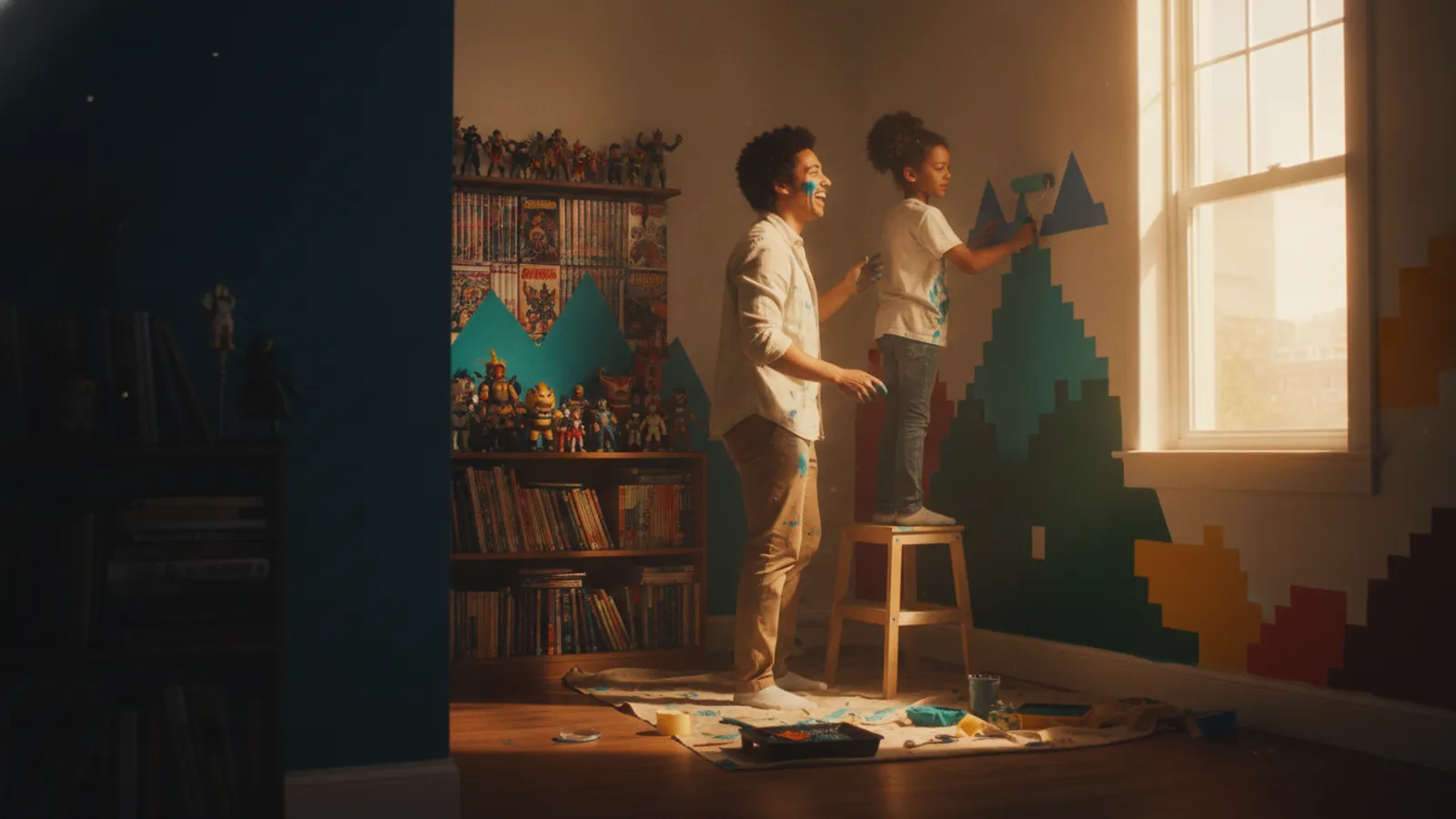
The path was this practice’s cycle, turn after turn. When he discovered Minecraft, we painted his room like a Minecraft world. When the passion was Ducktales, all the comics and the vintage Picsou collections appeared — my sister Nani helped with that from Switzerland. When he went all-in on Harry Potter, there were the books and the props. When Percy Jackson arrived, the whole house went Greek and mythological — and then Egyptian, and Norse, as Rick Riordan expanded his literary empire. When he discovered Portal, there were the board game, the t-shirts and the stickers. And with Gravity Falls we reached the summit of the trade: we dressed up as Dipper and Grunkle Stan. We exercised the passion muscle. Today it’s Hollow Knight, Silksong, Deltarune and Undertale. Tomorrow it will be cardiac surgery or nuclear fusion. The muscle is the same.
And the counterweight, which is half the lesson: my son has perfect musical ear — he replicates a melody after hearing it once — and the electric piano, which wasn’t cheap, gathers dust in his room. And I am at peace with that. Because the practice isn’t “everything I buy must pay off”: it’s expose, observe, water — and accept the dust on what didn’t catch. The piano isn’t a failure. It’s information. Passion doesn’t get invoiced.
The three traps
So the advice doesn’t get warped along the way:
The catalog trap. Giving options is not buying everything. The public library, the loan, the trial class explore just as well as the expensive collection — and teach better. The menu is built from samples, not from receipts.
The project trap. Observing your child’s response is not measuring him, nor turning his passion into a résumé, nor into an investment with expected returns. The fandom is his. You are the props supplier and the informed audience — not the portfolio manager. And this trap carries a measured cost: following teenagers for a semester through their first music class, passion researchers found that autonomy support from the adults close to them led to a harmonious passion — the kind that coexists with the rest of life — while high parental valuation without that autonomy support predicted an obsessive passion, the kind that pushes and grips. Loving your child’s passion a lot without letting it stay theirs isn’t neutral. It’s the ingredient that sours it.
The badly-carried-dust trap. If the abandoned instrument becomes a recurring reproach, the whole practice is poisoned: the child learns that exploring carries a fine — and stops exploring. What gathers dust gets left in peace.
Start this week
One new sample on the menu: a book on a subject he’s never touched, a different outing, the comic someone lent you.
Observe for three days: what did he come back to on his own?
Water one single thing: one more book of that, one conversation about that, your real interest in that.
And make peace with one pending patch of dust: that instrument, that kit, that class that didn’t catch — it gets archived without a speech.
Anchor line: The muscle doesn’t know whether it trains on Greek gods or the periodic table — but it only shows up when there’s passion in the room. Your job isn’t to choose the passion: it’s to set the menu, truly watch, and water where it sprouted.
Comments from the house
Note from Carlos — the author
Of all the practices in this house, this is the one longest in execution and the one I defend with the fewest doubts. I’ll only add the operating secret: the cycle works because the parent’s interest is real. I read the Picsou comics too.
Sancho — the Squire
The official props supplier of every campaign — that’s me and that’s this article! When the knight changes quests, the squire doesn’t bill him for the old armor: he fetches the new one. From the castle to Olympus, from Olympus to the portal, from the portal to the mystery shack — the luggage changes, the companion doesn’t. And I note the text’s finest point: watering where it sprouted is not the same as sowing by force. Even a squire knows the donkey won’t gallop no matter how many spurs you put on it.
Marina Haddad — the voice of evidence
Good news from my chair: here there is a real field behind it. Interest development is studied seriously — there are models of how a situational interest becomes a sustained one, and a whole area on what fans learn in their communities. This article’s research prompt will say what can be cited and what stays as reasoning. My one nuance: the “may be more effective than any other technique” part is the author’s voice, not a measured result — and I like that the text presents it as lived conviction, not as data. That’s how it’s done.
Nonna Lucia — the grandmother’s gaze
Let me defend the grandmother in the text for a second, because I have said that phrase — “you’re going to spoil him” — and I know where it comes from: from generations where the toys were three and the books, a luxury. It isn’t stinginess: it’s a different arithmetic. But I’ve seen the difference between the child full of things and the child full of options, and it isn’t the quantity — it’s whether there’s an adult truly watching what he responds to. With that, even this old woman is convinced. Without it, the grandmother was right.
Polo — the caretaker closes
The relatives of this muscle in the library (and below, for the first time, the list of where everything stated here came from — the caretaker keeps archives too): Collecting seriously for when the passion calls for an archive, Today you teach me so the fandom flows in your direction, The library on Fridays as a zero-cost buffet, and Be their sparring partner for when the passion calls for a court. The card to take with you: Exercise the passion muscle. And a caretaker’s secret: new passions almost always come in through the service entrance — nobody announces them.
Sources and references
Each source on this list was checked directly against the original text before being cited. Those that support reasoning rather than measurement are labeled as such, here and above. The full audit, claim by claim, is in resources/research/el-musculo-de-la-pasion.md.
Hidi, S. E., and Renninger, K. A. (2021).By Developing Interest Educators Can Motivate Learning. IDEA Paper #86, The IDEA Center. → ideacontent.blob.core.windows.net
Argues that interest develops in phases, that it can develop in anyone and in any subject, that “the triggering of interest may be fortuitous or supported by others,” and that in the early phases the learner needs outside support while in the later ones interest becomes self-generating. It is a synthesis article by the model’s own authors, written for higher-education instructors.
Hidi, S., and Renninger, K. A. (2006).The Four-Phase Model of Interest Development. Educational Psychologist, 41(2), 111–127. → ERIC record EJ736298
The foundational article proposing the four phases: triggered situational interest, maintained situational interest, emerging individual interest, and well-developed individual interest. Only the abstract of the original was consulted; the full text is behind a paywall.
O’Keefe, P. A., Dweck, C. S., and Walton, G. M. (2018).Implicit theories of interest: Finding your passion or developing it? Psychological Science, 29(10), 1653–1664. → PMC6180666
Supports the nuance that “interests are cultivated, not discovered”: across five studies with university and community-college students (N between 44 and 141), those who held a fixed theory of interest showed less openness to new topics and a bigger drop in interest when difficulty appeared. Samples of young adults, not children; measures beliefs, not parenting practices.
Vallerand, R. J. (2008).On the Psychology of Passion: In Search of What Makes People’s Lives Most Worth Living. Canadian Psychology, 49(1), 1–13. → selfdeterminationtheory.org
Supports the distinction between harmonious and obsessive passion, the three drivers of developing a passion (activity selection, valuation, and internalization), and the finding cited in “the project trap”: autonomy support from close adults → harmonious passion; high parental valuation without autonomy support → obsessive passion. It is the author’s own synthesis of his research program; the music study summarized there was at the time still unpublished.
Ito, M., Baumer, S., Bittanti, M., boyd, d., Cody, R., Herr-Stephenson, B., Horst, H. A., Lange, P. G., Mahendran, D., Martínez, K. Z., Pascoe, C. J., Perkel, D., Robinson, L., Sims, C., and Tripp, L. (2010).Hanging Out, Messing Around, and Geeking Out: Kids Living and Learning with New Media. The MIT Press. → full PDF
Supports what is claimed about fandom: 659 semi-structured interviews and more than 5,194 hours of observation (2006–2007), with studies dedicated to the Harry Potter fandom and to anime; defines geeking out by its “high levels of specialized knowledge” within communities that recognize that expertise, and clarifies that you can geek out over sports or music just as much as over the markedly nerdy. It is qualitative ethnography: it documents what kids know and do, it does not measure transfer to school outcomes.
Gee, J. P. (2004).Situated Language and Learning: A Critique of Traditional Schooling, chap. 6, “Affinity Spaces.” Routledge. → chapter PDF
Supports the framework of “affinity spaces”: communities organized around a shared interest rather than around age or class, where novices and experts coexist in the same space. It is a conceptual framework with an illustrative case — a fan community around a mythology-based game — not an empirical study.
Jenkins, H., with Clinton, K., Purushotma, R., Robison, A. J., and Weigel, M. (2006).Confronting the Challenges of Participatory Culture: Media Education for the 21st Century. The MacArthur Foundation. → PDF
Supports the description of participatory culture and its “informal mentorship, through which what the more experienced know gets passed on to newcomers.” It is a position paper: it speaks of “potential” benefits and of what the literature “suggests,” not of demonstrated effects.
Montessori, M. (1914).Dr. Montessori’s Own Handbook. Frederick A. Stokes Company. → Project Gutenberg #29635
Supports the two phrases attributed to her above: that the children’s house “is the environment which is offered to the child that he may be given the opportunity of developing his activities,” and the educator’s motto, “wait while observing.” It does not support material abundance: her prepared environment is limited and orderly.
Wilcox, B. L., Cantor, J., Dowrick, P., Kunkel, D., Linn, S., and Palmer, E. (2004).Report of the APA Task Force on Advertising and Children. American Psychological Association. → PDF
Supports what is claimed about advertising: that children under seven or eight don’t recognize the persuasive intent of ads, and that preference for a product can appear after a single exposure, gets reinforced with repetition, and translates into requests that influence parents’ purchases. It is from 2004 and its empirical base is television; it doesn’t cover algorithmic platforms or influencers — “the algorithm” in this article is the author’s own figure of speech, not this source’s data.
Help us make it better
Did something ring false, feel missing, or feel like too much? Tell us — good comments make articles better.