Talking to Your Child About Divorce (or Anything Else!)
By Carlos Miranda Levy · July 15, 2026
Children don't have a 'limited' understanding of the world — they have a limitless one. Why the hard conversation happens face on, horizontal and honest: whatever you don't address, your child will explain on their own, in ways you can't imagine. Published in 2019; more relevant than ever.
the tip in one minute — the full article is this page
Video transcript
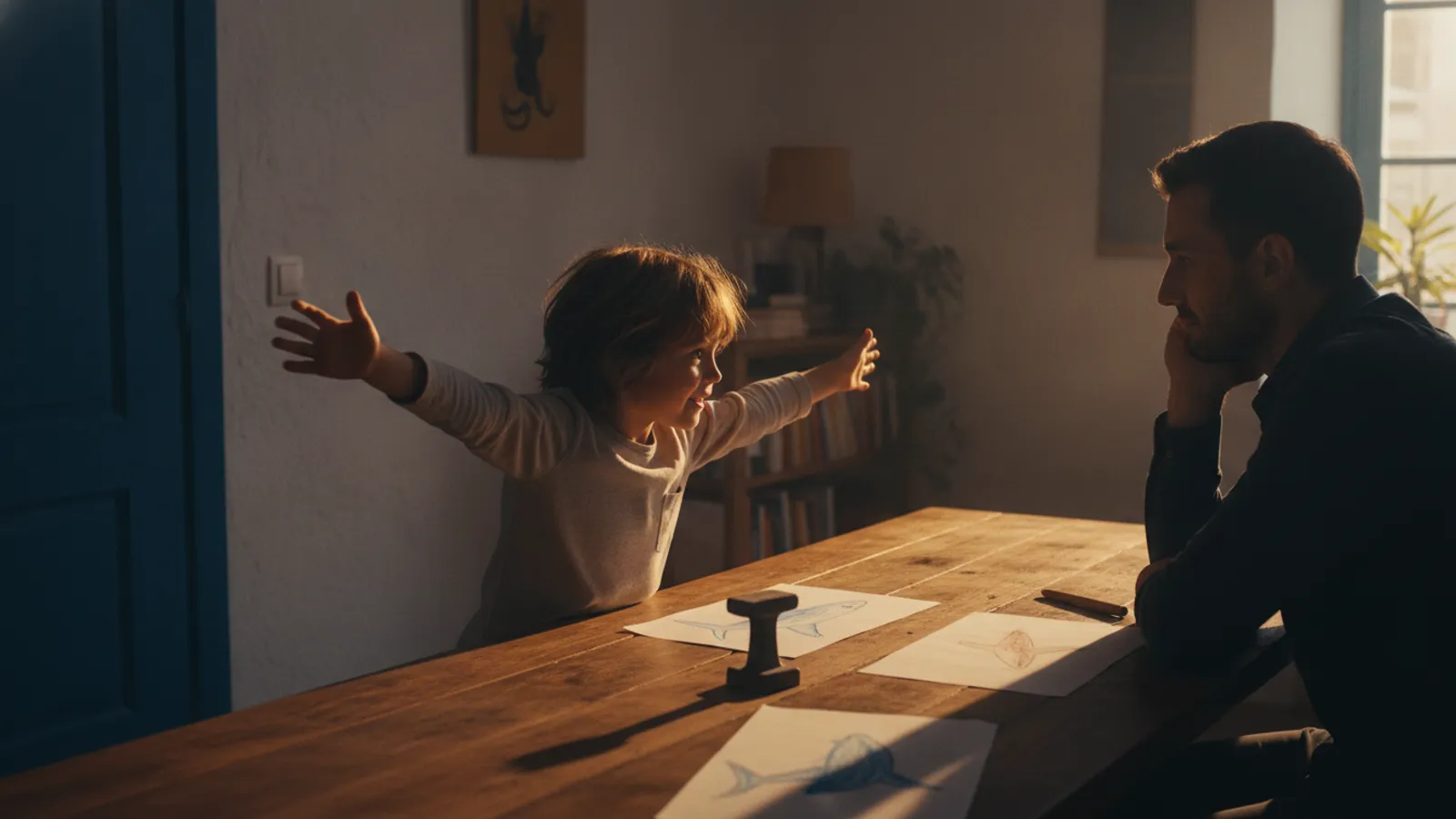
They say children have a limited understanding of the world. It’s exactly the reverse: their understanding is limitless. A six-year-old once explained to his father how to escape a hammerhead shark: you place an anvil nearby, and the shark gets distracted hammering at it while you escape. That isn’t limited understanding. It’s understanding without limits, looking for answers. That’s why the hard conversation — divorce, or anything — is had face to face and horizontally: peer to peer, as someone relevant and growing. Because they are. Don’t tell them nothing changes — it isn’t true, and they know it. Tell them that among all the changes, what matters remains: mom’s and dad’s love, and a different kind of together. And the sentence they need to hear: “we’re separating because of our conduct and our feelings — not because of yours.” Before explaining anything: listen. The expression of their emotions comes first — and then, helping them put it into words. Because whatever you don’t address, the child will address, interpret and explain on their own — in ways you can’t even imagine.
This article was originally written and published by the author on March 9, 2019 — seven years and an entire childhood ago. We’re bringing it back because it’s as relevant now as it was then, improved and updated: it is, we discovered on rereading it, the direct ancestor of half this house.
It appalled me then — and it appalls me now — how some people consider that children have a “limited understanding of the world,” without seeing that it’s exactly the opposite: their understanding is limitless, not bounded by common sense or by all the restrictions that come with “conventional” knowledge. All of this began as a long response I wrote to a father asking for advice about his child’s feelings during a divorce.
The typical advice he was getting was the usual: happy continuity (“school and your friends stay the same”), the “we adults know what we’re doing,” and the “this will be good for you.” That approach makes parents feel better — it reassures them that they’re protecting their child. But addressing your child that way is condescending, and believing it works is fooling yourself.
The Limitless Understanding
Children are far more perceptive than we give them credit for. Thinking they have a “limited” understanding is a flawed, myopic, and even dangerous perspective.
They have an enormously broad understanding of the world, and in particular of their immediate surroundings. It might not be the “correct” one — but they have an explanation for everything. And for what they don’t have an explanation, they create one: sometimes accurate, sometimes wild.
For years I’d been telling, from memory, how Piaget recorded a little girl explaining to him that the wind is made by the trees when they shake. We went looking for the passage in the original text — La causalité physique chez l’enfant, from 1927, chapter two, “The Origin of Wind and Breathing” — and it turns out my memory had improved the scene on its own, which is exactly what this article says we all do. What Piaget actually transcribed is this:
GRAT (age 8): “Where does the wind come from? — From the trees. — How did the wind start? — Because the branches move. — Is it the branches that make the wind? — Yes. — But how do the branches move? — Because there’s wind.”
It wasn’t a girl, and she wasn’t running, and she wasn’t waving her arms: it was an eight-year-old boy sitting in front of a researcher, holding, without blinking, a perfect circle. And the real version is better than mine, because in it you can see the whole machinery at work: the child has an explanation, the explanation bites its own tail, and he doesn’t see the problem — not because he understands little, but because his system for explaining the world doesn’t yet need causes to run in a single direction.
Piaget, who questioned dozens of children about this, found that the belief had its own age: around five, the wind is made by someone — a man, God, with a puff of breath or a machine; and around eight, the wind is produced by the very things the wind actually moves: the trees, the clouds, the waves, the dust. And he also found something that moves me: a year later, that same child begins to see through the trick on his own. “Do you still believe that?” they ask him. “Not so much.”
And in my own house, when I wrote this, my six-year-old had just explained to me that the best way to save yourself from a hammerhead shark attack is to place an anvil nearby: the shark will get distracted hammering away at it while you escape.
That is not a limited understanding. It’s an understanding without limits: creative, under construction, searching for answers — and delighting in inventing its own.
Parental guidance plays an enormous role in that process. So yes: talk to them, and reassure them that things will be okay and that the situation is the adults’ responsibility, not theirs. But talk to them horizontally — a peer-to-peer, honest conversation — so they feel addressed as someone relevant and growing. Because they are.
Continuity, Told Honestly
Your child is going to have to grow as part of this change. They’re going to deal with mixed feelings and divided experiences: the movies with dad, the beach with mom, life split between the two people they love most and who love them most.
Continuity, in large part, is over. Changes are coming. Prepare them for that — and reassure them that among all those changes, what matters most stays: mom and dad’s love, the family bond, and everyone’s complicity in navigating life and flourishing in it.
Things are going to change, and no matter how hard we try to protect her, the girl is going to live through hard moments: mom sad, dad upset at times, or vice versa. Explain to her that some changes will be difficult, but that we’ll pull through as a whole, together as a family — in a different kind of together. The family bond doesn’t break even though mom and dad are now in separate places. Love remains, grows, and will carry us through the changes.
And here’s the classic mistake: telling her that “school, the neighborhood, and your friends stay the same” is like telling a teenager going through their first heartbreak that, even though their first love is over, the school, the pizza place, the park, and the movie theater are all still there — and that they’ll meet other people. No: things won’t be the same, and it’s hard to see how they’ll be better. Because for a broken heart, all of that no longer means anything without the person they loved.
Same for a child. What good are school, friends, toys, two houses — if she can’t spend good time with mom and dad at the same time? If she has to tell her stories twice, and dream her trip to Mars or the bottom of the sea with mom or with dad, but not both?
Name it. Honesty about what’s lost is the only solid foundation for what gets built.
”Because of Our Behavior — Not Yours”
On the legitimate worry that the child might feel guilty or responsible for the separation because of their own behavior: it’s addressed the same honest, respectful way.
“We’re separating because of our behavior and the feelings between us, which changed — not because of yours. Our love for you remains and grows, and it doesn’t depend on your behavior — though we’ll keep working on that with you, as parents who love you.”
The worry isn’t a parent’s paranoia: it’s documented. A Department of Justice Canada review summarizes it this way, based on the study by Healy, Stewart, and Copeland on children’s self-blame after separation — children living in families with more hostility between the parents after separation tended more to blame themselves for the situation, and that self-blame was associated with a lower sense of competence, more psychological symptoms, and more behavioral problems. Two honesties are owed here about that finding. The first: we couldn’t access the original study, only the official review that summarizes it, and we’re saying so. The second, which is the one that really matters: what appears associated with self-blame isn’t the separation — it’s the hostility between the parents afterward. Which is to say that the best vaccine against your child blaming themselves isn’t just the sentence “it wasn’t because of you.” It’s how the two of you treat each other starting tomorrow.
And you won’t read any statistic here about how many children blame themselves. Several circulate; none of them could we find in a source we could actually open, so we don’t repeat them.
It’s understandable to feel guilty, lost, unsure how to respond. Our child’s life is about to change — or is already changing. She’s affected by a decision of ours without having done anything wrong or caused it. It can be an early lesson about the unfairness of life and about dealing with what we don’t control — and an opportunity to learn that, although there are things that aren’t our responsibility, it is our responsibility to make the best of every situation.
Listen First (Thank You, Anne)
There’s another step, a very important one, that my friend Anne gave me when she read the first draft of that piece: “écouter l’expression des émotions des enfants est la première chose à faire” — listening to children’s expression of emotions is the first thing to do.
So yes, please: listen to your daughters’ and sons’ emotions and encourage them to express them. Take the time to listen to and acknowledge their feelings, fears, frustrations — and even their suggestions, proposals, and ideas.
And along with listening comes our role in helping them verbalize: putting words to what they feel. It’s normal to feel disappointed, sad, guilty, insecure, scared, shaken — but these might be new feelings for the child, and they’ll have no idea how to handle them. We can work together to identify them and find simple words they can understand and associate, so they can share them and talk them over with us. We listen, we don’t judge — and then we talk about those feelings and accompany the child toward a shared, comfortable experience.
Please: don’t underestimate your child’s understanding or the impact of change, and don’t base your argument on continuity or on “we know better.” Don’t ignore their infinite capacity to understand and to create their own answers and explanations.
Address things — the real ones. Take the time. Because whatever you don’t address, the child will address, interpret, and explain on their own — in creative and unexpected ways you can’t even imagine.
Anchor line: A child’s understanding is not limited — it is limitless. Whatever you don’t explain to them, they will explain to themselves. Choose the conversation before silence writes it for you.
This house’s limits, stated plainly: this is peer experience — that of a father who’s been through it — not psychological or legal advice. A divorce brings situations where the best decision is to seek professional hands who know your case closely. Here we accompany you; we don’t diagnose you.
Comments from the House
Note from Carlos — the author
I wrote this when my son was six, in the heat of the moment, appalled at a thread of condescending advice. Seven years later I reread it and wouldn’t take a single comma off the thesis: the limitless understanding, the horizontal conversation, the “because of our behavior, not yours.” What I do see now is that this text was the seed of half this house’s catalog — and that the kid with the anvil and the hammerhead shark is still right: creativity doesn’t wait for the world to be explained to it.
Ulises — the one who knows the map
This article said in 2019 what took me years to learn: false continuity doesn’t comfort — it insults. You don’t tell a child that nothing changes; you tell them that what matters doesn’t break. And I especially sign the part almost nobody does: preparing them to see us sad or upset at times. The child who was warned isn’t frightened by the weather — he navigates it.
Marina Haddad — the voice of the evidence
Three notes, and the first is a correction to the author.
On Piaget: we went to the primary text in French — chapter two of La causalité physique chez l’enfant, 1927, downloaded and read in full — and the anecdote, the way Carlos remembered it, isn’t there. The belief is: Piaget documents with transcriptions that children explain that the wind is made by the trees moving, and he even gives it an average age, eight years and two months. But there’s no girl, no one running, no arms waving. That a text about how children invent explanations was itself improved by its own author’s memory over seven years is the kind of irony you can’t make up, and I’m glad the house chose to correct it in plain sight rather than erase it.
On the bigger thesis: in the draft I had written that “research has spent decades documenting” that children perceive more than we assume. That’s too broad to cite, and I’m withdrawing it. What’s verifiable is smaller and sharper: children construct an explanation for everything, and hold onto it even when it bites its own tail. The article’s practical conclusion doesn’t change — it changes for the better.
And the limits box isn’t decoration: a divorce brings situations that call for professionals, and saying so is part of respecting the reader.
Tomás Andrade — the translator
The verbalizing section is my biography in one paragraph: putting words to feelings is a craft, and someone has to teach it. I’ll only add the order of operations, which the text already carries and deserves underlining: first you listen, then you name, and only at the end do you talk. The manuals call it protocol. Anne said it more beautifully.
Only sources we were able to download and read appear here. This piece’s central theses — the limitless understanding, the horizontal conversation, the honest preparation versus false continuity — are the author’s lived position since 2019 and carry no citation: we looked for support for the comparison between honest preparation and minimizing, and didn’t find any. The full report, with everything that was searched, what was corrected, and what wasn’t found, is at resources/research/hablar-del-divorcio-o-de-lo-que-sea.md.
Piaget, J. (1927).La causalité physique chez l’enfant, chapter II: “L’origine du vent et la respiration.” Paris: Félix Alcan. PDF from the Fondation Jean PiagetHolds: the verbatim transcriptions of children explaining that the trees and their branches make the wind (GRAT, age 8; TAQ, age 7), the three stages of the wind’s origin with their average ages, and the child who a year later begins to see through the circle on his own. Corrects the version the author carried from memory: there’s no girl, no running, no waving arms.
Piaget, J. (1929).The Child’s Conception of the World (English translation of La représentation du monde chez l’enfant, 1926). Full text at the Internet ArchiveHolds: the same belief recorded in another volume (GIAMB, age 8½: “it’s when the trees sway that they make the air rise”), with Piaget’s own cross-reference to the wind chapter of the other book.
Healy, J. M., Stewart, A. J., & Copeland, A. P. (1993). “The role of self-blame in children’s adjustment to parental separation.” Personality and Social Psychology Bulletin, 19(3), 279–289 — cited through Department of Justice Canada (2001), The Early Identification and Streaming of Cases of High Conflict Separation and Divorce: A Review (2001-FCY-7E), textHolds: that children in families with more hostility between the parents after divorce tended more to blame themselves, and that self-blame was associated with a lower sense of competence, more symptoms, and more behavioral problems. We couldn’t access the original study, only the official review that summarizes it; we say so because citing without having read is what this house doesn’t do.
Warmuth, K. A., Cummings, E. M., & Davies, P. T. (2020). “Constructive and destructive interparental conflict, problematic parenting practices, and children’s symptoms of psychopathology.” Journal of Family Psychology, 34(3), 301–311. DOI 10.1037/fam0000599 · full textHolds: the distinction between constructive and destructive interparental conflict, and that what’s determinative isn’t whether parents argue but how. In their own data the effect on the child’s symptoms wasn’t direct: it ran entirely through parenting practices.
Eisenberg, N., Cumberland, A., & Spinrad, T. L. (1998). “Parental socialization of emotion.” Psychological Inquiry, 9(4), 241–273. DOI 10.1207/s15327965pli0904_1 · PubMed · and Hurrell, K. E., Houwing, F. L., & Hudson, J. L. (2017). “Parental meta-emotion philosophy and emotion coaching…” Journal of Abnormal Child Psychology, 45(3), 569–582. Full textHold: that the order Anne pointed out to the author in 2019 — listening and validating first, putting words to it after — coincides with an established framework (Gottman’s meta-emotion, described in Hurrell et al.; emotional socialization in Eisenberg et al.). With these authors’ own written caveat: the literature “is not conclusive” and is “mostly correlational.” It is not an intervention of demonstrated efficacy, and the article doesn’t present it as one.
Help us make it better
Did something ring false, feel missing, or feel like too much? Tell us — good comments make articles better.