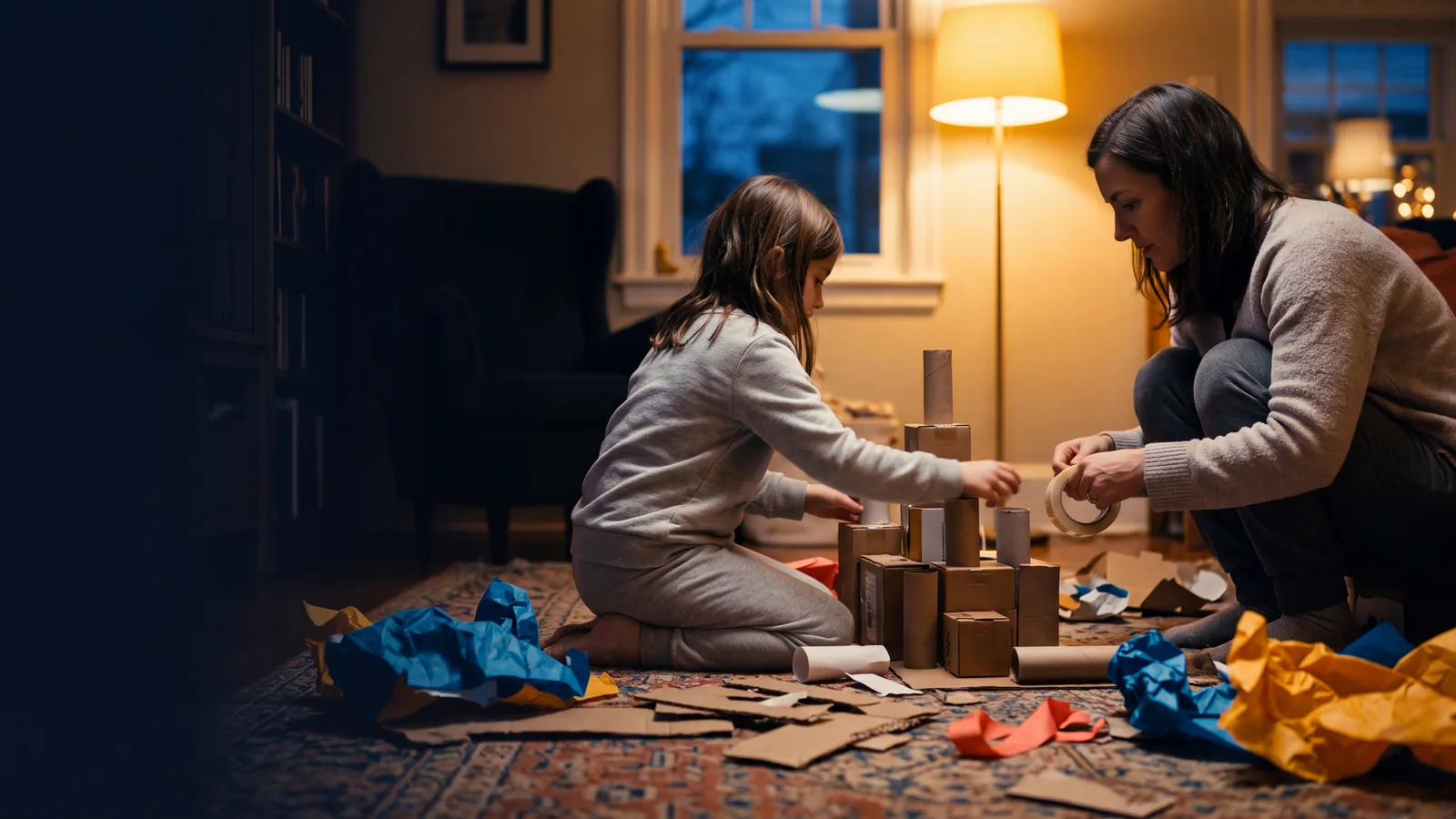
How it’s done
The plan starts before anything is opened, with a single rule: no wrapping gets thrown out tonight. Boxes, cardboard tubes, wrapping paper, ribbons, bows, cardboard trays and packing fill go to a corner of the house you call the depot. The next day, or that same afternoon once the excitement settles, open the unwrapped afternoon: for one hour nothing new gets played with, and you build only with what the new things came wrapped in. The prompt is open —make something that didn’t exist this morning— and, if starting is hard, there are three doors in: a city of boxes where the toys that just arrived can live; a suit of armor, a helmet or a whole costume; an impossible machine with tube levers, slots and drawn-on buttons. The toolbox is short: tape, round-tipped scissors, markers, school glue. Whatever needs strength or a blade (cutting windows in thick cardboard, using a utility knife) is done by an adult, and the child decides where the cut goes. At the end, a photo of the creation and a decision made together: what stays for a few days, what gets taken apart and what goes to recycling, sorted by the kids themselves as the last step of the game.
What it builds — the why
Imagination with material that comes without instructions, which is the kind that works hardest: a box doesn’t say what it is, so the child has to decide. It lowers the temperature of the year’s peak moment of consumption without a single sermon, because the center of the afternoon stops being what was bought and becomes what was made. And it leaves an idea that outlasts any toy: the value of something isn’t in its price, it’s in what you’re able to do with it.
How it changes with age
3–5 Early childhood
6–9 Childhood
10–12 Preteens
Variations
No gifts to open (families who exchange on another date, or who don’t exchange): ask for boxes at the corner store, which has plenty in December. Southern summer version: the box goes out to the yard or the shade of the balcony and becomes a boat, an ice-cream stand or a hideout. Cousins version: one team per big box and an exhibition at the end, with a guided tour from each builder.
What to watch for in your child
Safety first, without drama: plastic bags and sheeting away from the little ones, staples and hooks out before you hand over a box, and the utility knife always in adult hands. A big box is a house, not a ladder: nobody climbs on stacked boxes, and no child gets shut inside a box taped closed. And don’t turn it into a lesson against gifts: gifts are fine. If he wants to play with the new things, invite him to the cardboard city; the idea is to add an afternoon, not take anything away.