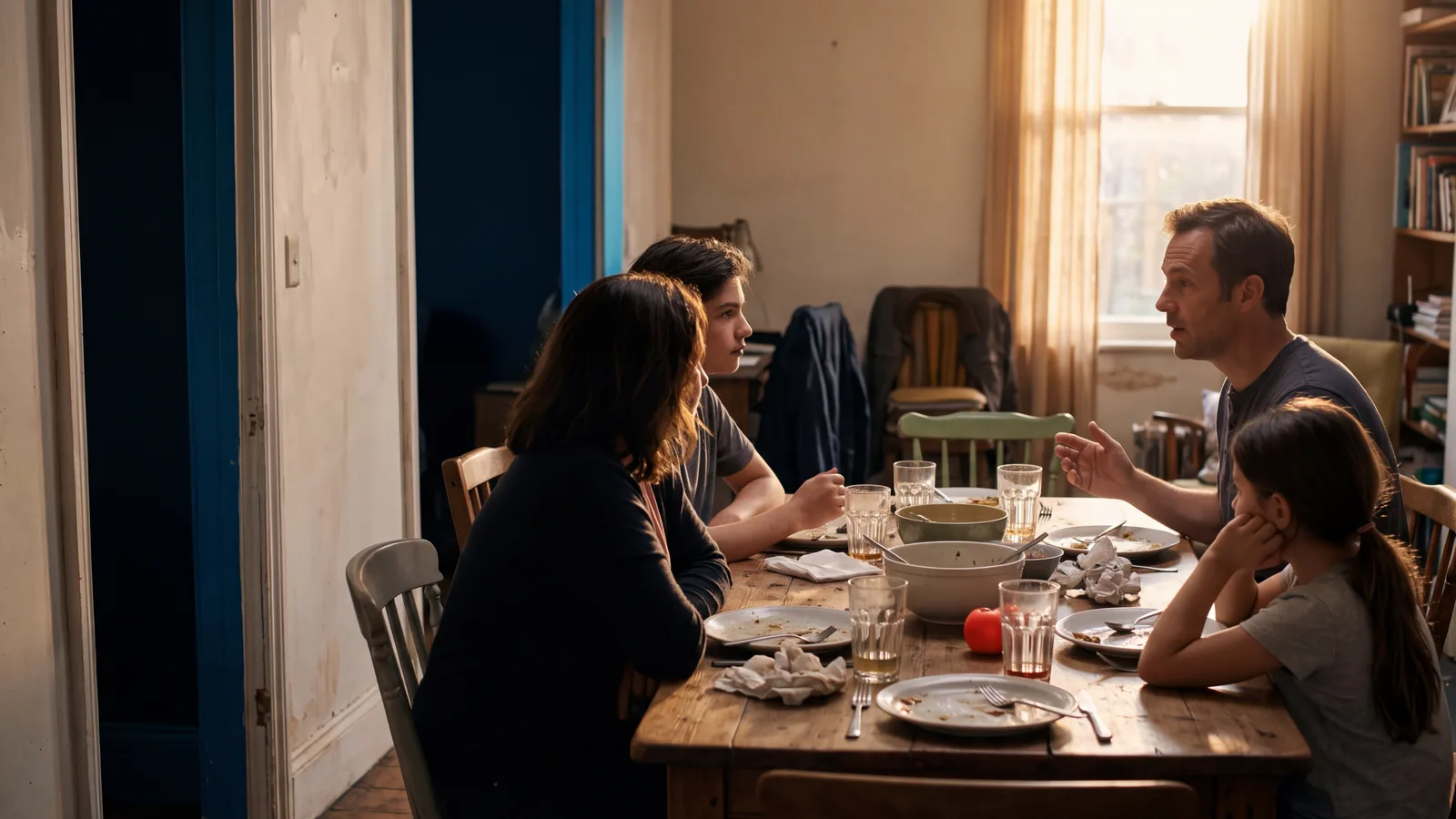
How it’s done
Pick a meal, a holiday one or an ordinary Tuesday, and before dessert open the round. An adult starts, and starts concrete: not «thanks for everything», but a person and a detail («thank you for going to pick up Grandma in the rain»). Then everyone says just one thing, in the order they are seated. Three rules hold it all up: you thank someone for something they did, not something they have; nobody comments on or corrects what another says; and whoever wants to pass, passes, with no explanation and no long face. If there is time and appetite, a second round: sometimes the one who passed in the first speaks in the second. When it ends, it isn't evaluated or summed up. You keep eating. And you repeat it the following week, because the round doesn't work through how intense one evening is, but through what becomes a habit. If the table has an empty chair this year, the round can have a place to thank the one who is no longer there; there's no need to force it, it's enough that the adult offers.
What it builds — the why
Gratitude as a way of looking, not as a courtesy formula: noticing what others did, naming it with detail and saying it out loud. It gives the shared table a moment when everyone is at the same height, from the smallest to the biggest. And it teaches, by imitation, that adults give thanks too, and mean it.
How it changes with age
3–5 Early childhood
6–9 Childhood
10–12 Preteens
13–15 Early adolescence
16–18 Adolescence
Variations
Two-homes version: the round travels; it's done at each home's table, with whoever is there that week. Long-distance version: a relative who isn't there joins by phone for their turn. Written version: everyone writes their thanks on a paper, they're kept in a jar and read together at the end of the year.
What to watch for in your child
The trap is forcing it: turning the round into an exam with the whole table watching the one who doesn't want to speak. That teaches performing gratitude, not feeling it. Don't use it to give lessons either («you should be more thankful») or to compare siblings. If someone always passes, don't point it out; keep offering the round and let the example do its work. And if the table is going through a loss or a very hard year, the round can include the difficult without obliging anyone to find the good side of it.