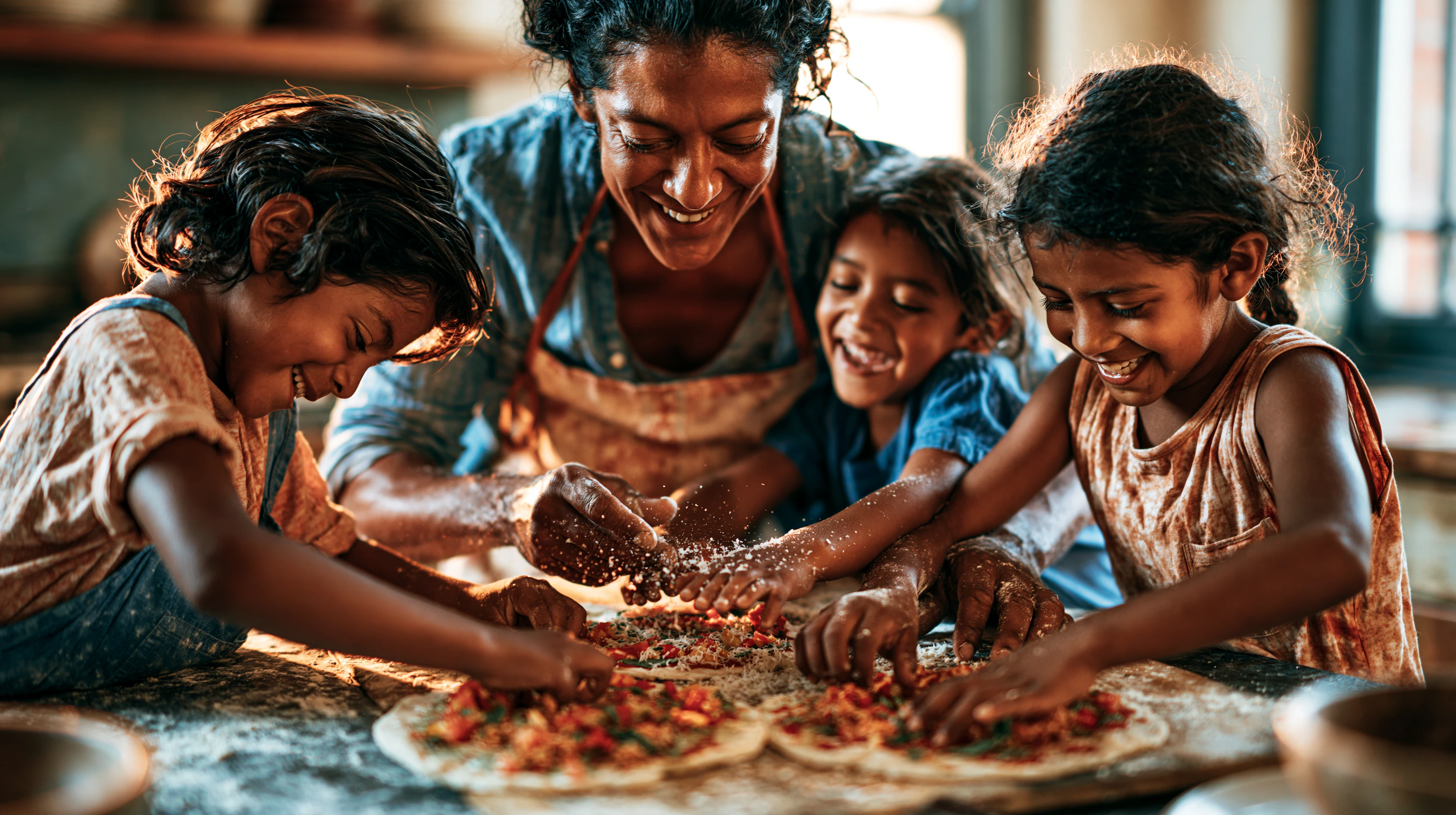
It’s Friday, nobody feels like doing anything, and the hand is already reaching for the phone to order in. Stop it for a second. What if, instead of ordering it, you cooked it together?
I’m not talking about running a restaurant or losing the whole afternoon chopping. I’m talking about thirty or sixty minutes, music on, everyone in the kitchen, to put together something that — I promise you — is going to turn out a million times better than what was going to arrive in that bag. Because what you cook carries your touch, your extra flourishes, and exactly what your family likes. The food, in the end, becomes the excuse; the time together is the real dish.
Here are the keys to making it easy, low-stress, and — with luck — a ritual that sticks.
Choose simple, choose what you love
No competition-grade recipes. Tacos, sushi, pasta, sandwiches, pizza, salads, noodles, a cielito lindo (that seven-layer dip that became a fiesta staple in the Caribbean), milkshakes, smoothies, brownies — whatever everyone likes and you know they’ll actually eat. Rule number one is that it be something they already love, not an experiment nobody asked for.
The trick: generous with the good, watchful over the bad
Here’s the secret that lifts a simple dish into something memorable. Think it through together: when we order this from outside, what do we like most… and what never quite convinces us? Is it the sauce that’s always stingy? The sad side dish? Too little cheese? The texture?
That’s your map. Be generous with what you love and merciless with what you don’t. If the problem with delivery is that the sauce never goes far enough, make double. If the bread always arrives soggy, toast it. A mega two-story sandwich, a seven-topping pizza, a mushroom festival — you’ll be surprised how much a simple dish rises just by taking care of the details nobody outside bothers to take care of for you.
The experience starts before the kitchen
It starts at the supermarket — or in the garden. The magic of this happening spontaneously on any random Tuesday depends on having the ingredients on hand. A well-thought-out pantry is worth it, and if there’s room, a small garden: basil, cherry tomatoes, mint, rosemary, thyme, cilantro, parsley. Cutting your own basil for the pasta is, for a child, half an adventure already done.
And a few good tools make an enormous difference — if not to the food, then to the experience: a blender that works, a good wok, a decent knife set, measuring cups, and an apron for each person. The apron, especially, is pure theater — and theater is half the fun.
The kitchen is a workshop, not a playground
A boring paragraph that has to be said, because everything else depends on it. A kitchen with children in it is a workshop: it has edges, it has fire, and it has liquids that burn. The American Academy of Pediatrics’ basic measures are plain and they work: pot handles turned inward, toward the back of the stove, so no hand can reach them; knives, forks, and scissors stored separately from the “safe” utensils; someone nearby if the microwave is within the child’s reach; cleaning products up high and locked away; and a fire extinguisher in the kitchen (HealthyChildren.org, AAP, 2023).
On the question everyone asks — “at what age can they use a knife?” — this house won’t give you a number, and it’s worth explaining why: there isn’t one. We looked for an age chart in serious pediatric sources and it doesn’t exist; what’s abundant online are charts from brands that sell children’s knives. The task is assigned by the adult who knows that child — their hand, their attention, their ability to hear an instruction all the way through — and the adult stays right there. There’s an enormous amount of real cooking work before the blade and the fire: washing, peeling by hand, mixing, measuring, kneading, plating, decorating, setting the table. Nobody misses the party for not cutting the onion.
Simple, yours, and no audience
Keep it low-key and unpretentious. It’s not a gourmet dinner unless that happens to be exactly what everyone wants that night. And there’s no need to invite anyone: this can be yours, your thing, your ritual. Cook, and then put on the movie or show you enjoy; or take it out to the balcony or the yard and eat it al fresco. The kitchen was the game; the table is the prize.
Make it a ritual — and, if you want, with a challenge
What repeats, stays. Pick a day, or tie it to something: movie night, the outdoor outing, the after-practice or after-play moment. A ritual isn’t an obligation; it’s an appointment the family already knows is waiting for it.
And for nights with extra energy, a small-scale challenge: “what if this time we cook a dish of…?” Here fiction offers a lot to play with — the lamb stew with plums that Katniss names as her favorite Capitol dish in The Hunger Games, the Vulcan plomeek soup from Star Trek, or, for the brave, the legendary Burdigato Supreme from Teen Titans Go! (episode “Real Boy Adventures”): taco, hamburger, hot dog, and pizza fused into a single creature that nearly aligns the planets. The only rule of the challenge: it should add fun, not eat it up. If the challenge starts to stress you out, drop it. And if the challenge becomes the fun — all the better.
What you’re really cooking
A child who learns to cook learns many things at once: that homemade can beat store-bought, that taste is educated by paying attention, that a dish is the sum of small decisions. They gain autonomy, they gain palate, they gain the quiet pride of having made something with their own hands.
And here it’s worth taking down a promise that gets repeated a lot and doesn’t hold up as well as it sounds: “if the child cooks it, they’ll eat it.” What the research actually shows is more modest. A randomized trial with 257 fourth graders, after ten weeks of cooking and tasting at school, improved their preferences for vegetables, their attitudes toward cooking, and — above all — their confidence in their own ability to cook; the effects were small, and the authors themselves clarify that they did not measure what the children actually ate (Cunningham-Sabo and Lohse, 2013). And a Norwegian randomized trial that taught parents to prepare varied homemade food, hoping to reduce rejection of new foods, found no difference at all in skepticism toward new foods or in fruit and vegetable intake at 15 or 24 months (Beinert et al., 2017). What is well supported for getting a young child to accept a vegetable is much more boring: offering it again, and again, without pressure (Holley, Farrow, and Haycraft, 2017). So cook together for what cooking together gives you — the time, the hands, the pride — and not as a strategy to get them to eat the broccoli. If they eat it too, celebrate it; don’t expect it.
About the shared table there is indeed something more to say, with the same caution. A meta-analysis of 17 observational studies with more than 180,000 children and adolescents found that sharing three or more family meals per week is associated with healthier eating patterns (Hammons and Fiese, 2011); and in adults, eating at home more frequently is associated with more fruit and more vegetables per day (Mills et al., 2017). In both cases it’s association, not cause — the authors themselves say so — and whoever cooks at home probably also does ten other different things. It’s not a recipe. It’s pleasant statistical company for something you were going to do anyway.
But what’s really cooked those nights isn’t eaten. It’s the shoulder-to-shoulder time, the shared mess, the sauce that came out epic by accident, the laughter when something burns. Next time your hand reaches for the phone, you already know: delivery arrives in thirty minutes; this stays forever.
Sources and references
Only sources that were downloaded and read are listed. When only the abstract could be read, this is indicated.
- American Academy of Pediatrics (2023). “Kitchen Safety: 10 Tips for Families With Young Children.” HealthyChildren.org. (Updated 4/11/2023.)
- Beinert, C., Hernes, S., Haugen, M., and Øverby, N. C. (2017). “No long-term effect of a 2-days intervention on how to prepare homemade food, on toddlers’ skepticism for new food and intake of fruits and vegetables and sweet beverages: a randomized, controlled trial.” BMC Research Notes, 10, 607. Full text.
- Cunningham-Sabo, L., and Lohse, B. (2013). “Cooking with Kids Positively Affects Fourth Graders’ Vegetable Preferences and Attitudes and Self-Efficacy for Food and Cooking.” Childhood Obesity, 9(6), 549–556. Full text.
- Deline, A. (March 22, 2012). “The Hunger Games: Katniss’s favorite dish.” The Christian Science Monitor. Article.
- Hammons, A. J., and Fiese, B. H. (2011). “Is frequency of shared family meals related to the nutritional health of children and adolescents?” Pediatrics, 127(6), e1565–e1574. PubMed 21536618. (Abstract only; meta-analysis of observational studies.)
- Holley, C. E., Farrow, C., and Haycraft, E. (2017). “A systematic review of methods for increasing vegetable consumption in early childhood.” Current Nutrition Reports, 6(2), 157–170. Full text.
- Mills, S., Brown, H., Wrieden, W., White, M., and Adams, J. (2017). “Frequency of eating home cooked meals and potential benefits for diet and health: cross-sectional analysis of a population-based cohort study.” International Journal of Behavioral Nutrition and Physical Activity, 14, 109. Full text.
Full audit: resources/research/cocinar-en-vez-de-pedir.md.
This text is peer commentary on parenting, not nutritional or clinical guidance. For allergies, dietary restrictions, or concerns about a specific child’s diet, that’s for a professional who knows them.