What if December wasn’t a single postcard, but the most natural moment of the year for your children to discover the real size of the world without ever leaving the table?
If you look at most of the stories, movies, and ads surrounding your kids these weeks, you might think the entire planet moves through December the exact same way: thick sweaters, crackling fireplaces, snow on the windowpane, and a sleigh landing on the roof. That picture is so relentless that even in cities where frost has never fallen, children draw snowmen in their notebooks because they assume that is what the season is “supposed” to look like.
Pull that curtain aside just a little, and the obvious appears. For millions of children across South America, the Caribbean, Oceania, and Africa, December arrives in full summer or under humid tropical warmth, with open windows and walks in flip-flops. And in plenty of households north and south alike, the month doesn’t revolve around one calendar or one table either: homes waiting for Christmas Eve live alongside families lighting Hanukkah candles, tables marking the new year with customs of their own, and households simply resting without any religious holiday at all.
In my view, showing our children how other kids celebrate in December does not dilute family traditions at home; it makes them more grounded and more generous.
Stepping outside a single postcard
When a child grows up assuming there is only one “normal” way to spend these weeks, any nearby difference feels odd or mistaken. A neighbor setting a menorah in the window, a cousin living in the south eating chilled salads before stepping out to the yard in a swimsuit, or a classmate whose family does not exchange gifts in December can seem strange when nobody has explained beforehand just how wide the map is.
Talking about it early shifts how they see without needing any formal comparative-history lesson. It happens naturally while washing fruit in the kitchen, setting out plates, or browsing traditions, languages, and recipes from different regions together on itischristmas.com (or in Spanish at esnavidad.com). Suddenly a child discovers that families in the Philippines hang glowing star lanterns called paroles at their doorways, that across much of the Southern Cone midnight smells like fresh fruit and an open yard, and that in the Caribbean December sounds like aguinaldos and parrandas arriving at a neighbor’s front door.
That discovery does something quiet in a child’s mind: it teaches them that their own family custom has value and roots without needing to be everyone else’s custom too. It also helps when a household blends heritage from more than one place, or when a child splits the holidays between two homes. A child who understands that no single table holds a monopoly on December stops comparing anxiously and starts observing with genuine interest.
Curiosity starts with small questions
In our experience, concrete questions work far better than long speeches about tolerance. A five-year-old won’t retain an abstract lecture on cultural respect, yet remembers clearly the evening they pointed at a country on a map before dinner.
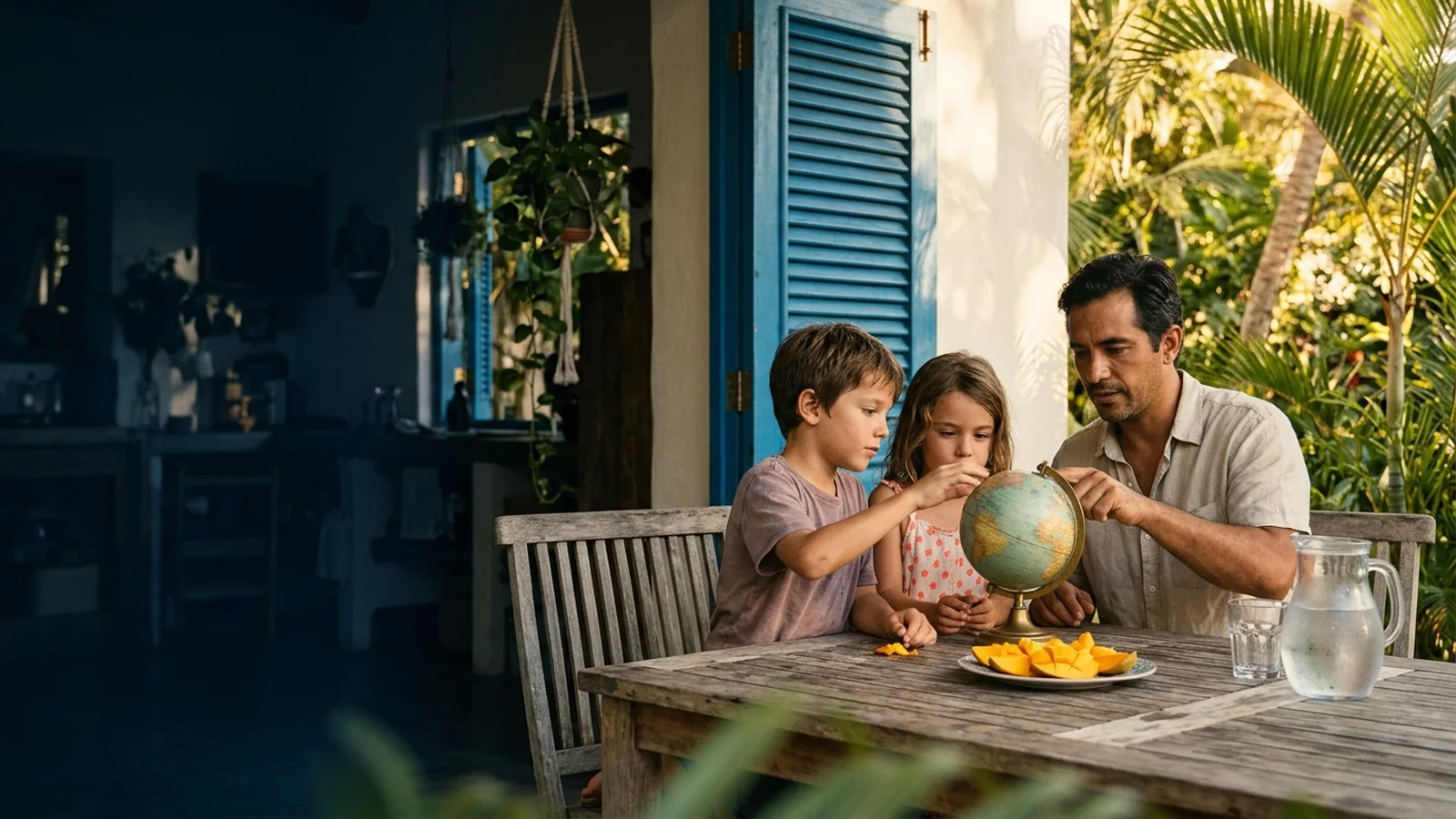
One easy doorway is asking what the weather is like today where other children live. Spreading out an atlas or spinning a globe on the table and pointing to where kids are putting on scarves on the night of December 24 while others walk barefoot across the grass sparks more wonder than any explanation. For someone raised in cold winters, picturing dinner beside the ocean feels like a storybook; for someone growing up in tropical warmth, realizing that dusk falls in mid-afternoon in the other hemisphere turns geography into real children their own age.
From the map, move straight to the ear. Trying out how other languages greet the season turns difference into something audible and playful rather than an isolated fact. Saying a greeting aloud in Tagalog, Swahili, Portuguese, or French, stumbling over syllables across the dinner table, and laughing because the adult mispronounces it first takes all stiffness out of learning. With older kids around ten or fourteen, noticing how Navidad, Natal, Natale, and Noël share a root even as the language shifts opens real conversations about travel and history.
And once they have glimpsed a handful of other customs, almost every child arrives on their own at the deeper question: what do all these tables share even when the menu, the date, and the coats change? Almost always they land on the same answer without anyone feeding it to them: the dishes and scenery shift, yet nearly everywhere someone is cooking for people they love, a light is lit, and people want to gather.
No postcard tourism, no quizzes
Personally, I think two equally shallow shortcuts are worth avoiding when bringing other cultures to the family table. The first is shrinking another tradition into a one-afternoon costume, treating it as an exotic novelty without naming what it means to the families who live it. The second is turning dinner into an impromptu geography quiz where a child feels tested on unfamiliar names to please the grown-ups.
The real aim is simpler: helping your child meet difference with respect and genuine curiosity. When a neighbor, classmate, or distant relative celebrates differently, listening to how December unfolds in their home — and sharing what happens in yours with the same ease — teaches far more than any textbook. Children learn by watching how we look at what is unfamiliar to us.
Something to do this week
Choose one country different from your own as a family — ideally in the opposite hemisphere, where December brings the reverse of whatever weather sits outside your window — and spot it on a map before dinner. Pick one small custom that catches your eye on itischristmas.com (or in Spanish at esnavidad.com) and bring it to the table with The December greetings map. Sometimes the best year-end journey starts with an honest question passed between plates.