What if December’s question in a two-home family weren’t “who gets the holidays,” but “how does the child live them”?
In many families the holidays arrive with a split calendar. Christmas Eve in one home and the 25th in the other; New Year’s on one side and Three Kings’ Day on the other; the first half of the summer with one parent and the second with the other, wherever December opens the long break. The eight nights of Hanukkah are sometimes shared between two homes. Each family arranges it as best it can, by agreement or by whatever applies, and there is no single right model.
This piece isn’t about who has the children or how that’s decided. That belongs to each family and, when there’s serious disagreement, to the people who know about it: a family mediator or a lawyer. It’s about something else: what the child lives inside that calendar, which really is in our hands.
How the child hears about it
The first thing is when and how the plan is told. My position is simple: early, clearly, and said by the adults, not discovered by the child. A child who knows in good time where they’ll be each day can look forward to each part. One who finds out the night before, or overhears half the negotiation, carries an uncertainty that isn’t theirs to carry.
Some guidelines that help:
- Tell them together, if you can. When both adults say it at the same time, the child gets a message: the grown-ups decided this, and we agree on taking care of you.
- A calendar in plain sight. On the fridge in each home, with the days marked. For little ones, with drawings.
- Don’t put the decision on them. Asking “who do you want to spend Christmas Eve with?” seems respectful, but it makes the child choose between the two people they love most. You can ask what they’d like to do in each home, not which one to stay in.
- Name what they’ll miss. “On Christmas Eve you’ll be with your mom and you’ll miss your dad. That’s normal, and you’ll be able to call him.” Saying it beforehand makes it lighter.
The handover between homes
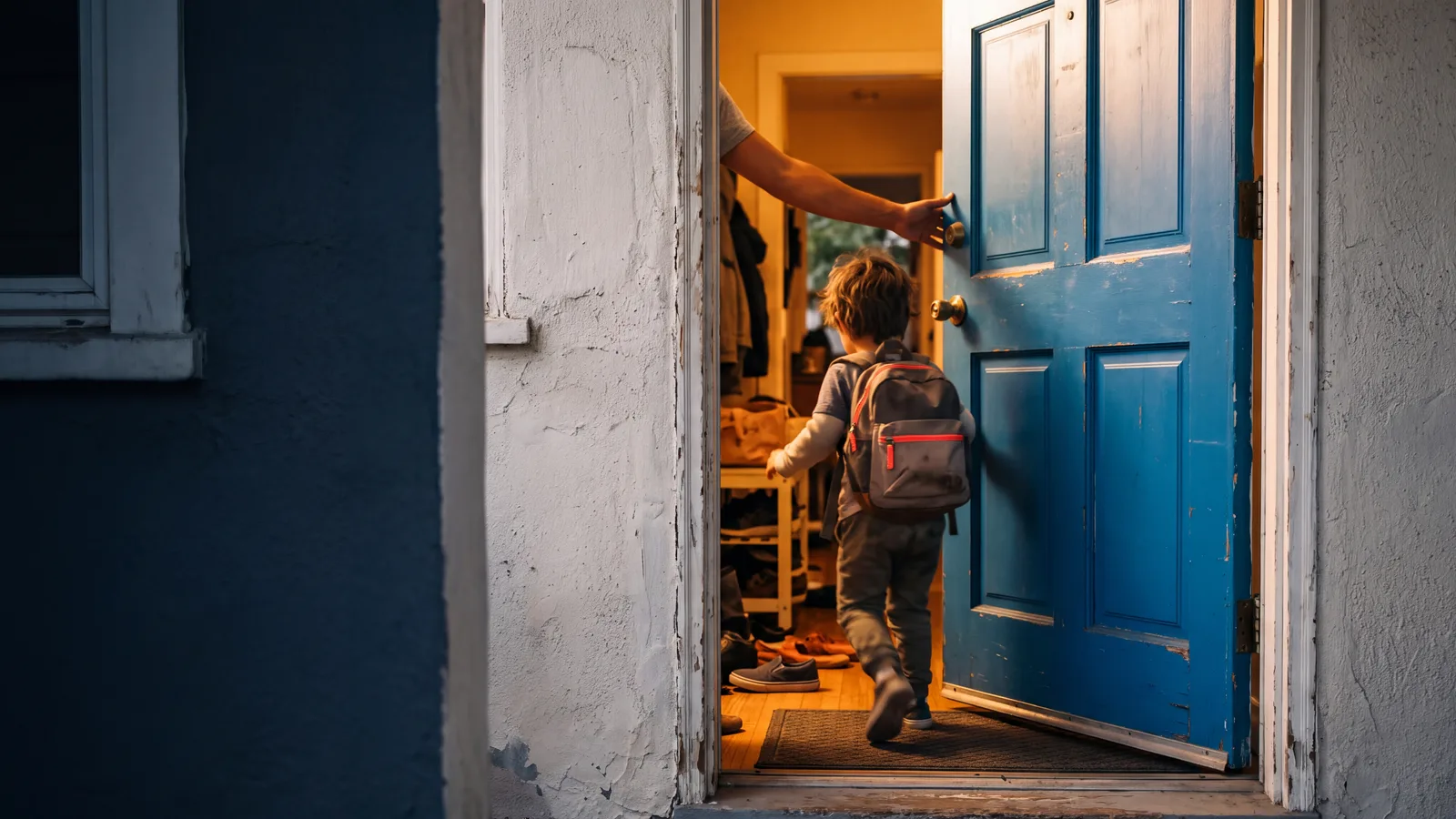
The most delicate moment of the holidays usually isn’t the dinner: it’s the handover. The door, the car, the suitcase, the adult who stays behind. For the child it means going from one world to another in a few minutes, with the feelings of what they leave and what they find.
When you receive them, give them time. Don’t ask right away how it went or what they got. Don’t question them about the other home. Let them arrive, settle in, tell what they want when they want. If they come back tired, irritable or quiet, it’s almost always the transition, not a message about us.
When you send them off, something similar: let them go with permission to enjoy themselves. A “have a wonderful time with your dad,” said and meant, is one of the biggest gifts a child can receive in December.
The grandparents on both sides
The holidays are also the season of grandparents, and a two-home family usually has two extended families, with their customs, their dinners and sometimes their wounds. The child has the right to love both sides without feeling they’re betraying either.
We adults can help with little: not speaking badly of the other family in front of the child, making a call or a visit easy even when it isn’t scheduled, and asking the grandparents on our side to do the same. If the relationship between adults is hard, it’s enough that the child doesn’t have to carry it.
The adult who stays behind
There’s someone hardly anyone talks about in December: the father or mother who spends the big night without the children. That night deserves a plan too. A dinner with friends or with one’s own family, a call agreed at a time that won’t interrupt, something of one’s own to do. An adult who takes care of themselves spares the child the worry of leaving them alone.
The ritual that travels with the child
There’s something that gives continuity to split holidays: a ritual that goes with the child, not with the home. A nativity figure or an ornament that travels in the suitcase. A Hanukkah candle lit in each home. A book read on the same night, wherever they are. The letter to the Three Kings written in one home and left in the other. In the south, the first swim of the summer, with whoever it is. The form depends on each family, its faith or the absence of one; what matters is that something belongs to the child and goes wherever they go.
When both homes can agree on that ritual, all the better. When they can’t, each home can offer its own, and the child ends up with two traditions instead of half of one.
A necessary note: this piece is experience shared between parents, not legal or custody advice. If there is serious conflict between adults over the holidays, the way forward is a family mediator or a lawyer. And if there is any risk to the child or to anyone in the family, it is no longer a parenting matter: crisis resources lists where to turn.
Something to do this week
Put the holiday calendar on the fridge, day by day, with where your child will be. Tell them calmly and, if possible, together with the other adult. And choose together one small ritual that travels with them to both homes.