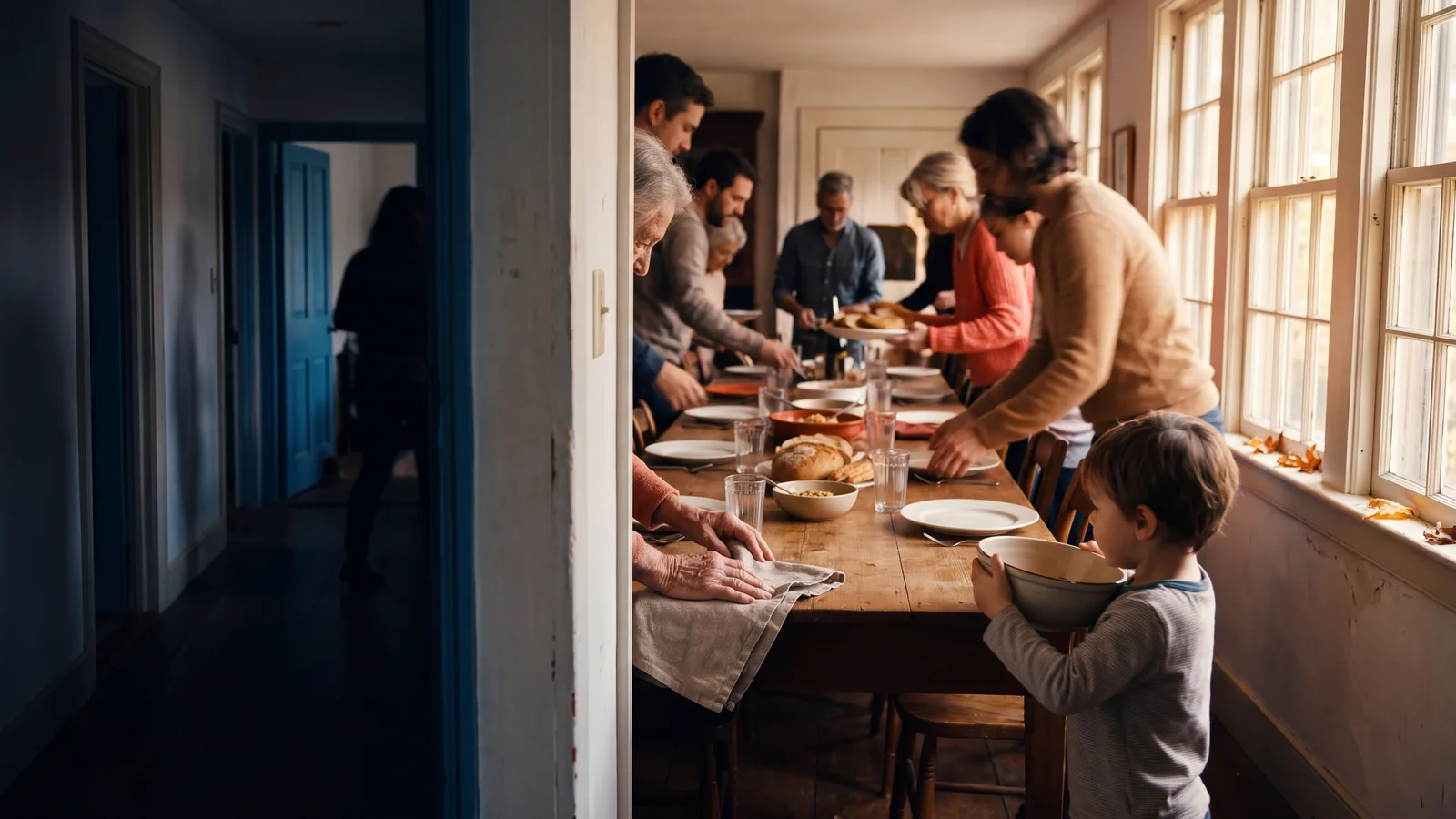
How many times have you said to your child “what do you say?” waiting for a “thank you”? And of all those times, how many of those “thank yous” were gratitude, and how many were obedience?
On the fourth Thursday of November, in the United States, many families sit down at a table with a name of its own: Thanksgiving. Canada celebrates its own in October. In almost all the rest of the world, that Thursday is just another Thursday. And yet what that holiday puts at the center belongs to no single country: a long table, people who don’t always sit together, and a question asked out loud. What are we thankful for?
This page isn’t proposing that you adopt someone else’s holiday. It proposes that you keep the best of it: the idea that, once a year or once a week, the table is for something more than eating.
Gratitude can’t be demanded: it spreads
Here is the provocation: demanded gratitude doesn’t teach gratitude. It teaches how to perform it. A child from whom a “thank you” is pried learns that there is a word adults want to hear and that, said on time, it ends the conversation. That’s a good lesson in manners. It isn’t the one we’re after.
What we’re after is something else: that our children learn to notice. To notice that someone cooked. That Grandma traveled four hours to be here. That the neighbor kept their package safe. That the year, with all its difficulty, also brought good things. Gratitude, before it is a word, is a way of looking. And ways of looking aren’t learned from instructions: they’re learned by watching the people you love look.
I’m not presenting this as a laboratory finding. It’s a position, and the kind you can test at your own table this very week. The next time you want your child to say thank you, say it first. Out loud, with a name and a detail: “Thank you for the soup; you put in the cumin I like.” And watch what happens at the table.
What usually happens is that the detail spreads. A “thanks for everything” leaves nothing to imitate. A “thank you for staying up waiting for me when I came home late” teaches exactly what is being thanked: the concrete, what it cost, what someone did without being asked.
The table belongs to everyone, even if the holiday doesn’t
There is something the shared table does better than any other place in the house: it puts all of us at the same height. The adult and the five-year-old girl, the teenager who arrived with headphones on and the uncle who comes once a year. For a while nobody is standing, nobody is on another screen, nobody is above anyone else. It’s the oldest format we have for talking, and it still works.
But the holiday table is not the Tuesday table, and it’s worth arriving at it with your eyes open. It’s the table where relatives’ opinions about how we raise our kids show up. Where the teenager would rather be anywhere else. Where someone eats too much and someone comments on another person’s plate. And, sometimes, the table where for the first time someone is missing.
Each of those scenes has its own page this season, because each deserves more than a paragraph. Here I want to say just one thing about all of them: gratitude doesn’t require a perfect table. You can be thankful at a table with an empty chair. You can be thankful at a table split between two homes, this week’s and next week’s. You can be thankful at a table of two or of twelve, with store-bought food or with a recipe from three generations. What makes the table isn’t the menu or the headcount: it’s that thanks are given out loud and that everyone is invited to give them, including the one who doesn’t want to yet.
The one who doesn’t want to speak is also invited
And here is the most common trap of the season: turning the round of thanks into an exam. “Okay, you, what are you thankful for?”, with the whole table looking at the twelve-year-old. That isn’t gratitude: it’s exposure. And the teenager who answers “nothing” isn’t being ungrateful; he’s protecting himself from a stage he didn’t choose.
The rule I propose is simple: the adult starts, and starts with something concrete. Everyone says just one thing, and whoever wants to pass, passes, with no comment and no long face. Sometimes the one who passed in the first round speaks in the second. Sometimes he speaks the following week, in the car, when nobody is looking at him. Sometimes he doesn’t speak, and he heard everything. All three count.
With the youngest, the round can be a single word or a drawing. With those in elementary school, a person and a reason. With teenagers, the question changes: no longer “what are you thankful for?”, but “what was the best thing about this year that nobody saw?” That question doesn’t ask for tenderness in public; it asks for judgment. And teenagers, when you ask them for judgment and not a performance, usually have a lot to say.
To do this week
Choose one meal this week (it doesn’t have to be a special dinner or a Thursday in November) and hold a round of thanks. Three rules: you start, with a name and a detail; everyone says just one thing; whoever passes, passes. When it ends, don’t comment on it or evaluate it. Just repeat it the following week.
The full guide is in the activity The round of thanks, with what changes at each stage and the trap of forcing it. And if this week you have the big table, with relatives, extra chairs or an empty chair, in this season you’ll find the situations that tend to come up there.
The holiday belongs to one country. The table belongs to everyone.