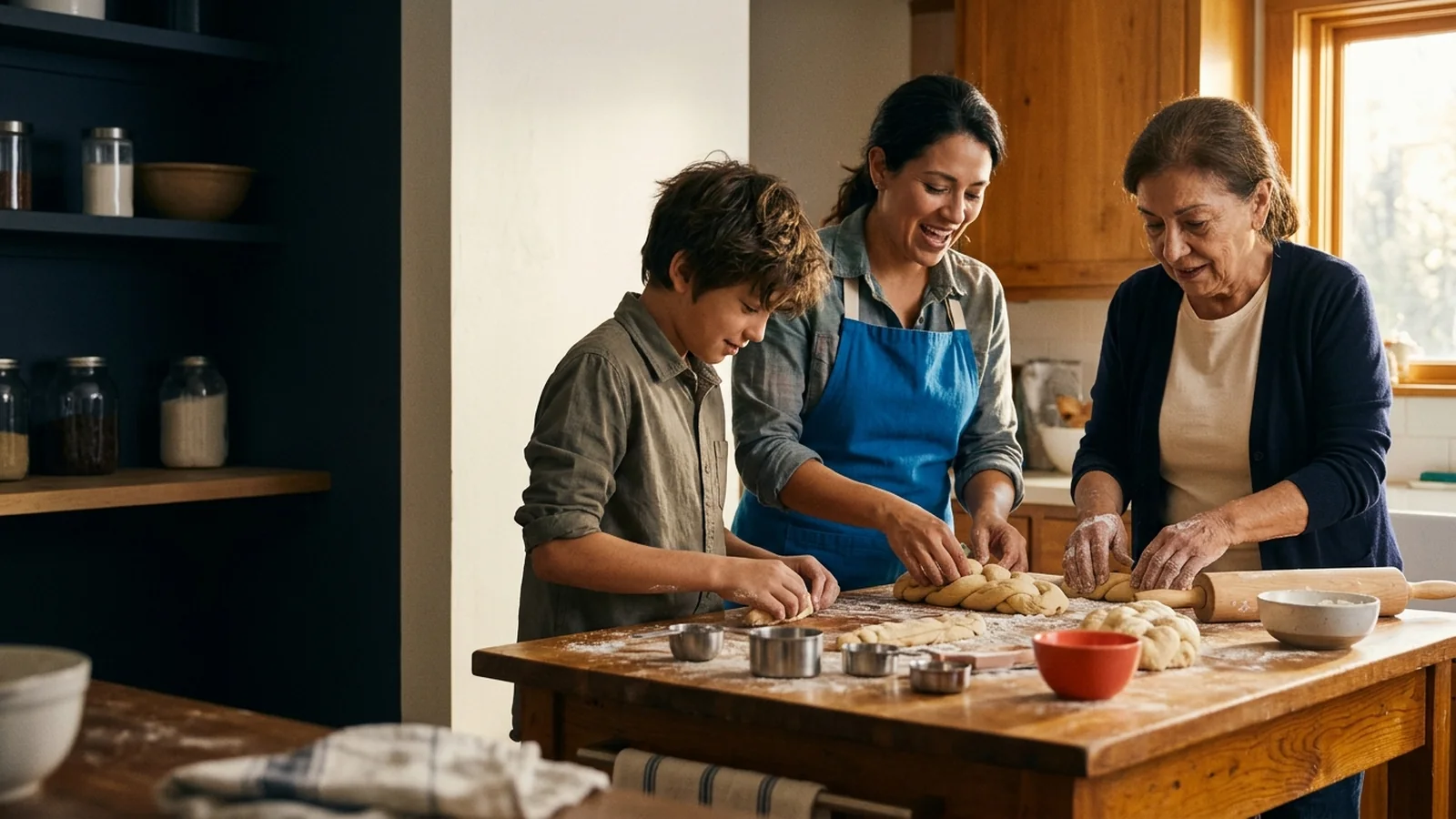
What if the finest December classroom at home had no whiteboard or workbooks, just flour on the table and room to make mistakes?
During the school year, the kitchen mostly serves as a high-speed transit zone. Between breakfasts against the clock, weeknight dinners squeezed between homework and baths, and plain end-of-day exhaustion, almost every adult has asked children to step out for a minute “so I can finish faster.” During school weeks, that rush comes down to daily logistics, and there is no reason to carry guilt over it.
During the holidays, one single variable shifts, and it shifts everything: we have time. Whether December brings winter cold outside that makes an oven warm the house, or southern summer invites early-morning baking before the heat climbs and cool dishes toward evening, time changes the room completely. When there is time, the kitchen stops being logistics and turns into one of the finest classrooms at home, with no exams, no grades, and an edible prize at the end.
Personally, I think letting children step into the kitchen for real is one of the happiest, most concrete ways to build independence, patience, and family memory during these weeks.
What unfolds when a child truly takes part
We aren’t talking about calling them in at the last second to place a cherry on top once everything is finished, but giving them a genuine role from the start: reading steps, weighing flour, counting spoonfuls, watching the timer, or seeing why dough needs time to rest before baking. When an adult shares that space calmly, several good things happen at once.
First come math and reading with immediate purpose. Doubling a recipe because guests are coming, or cutting it in half because fewer people are home that week, makes fractions real long before they show up in a textbook. Following instructions line by line proves that skipping a step changes the dough; timing each tray builds mental order. Nothing feels like a school chore when it comes out of the oven as warm bread or cookies to pass around.
Alongside that grows something quieter yet just as essential: tolerance for waiting and for mistakes. Sauces take longer than expected to thicken, dough clings to fingers, and edges brown a minute too fast. When the adult breathes, tastes, and adjusts the heat instead of rushing to hide the mishap, a child watches how missteps get handled. They learn in real time that a mistake doesn’t ruin the afternoon; it invites paying attention and fixing what can be fixed.
And rising above measurements and timers, the kitchen builds a bridge across generations. For many families, December is the season when grandparents, aunts, uncles, and grandchildren gather around a heritage dish. Watching how a grandfather kneads dough, asking why a certain spice goes in, or hearing which town an old family recipe traveled from builds shared memory far sturdier than any posed photo in front of the tree.
Matching real work to each age
In our experience, the secret to enjoying the afternoon without losing your cool is matching the task to the child’s age and accepting up front that flour will land on the table and on sleeves.
With little ones, ages three to five, tactile tasks well away from heat work best: rinsing fruit in a wide bowl, stirring dry ingredients, squishing dough by hand, or placing raisins and toppings. At that stage they aren’t chasing bakery precision; they want to feel their own hands helping make the meal everyone will share.
With elementary kids, ages six to nine, reading and real measuring enter the mix. They can read each step aloud like a mission leader, level measuring cups and spoons, crack eggs into a small dish before adding them to the batter, and line up ingredients before anything turns on. Setting out what you need before lighting the stove is a practical habit that carries straight into homework later.
With tweens and teens, the invitation scales up. Hand them a complete recipe to run — either a house favorite or something new picked from Cook a holiday dish from another country or browsed on itischristmas.com/recipes/ (and in Spanish at esnavidad.com/es/recetas/) — while you step back as their sous-chef. Washing a bowl, passing a towel, or checking the oven under their direction flips household roles for an afternoon; feeling capable of feeding their family leaves a teenager with a kind of confidence few speeches can match.
Protect the mood more than the photo
In my view, a kitchen shared with children holds just one truly non-negotiable rule: safety around sharp knives, hot burners, and ovens. Everything else has generous room for imperfection. Lopsided cookies taste identical to neat ones, a flour-dusted table wipes clean in five minutes together, and screen-free conversation while a pot simmers is worth far more than magazine-ready plating. Nor is there any need to force a clean plate if everyone tried an unfamiliar dish from another country and the spice still takes getting used to: the win was cooking it together and tasting with curiosity.
Something to do this week
Pick an afternoon with no urgent errands — early in the morning if your city sits in summer heat, or toward dusk if winter cold holds outside — choose one traditional family recipe or one borrowed from another country, and hand each child a real responsibility from pulling out ingredients all the way through clearing the table together.