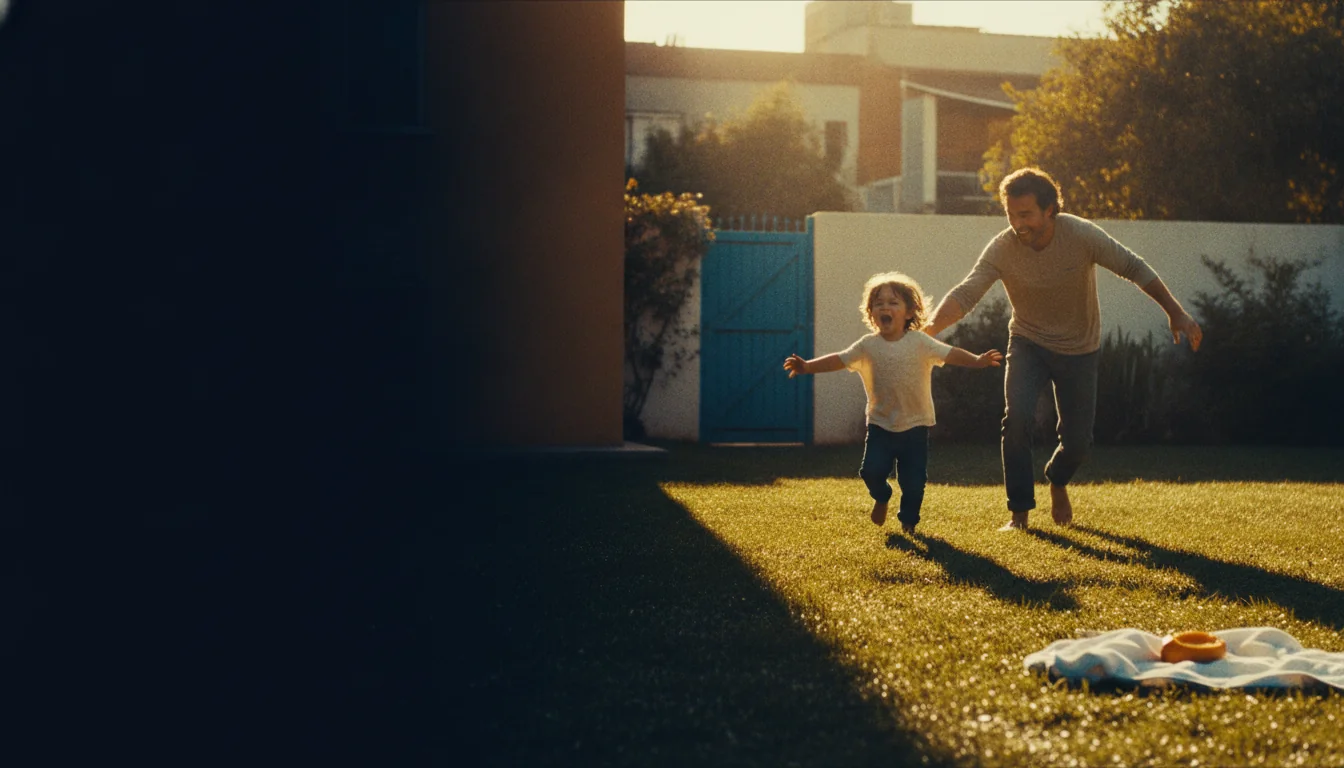
People are always asking me for the best apps to manage screens. My answer is always the same: 'sure, write this down.' And what I dictate isn't available in any app store — it already comes installed in your child's body. The best tools for regulating a child aren't apps: they're morning light, movement, laughter, sleep in the dark, and the touch of someone who loves them. An honest guide (metaphor, not medical advice) to the chemistry real life activates that no screen replaces.
the tip in one minute — the full article is this page
Video transcript
People are always asking me for the best app to manage their kids' screens. I always answer the same way: “sure, write this down.” And I dictate: oxytocin. Dopamine. Endorphins. Serotonin. Melatonin. What you just wrote down doesn't download from any store, doesn't ask for a password, doesn't sell your data. It comes factory-installed in your child's body. Before we go on, an honesty check: this is a metaphor, not a medical prescription. Nobody “fires” a hormone by pressing a button. What real-life activities do is create the conditions — relationship, sleep, light, movement, calm, play — in which the nervous system regulates itself. The touch of care — a hug, cuddling — calms more than any trick. And a myth that needs burying now: the “dopamine detox” doesn't exist. What competes with the screen isn't switching off pleasure: it's offering real reward — finishing something, learning a skill, the music they love. Shared laughter and movement do more for mood than any single-chemical “rush.” And the adrenaline of intense play isn't the enemy: it's the spark — as long as the comedown, the calm, comes after. The best-proven lever of all, and the cheapest: morning light. The most ignored: nighttime darkness — no screens, and no melatonin gummies. Just routine and a dark room. Stress isn't poison: it's adaptive. What helps is less chronic stress — nature, predictability, sleep. And a promise: your child's puberty can't be hacked. It's accompanied. Morning light. Move the body. Really laugh. Caring touch. Dark night. Nature. Slow rewards. Seven apps that already come installed. The best tools for your child aren't bought: they're lived.
People are always asking me to recommend the best apps and tools for managing kids’ screen, social media, and AI use. My answer is immediate and unequivocal. I say: “sure, write this down.” I pause — I let them pull out their phone, open their notes app — and then I dictate.
What I dictate can’t be downloaded from any store. It has no subscription, asks for no password, sells none of your data. These are the best tools that exist for regulating a child, and they already come factory-installed in their body. The list, exactly as I dictate it, is this: oxytocin, dopamine, endorphins, adrenaline, serotonin, melatonin, cortisol. And a handful more working behind the scenes.
It’s not a joke, even though it starts like one. It’s the most serious thing I know about screens: the real competitor to an app isn’t another app. It’s a hug, a walk, a shared laugh, a night in the dark without screens. The chemistry that sustains your child’s mood, calm, motivation, and sleep can’t be bought — it’s activated by living. And that’s exactly the ground where real life still beats the screen, if we let it win.
A warning before we go on (because it matters)
I’m going to use the word “app” as a metaphor, and I want to be honest about its limits, because honesty is half of what makes it useful.
No hormone “fires” at the push of a button. Nobody switches on oxytocin on demand or “resets” dopamine. What real-life activities do is something else — slower and more powerful: they create the conditions — relationship, sleep, light, movement, calm, play — in which a child’s nervous system regulates itself. These aren’t biochemical buttons; they’re a way of life. Whenever you read “activate” here, read it as “create the conditions for.”
And a second thing, so no one gets confused: this is a metaphor, not medical advice. It’s peer commentary — from one parent to another — not a consultation. If your child has real problems with sleep, mood, or attention, the best “app” is still the pediatrician. Nothing that follows replaces that guidance, and none of this includes giving a child supplements or pills to “raise” some chemical: that has no place here, and it shouldn’t have a place in any parenting article without a doctor involved.
With that clear, let’s continue. I’ll group the tools into three.
Group 1 · The ones that activate (to compete with the screen at its own game)
The screen hooks because it offers fast stimulation and constant reward. The answer isn’t to turn off stimulation — it’s to offer the good kind of stimulation: the kind that leaves a child satisfied instead of empty.
Oxytocin — the bonding one. It’s known as “the love hormone,” and here’s where honesty matters: that nickname is oversold, and its effects depend a lot on context. But there’s something solid underneath the noise: caring touch — hugs, cuddling, tickles, a hand on the back — and real closeness are associated with physiological calm and with bonding. It’s not a dose you administer; it’s a relationship you cultivate. Face to face, really listening, playing together, eating as a family. One inclusive detail I learned matters: for some children a hug doesn’t calm them — firm pressure, closeness, or silent company work just as well. Touch always respects the child’s consent.
Dopamine — the motivation one. It’s not simply “the pleasure one”: it’s the one behind anticipation, motivation, and learning. And here I’ll take down the most popular myth of all: the “dopamine detox” doesn’t exist. You can’t fast from a molecule your body manufactures, or “reset levels.” The screen isn’t bad “because it releases dopamine” — everything pleasurable involves it, including a good conversation. The screen’s problem is its variable-reward design, that little unpredictable-prize machine that competes with the slow rewards of real life. What offers real reward? Finishing something, learning a skill, exploring a new place, and — this is well documented — music you love, especially in that goosebump moment when the song’s climax hits.
Endorphins — the well-being ones. They’re the body’s natural painkillers, and two things reliably move them: shared laughter and movement. Real laughter, the group kind — playing, joking around, watching a comedy together — measurably raises the pain threshold and weaves bonds (Robin Dunbar and his team’s work showed this with social laughter). On exercise it’s worth being precise, because pop culture exaggerates: the famous “runner’s high” isn’t just endorphins — in fact, a good part of it comes from other compounds, endocannabinoids, which do reach the brain. The exact mechanism doesn’t matter much: moving improves mood through several pathways at once — and, over the weeks, it even helps the brain learn better. Running, biking, jumping, dancing in the living room. A body that moves regulates the child living inside it better.
Adrenaline — the activation one. And here’s an important correction, because almost everyone treats it as the villain: adrenaline isn’t bad. It’s adaptive. It’s what fuels intense physical play, sports, adventure, challenge, novelty. The goal is never to “eliminate it” to counter the screen; it’s to offer activation in healthy contexts and then allow the comedown: up with play, down with calm. That cycle — activating and recovering — is the lesson, not permanent stillness.
Group 2 · The ones that regulate (the background balance)
If the first group competes with the screen, the second holds up the ground where everything else happens: stable mood, sleep, calm.
Serotonin — the mood one. The best-supported lever in this whole article is also the cheapest and most overlooked: morning light. Serotonin turnover in the brain rises with hours of bright daytime light — it’s measured, and it’s the basis for why mood drops in dark winters. Get the child out into light early, time outdoors, daytime sun. (And let me cut off a dinner-table myth at the root: no, eating turkey, bananas, or “foods with tryptophan” does not reliably raise serotonin in the brain. That story is false. The lever is light and movement, not a plate of food.)
Melatonin — the sleep one. It’s the chemical signal for “it’s nighttime,” and the body manufactures it in response to darkness. Light — especially the bright, blue light of screens — suppresses it. Hence the lever, which is not a pill: a stable sleep routine, dimming the lights at dusk, and removing screens before bed, a dark room. And a circadian bonus: the same morning light that helps with serotonin anchors the clock and improves nighttime melatonin. A safety note, because it’s become common practice: melatonin supplements for children are not a “sleep app” — the American Academy of Pediatrics asks that they be discussed with the pediatrician case by case, and childhood poisonings from them have multiplied. Darkness and routine, not the gummy.
Cortisol — the stress one (which also isn’t the villain). Hard to believe given its bad reputation, but cortisol isn’t poison. It’s adaptive, follows a healthy daily rhythm (high in the morning, to wake you up), and is part of how we respond to the world. What causes harm is chronic, sustained stress. So the goal isn’t to “lower cortisol” as if it were toxic; it’s less chronic stress, and that’s built with concrete things: predictability and routine, connection, sleep, movement, and — well documented in children — time in nature, which lowers stress markers. You don’t eliminate the alarm; you teach the body to switch it on when needed and switch it off afterward.
Group 3 · The ones working behind the scenes (and one that can’t be hacked)
There’s a third group that almost never makes it into dinner-table lists because it doesn’t lend itself to tricks: they’re the brain’s background balance. Here honesty asks us to turn down the volume on the promises.
GABA and glutamate are the brake and the accelerator of the whole brain — inhibition and excitation. They’re not levers you “raise” with a food or a supplement (and yes, I cut the “eat this to raise your GABA” stories: GABA you swallow doesn’t reliably reach the brain). What does support calm is the obvious and the boring: slow breathing, routine, rest, a quiet environment. And what trains learning — where glutamate does its work — is learning by doing: reading, challenging play, curiosity.
Acetylcholine and norepinephrine sustain attention and alertness. Attention can’t be bought in a bottle — no “nootropics,” no supplements for children — it’s trained by focusing on one thing at a time, reading, good sleep, and play. And norepinephrine, like adrenaline, is adaptive alertness: it activates for the challenge, calms afterward.
And one that’s worth taking off the “apps” list: testosterone and estrogen. They’re not here so anyone tries to “raise” them in their child. That’s not something you do, and any advice like “train strength to raise his testosterone” for a child or teenager is out of place. These are the hormones of pubertal development, and their only place in this guide is as a reminder: some things can’t be hacked. Puberty follows its own rhythm. Your role isn’t to force a hormone; it’s to accompany the process — good sleep, movement, good food, a safe relationship where questions can be asked without fear — and let development do its own thing.
How you actually use them (the practical part)
If I had to reduce all this neurochemistry to a list a tired parent could use tomorrow, it would be this — and notice that none of them requires buying anything:
Morning light. Get the child outside early. Walking to school, breakfast by the window, five minutes in the yard. It anchors mood and nighttime sleep.
Move the body, together. Biking, swimming, jumping, dancing in the living room, a sport. Not for the figure: for the mood.
Laugh for real. Seek out shared laughter — play, jokes, comedy. Group laughter is one of the most underrated medicines there is.
Caring touch. Hugs, cuddling, closeness — always with the child’s consent, and tailored to what actually calms them.
Night in the dark. Sleep routine, dim lights at dusk, screens out of the room, darkness. The best sleep “app” is turning off the others.
Nature and calm. Time outside, greenery, no rush. It lowers background stress better than almost anything.
Slow rewards. Finishing something, learning a skill, music they love, exploring a new place. What leaves them full, not empty.
None of these seven is new. That’s the point. We’ve spent the entire history of the species regulating ourselves this way, and suddenly we expect a lit-up rectangle to do it better. It doesn’t. It just got here first, and shouts louder.
What you’re really doing
When you get your child out into the morning light, when you make them laugh until their stomach hurts, when you defend the dark night and the outdoor Sunday, you’re not “taking away the screen.” You’re giving them the only thing that truly competes with it: a life that feels good on the inside without needing a plug. The screen offers borrowed stimulation. You can offer their own — the kind their body already knows how to make, and that just needs someone to give it the occasion.
That’s the long answer to the question people ask me. The short one fits in the dramatic pause before I dictate: the best apps for screens already come installed. You just have to use them.
I don’t compete with TikTok by buying another app. I compete with a walk in the sun, a laugh in the kitchen, and a night in the dark. And, if I’m honest and consistent, those still win.
Comments from the house
[FINAL SECTION — PENDING: Carlos completes it]
Note from Carlos
Help us make it better
Did something ring false, feel missing, or feel like too much? Tell us — good comments make articles better.