Almost every tradition from the tender years expires when the child grows up, the place closes, or the family moves. How to design at least one that doesn't: tie it to a type of place, not a single one, and let it grow with your child. A lifetime of standing dates, practically guaranteed.
the tip in one minute — the full article is this page
Video transcript
Almost every tradition we build with our children comes with an expiration date, and we don't notice until it arrives. The Sunday ice cream. The swing at the same old park. Friday pizza at that place on the corner. Don't stop building those: the ones from the tender years are irreplaceable precisely because they don't last. But it's also worth planting, on purpose, another kind of tradition — one designed to last. Most die for one of three reasons: the child grows up, the place closes, the family moves. And all three can be dodged from the design. Dies of age: choose one that grows with them. The library works at six with the picture books, at seventeen hunting old editions, and at thirty when they take you. The frame doesn't change; the content matures. Dies of place: tie it to a kind of place, not to a single one. Not “the café on the corner” —which closes— but “a café.” Not “that ice cream shop” but “a bakery.” The kind of place exists everywhere; the specific spot doesn't. Dies of moving — and here's the magic of the portable: if it lives in a kind of place or in an activity, it travels with you. Everywhere there's a library, a pool, a bakery. The tradition doesn't depend on a map: it depends on the two of you. What you're really building is a memory bank open for a lifetime — the thread that doesn't snap when the teenager pushes outward. Many parents discover too late that the best inheritance wasn't a thing, but a habit. So choose one. Just one, to start. Tie it to a kind of place and not to an address, make it wide so it grows with your child, and guard it with loving stubbornness. A whole lifetime of dates — that neither time nor a “closed” sign will take from you.
Almost every tradition we build with our children has an expiration date, and we don’t notice until it arrives. Sunday ice cream. The swing at the usual park. Friday pizza at that corner spot. They’re beautiful — shared experiences, pure bonding, memories you keep like photographs — but many are built for a child who’s going to stop existing. One day the park gets too small for them, the ice cream feels “for babies,” the corner spot closes, or the family moves to another city and the tradition stays behind, on the old sidewalk, with no one to inherit it.
That doesn’t mean you should stop building those. The ones from the tender years are irreplaceable precisely because they don’t last: they belong to a short, sweet season, and you have to wring it dry. But it’s also worth deliberately planting another kind of tradition: one designed to last. One that survives the three things that kill almost all of them — the child growing up, the place closing, the family moving. I call these traditions that don’t expire — and the secret to building them fits in one word: make them portable, so they don’t depend on one specific place or one specific age.
Why the rest expire (and how to avoid it)
Most traditions die for one of three reasons, and all three can be designed around.
They die of age. The tradition that only works with a five-year-old gets strange with a fifteen-year-old. The solution isn’t to freeze it: it’s to pick one that grows with them. Getting books from the library works at six (the picture ones), at twelve (the manga that just came out), at seventeen (the old edition you hunt down together like treasure hunters), and at thirty (when they’re the one taking you). The frame doesn’t change; the content matures with the person.
They die of place. A tradition tied to one specific spot is one bankruptcy away from disappearing. Hence the central trick: tie it to a type of place, not a single one. Not “the café on the corner” — which closes — but “a café.” Not “that ice cream shop” but “a French bakery,” “a Chinese place,” “a Japanese place,” “the library wherever we end up.” The type of place exists everywhere; the specific spot doesn’t.
They die of moving away. And here’s the magic of portability: if the tradition lives in a type of place or in an activity, it travels with you. You move to a new city, go on vacation, change countries — and the date still holds, because everywhere there’s a library, a movie theater, a pool, a bakery, a place to swim or ride a bike. A tradition like that doesn’t depend on a map. It depends on the two of you, and the two of you go wherever you go.
What a lasting one looks like
Think of it less as a place and more as a recurring date with a shape. Some that age well:
The library, every so often: checking out new releases, hunting old editions, following the manga or comic saga that matters to them this season.
A show, watched together at a pace of one episode a week — one that starts as cartoons and ends, years later, as something the two of you choose together.
The movies, plain and simple: Saturday’s opening night, the popcorn, the walk out discussing the film afterward.
Water or bikes: swimming on Sundays, the weekend ride, a board and the wind.
The Saturday grocery run, which sounds like a chore and is one of the most underrated dates there is — two people, a cart, an hour without screens.
A type of table: the Chinese place on Fridays, the French bakery on Saturdays, the usual breakfast at “a” spot that changes address but never changes ritual.
They don’t have to be many. What you need is one, chosen deliberately and protected the way you protect what matters: it happens even when there’s exhaustion, it’s respected even when the schedule is tight, it picks back up when life interrupts it. Consistency is half the gift.
What you’re really building
A tradition that doesn’t expire is a bank of memories that stays open your whole life. It’s the thread that doesn’t get cut when the child becomes a teenager and everything else is pushing them outward: when almost nothing else sits them at the same table, the standing date still does, because there’s nothing to negotiate — it already exists, it’s already yours. And it’s what remains for later: the adult child who, wherever they live, still shows up for that. It seems to me that the best inheritance you can leave isn’t a thing, but a habit.
And here’s something worth knowing, because it contradicts the grim forecast we’ve all heard about adolescence. It’s true that family time drops, and drops a lot: a classic study that followed young people from ages ten to eighteen found both disengagement and transformation, and — this is the part almost nobody tells you — attributed the drop mostly to the pull of the outside world, not to problems inside the family (Larson et al., 1996). Later work refined the picture in a way that changes everything: following kids from ages eight to eighteen, it found that what drops is time in a group, while time alone with mom and alone with dad reaches its peak precisely in adolescence, early and mid, respectively. And the young people who spent more time alone with their father had, on average, higher overall self-esteem (Lam, McHale, and Crouter, 2012).
Read that slowly, because it’s exactly this text’s argument: the date for two doesn’t die in adolescence. That’s when you’ll need it most. Said with the honesty it deserves: these are correlational studies, on small and not very diverse American samples, and they describe a pattern, not proof of a cause. But the pattern is what it is.
So pick one. Just one, to start. Tie it to a type of place and not an address, make it wide enough to grow with your child, and protect it with loving stubbornness. Do that, and a lifetime of tradition is practically guaranteed — one that neither time, nor a move, nor a “closed” sign will ever be able to take from you.
Traditions from the tender years are photographs of a season. The one that doesn’t expire is the whole movie — the one still being filmed when the child is already taller than you, in a city you don’t know yet, in a place of the same kind as always.
Comments from the house
Note from Carlos
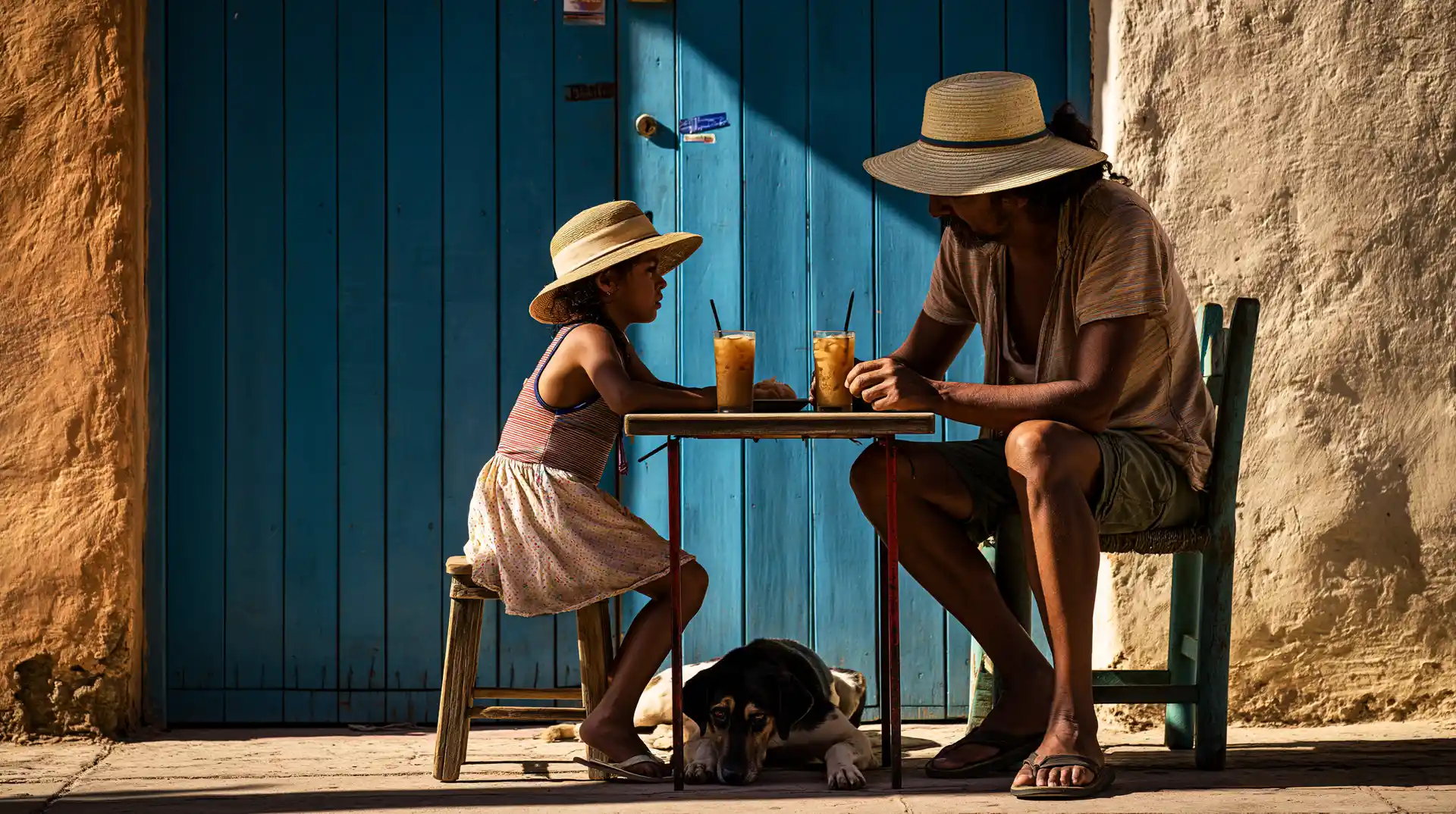
I’ll tell mine without mystery, because it’s one of the things I’m proudest of. My son and I have a Sunday morning date: Starbucks, the dog with us, and an iced tea each. It sounds like nothing and it’s almost everything. I chose it that way on purpose: wherever we are — another city, another country, traveling — there’s almost always a Starbucks nearby, so the date never depends on a place, it travels with us. That was the whole point: I wanted a tradition that couldn’t be lost by moving or by a location closing. An iced tea, a dog, and a Sunday. That’s enough.
Sources and references
Only sources that were consulted and read directly are listed. Where only the abstract of the study could be read, this is indicated.
Larson, R. W., Richards, M. H., Moneta, G., Holmbeck, G., and Duckett, E. (1996). “Changes in Adolescents’ Daily Interactions with Their Families from Ages 10 to 18: Disengagement and Transformation.” Developmental Psychology, 32(4), 744–754. — https://eric.ed.gov/?id=EJ529867(abstract)
Lam, C. B., McHale, S. M., and Crouter, A. C. (2012). “Parent–Child Shared Time From Middle Childhood to Late Adolescence: Developmental Course and Adjustment Correlates.” Child Development, 83(6), 2089–2103. — https://pmc.ncbi.nlm.nih.gov/articles/PMC3502683/
Fiese, B. H., Tomcho, T. J., Douglas, M., Josephs, K., Poltrock, S., and Baker, T. (2002). “A review of 50 years of research on naturally occurring family routines and rituals: cause for celebration?” Journal of Family Psychology, 16(4), 381–390. — https://pubmed.ncbi.nlm.nih.gov/12561283/(abstract)
On the scope of this evidence. Family science distinguishes the routine — the observable, repeated practice — from the ritual — the symbolic representation of a shared occasion; it’s the difference between stopping by a café and Sundays being the café’s. Fiese and colleagues’ review found that routines and rituals are associated with parental competence, child adjustment, and couple satisfaction, and the APA note added the sense of personal identity in adolescence. But these are associations, not causes: the authors themselves warn about inconsistent methods and convenience samples, and the APA notes that it’s just as likely that parents who already function well are the ones who manage to sustain rituals. The two studies on adolescence are equally correlational and drawn from small samples (220 and 188 families, white, in the United States).
None of this proves that designing a portable tradition produces a better child. What it shows is that the ground exists, and that the door this text describes — the date for two — remains open right when it seemed to be closing. The rest is design, and it’s yours.
Help us make it better
Did something ring false, feel missing, or feel like too much? Tell us — good comments make articles better.