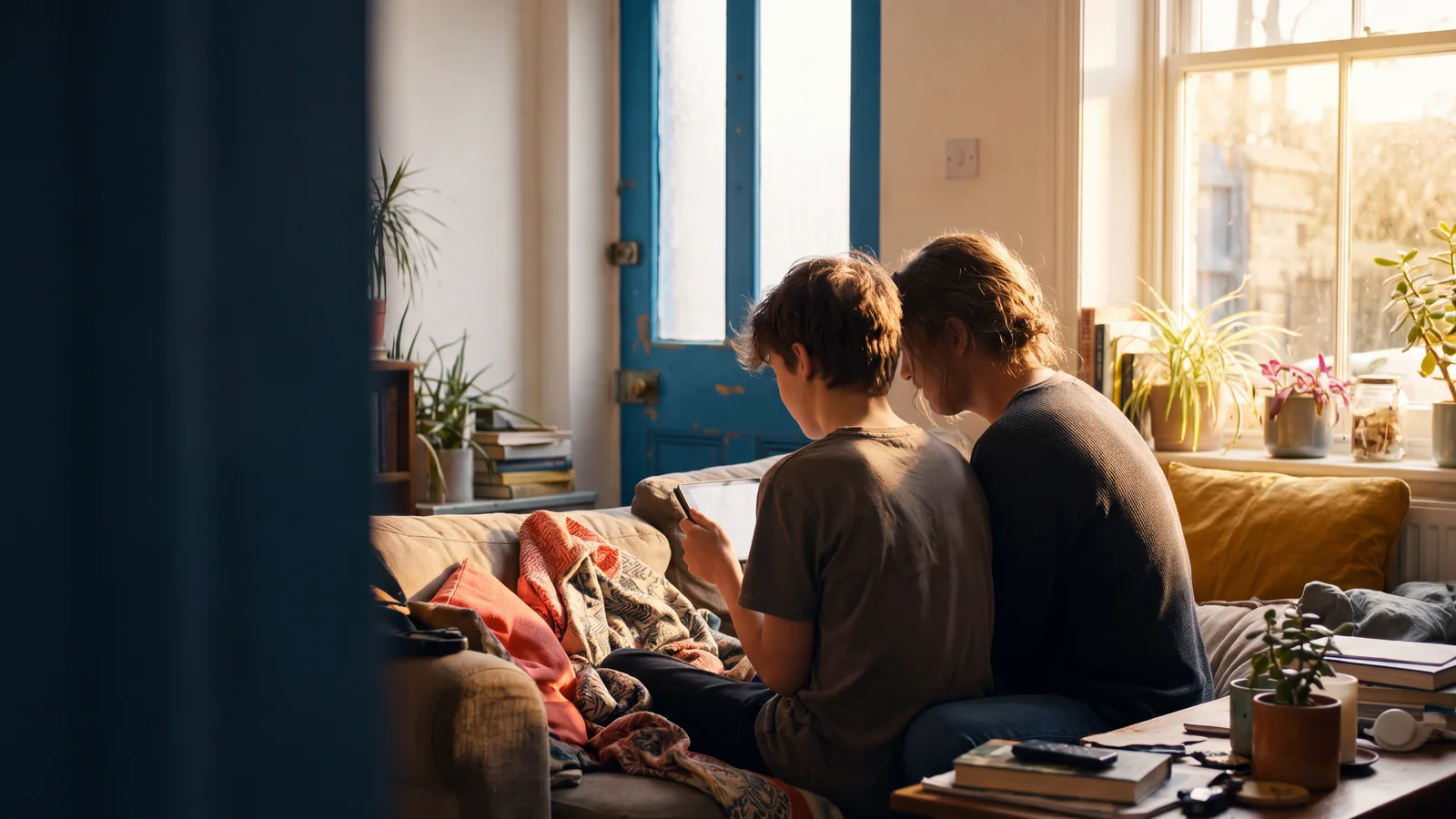
What if the school-year screen rule wasn’t made for the holidays, and insisting on applying it were exactly the mistake?
December splits the world in two. In the north, school stops for two or three weeks of celebrations, cold weather and visits. In the south (Brazil, the Southern Cone) December opens the long summer holidays, the ones that last until February or March, with heat, the beach when possible and the city when not. In both cases the same thing happens: the schedule that held the week together disappears, and with it the structure that made the screen rule work.
Then the guilt arrives. The child has been on the tablet for three hours; the teenager hasn’t left her room; we ourselves are on the couch with our phones. And the temptation of the two extremes appears: clamp down as if it were March, or give up until January.
I propose a third path: accept that the holidays are not the school year, that the rule changes, and that this is fine. What matters is that it changes on purpose and through conversation, not through attrition.
The honest conversation
The holiday rule isn’t announced: it’s talked through. And the honest conversation starts by acknowledging something our children already know: that we use screens too, that holidays are for resting, and that resting can include playing, watching series or talking with friends.
It sounds more or less like this: “These weeks are different. There’s no school, and you’re going to have more screen time than during the school year. I’m fine with that. What I want is for it not to swallow everything else. What do you think we should look after?”
With little ones, the conversation is shorter and the adult decides more. With teenagers, the conversation is the heart of it: if the rule is theirs too, they defend it; if it’s imposed, they look for the loophole. It’s worth listening to what they propose. They’re often more sensible than we expect, especially when they don’t feel accused.
Screens together, screens alone
Not all screen hours are equal. A movie watched as a family, with popcorn and commentary, is one thing. A game where the father or mother sits down, learns the rules and loses is another. A video call with grandparents who live far away is another still. And endless scrolling, alone, at midnight, is something very different.
The holidays are a rare chance to tip the balance toward the shared screen. Some ideas:
- A movie or series chosen in turns, one fixed night a week, and whoever picks it makes the case for it before watching.
- Play their game. Ask them to teach you the video game they love, and play it for real. For many teenagers, an adult taking a genuine interest in their world is the closest thing to a deep conversation.
- Screens for going out. Look up together a place to go, a recipe, a trail, a new beach. The screen as a map, not a destination.
- Create, don’t only consume. A short video of the holidays, one photo a day, the playlist of the summer or of the winter.
The shared screen doesn’t replace the rest of the day. But it changes the tone: it stops being the place the child goes away to and becomes, sometimes, a place where we meet.
What to protect
If you have to choose, and on holiday you do, I propose protecting three things and letting go of the rest:
- Sleep. Holidays allow going to bed and getting up later, and that’s fine. What’s worth avoiding is the screen that eats the whole night. An agreed switch-off time and devices out of the bedroom at bedtime work in almost any home.
- Mornings. Don’t let the first hour of the day start with a screen. Breakfast, moving, going outside for a while. A morning without screens tends to pull along a different day.
- One outing a day. A walk, the park, the beach, the market, a friend’s house, the pool, the snow where there is snow. Something outside the home, even if it’s short. In the southern heat, that’s early morning or late afternoon; in the north, the short midday light.
With that looked after, the rest can be more flexible than our guilt allows. A long afternoon of video games on holiday is not a parenting failure.
Teenagers too
With older children the temptation is to throw in the towel: “they’re big now, let them do what they want.” But a teenager on holiday still needs to sleep, still needs to move and still needs, even without saying so, someone at home to notice whether they’re okay. For them, the screen is above all their friends. Taking it away entirely means taking away their people.
With a teenager, the conversation works best as a negotiation between people who respect each other: what they propose, what you need, what you agree on. Then, after a week, check together whether it worked. Being able to change the rule is part of the rule too.
Something to do this week
Before the holidays start, or on the first day, sit down with your children and ask the question: “What should we look after these weeks?” Agree together on the three things you’ll protect (sleep, mornings, one outing) and one fixed night of shared screen time. Write it on a piece of paper on the fridge. After seven days, review it together.