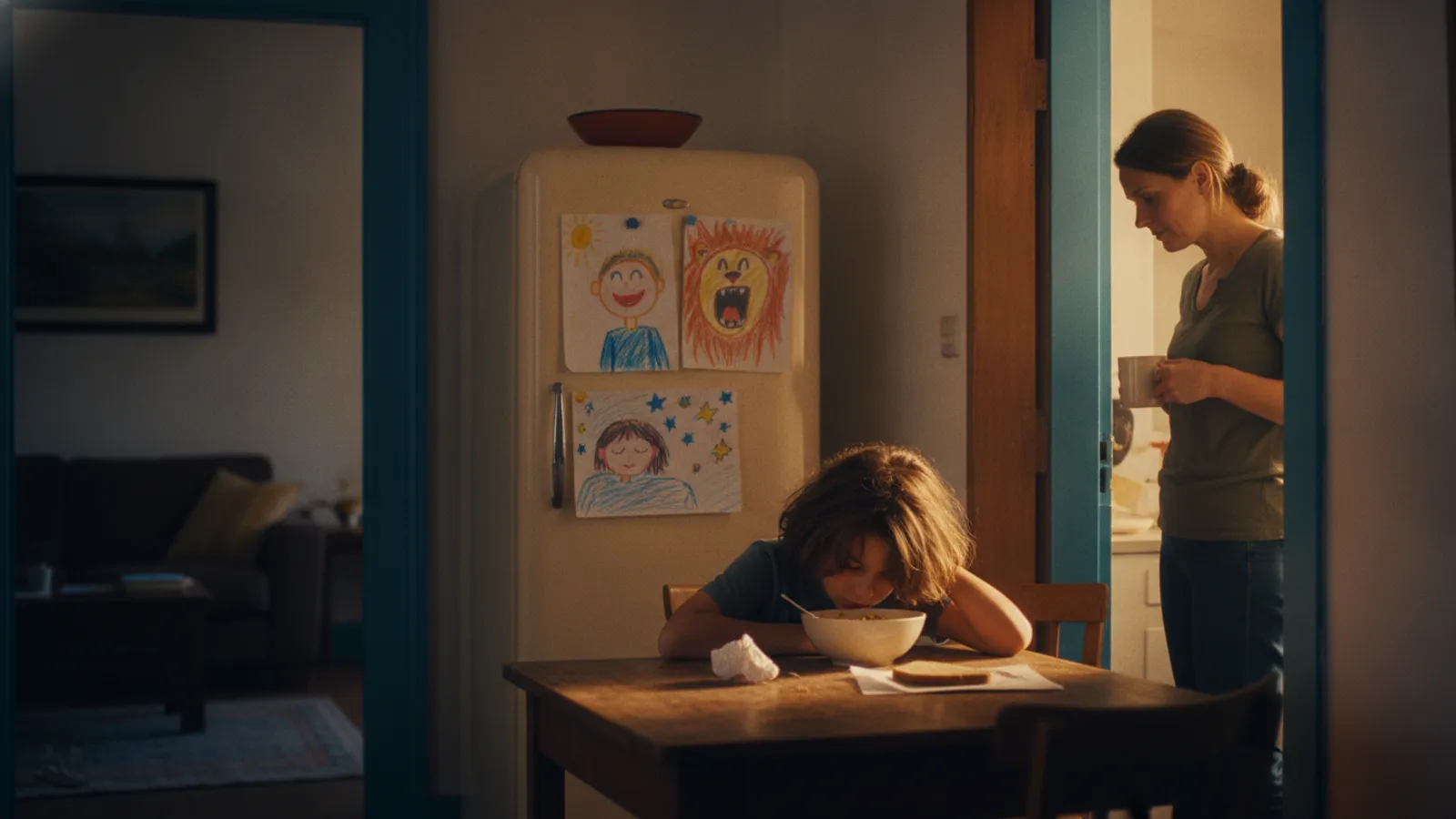
She's many — and today you got to meet a new one. We're not talking about growing up (that's a movie cliché): we're talking about the child at breakfast not being the one who comes out of school. Firm structure, flexible approach — and the craft of reading which one showed up.
the tip in one minute — the full article is this page
Video transcript
Your child isn't one person. They're many — and today you got to meet a new one. I don't mean they're growing up: I mean the child at breakfast isn't the same one who came out of school this afternoon. They're different from one hour to the next, from one setting to another, depending on how they slept, what they ate, what they were looking forward to or what let them down mid-afternoon. Tuesday's sleepy one isn't Saturday's beach one. Some are morning people; others get going at five. None of that is a factory defect: it's the normal condition of a human being under construction — and of several adults we know, starting with ourselves. That awareness should shape how you interact, when you step in, and even how you plan. The important conversation doesn't get scheduled for the hour your child has historically melted down. And here's the guardrail, which is half the thesis: this doesn't mean tiptoeing. Stability and clear expectations are non-negotiable. A child rests easy when they know what to expect. Structure is the riverbed; the water changes every day. The rules don't change with the weather — the way in does. “In this house, homework gets done” can come today through your company and tomorrow through their own independence. No formula works applied blindly to the average child, who doesn't exist. The trick was never the technique: it's recognizing the moment. And the manual can't give you that, because the manual doesn't know the one who showed up today. Yes, it's harder: judging and deciding every time is more tiring than applying the rulebook. But we're not raising machines. Ten seconds of reading the water before you dip the oar — that part of the craft, no one does for you.
This piece is a personal position of the author’s — the kind a parent can disagree with, and that’s fine. The house publishes it as what it is: a lived conviction, not a laboratory finding.
Your child is not one person. She’s many — and today you got to meet a new one.
We’re not talking about the obvious. That children grow, mature, and change, and that what worked at seven doesn’t work at twelve — everybody knows that: it’s practically a movie cliché. We’re talking about something finer, closer, more daily: your daughter this morning is not the one from last night. The one who comes out of school is not the one from breakfast. The one who’s tired on Tuesday is not the one at the beach on Saturday. They’re different from one day to the next, one hour to the next, one context to the next — at school, with friends, at home — depending on how they slept, what they ate, what they’re looking forward to or what let them down by mid-afternoon.
Some are morning people; others start up at five. Some turn impossible with hunger, others with tiredness, others from sheer accumulated emotion. None of that is a factory defect: it’s the normal condition of a human being under construction — and of several adults we know, starting with ourselves.
What this changes (and what it doesn’t)
The practical consequence is simple to state and hard to do: that awareness has to inform how we interact, when we step in, and even how we plan. The important conversation doesn’t get scheduled for the hour your child historically melts down. The new chore doesn’t debut on the day he came home dragging a disappointment from recess.
And here, before anyone accuses this house of softness, the guard-rail — which is half the thesis:
This does not mean walking on eggshells. It does not mean rules that change with the mood, unstable structures, or a home that reorganizes itself every time someone wakes up crooked. On the contrary: stability, structure, and clear expectations are a non-negotiable part of the job. A child rests easy when he knows what to expect.
Structure is the riverbed; the water changes every day. The riverbed isn’t renegotiated each morning — but the one rowing does watch the water. The rule doesn’t change with the weather — but the one rowing watches the water. The same rule — “in this house, homework gets done” — can come in through the door of support one day (“we do it together today, since you’re dragging”) and through the door of autonomy the next. The rule stayed intact; the approach read the water.
Against formulas applied blind
There’s serious advice and abundant literature on technique: when it’s worth “connecting and redirecting” — the first of the twelve strategies that Daniel Siegel and Tina Payne Bryson popularized in The Whole-Brain Child (2011), which in the middle of a storm calls for tuning in to what the child is feeling before trying to reason with him — when to empathize first and set the limit after, when to de-escalate in the moment and address the issue head-on later, once the weather allows it. Almost all of them are good tools.
But no formula, template, or recommendation — including this house’s own — works applied blind, all the time, to the average-child who doesn’t exist. The trick was never the technique: it’s reading the moment. Knowing when firmness is called for and when flexibility is. And no manual brings you that, because the manual doesn’t know the person who showed up today.
The craft of reading
Yes: it’s harder. Staying aware, judging, deciding every single time — that’s more tiring than applying what’s already set. A constant child, one who always responded the same way to the same stimulus, like a well-calibrated machine, would be more comfortable.
But we’re not raising machines. And this is the part of the craft nobody can do for us: awareness of our daughters and sons, and of their ever-changing selves and contexts. Reading them before acting. Ten seconds of watching the water before dipping the oar.
There’s a practice in this house’s library for exactly that: The House Forecast — the ten-second read (did she sleep? did she eat? what kind of day is she bringing?) before choosing the door.
Anchor line: Your child is not one person: she’s many. The rule doesn’t change with the weather — but the one rowing watches the water.
Comments from the house
Note from Carlos — the author
This is one of the convictions I found hardest to learn to practice, because it goes against comfort. What’s already set is restful; reading the water every day is not. But every time I applied the formula to the average-child instead of looking at the one in front of me, the formula lost.
Virgilio “Coach” Reyes — the voice of structure
Don’t mistake my enthusiasm: I’m signing this piece precisely because it defends structure. Twenty-five years on the track teach you that the athlete performs when the training is predictable — and that the coach who gives the same session to the well-rested kid and the one who came in without sleep isn’t being consistent: he’s being lazy. Discipline is architecture, and all good architecture has hinges. Rigid the frame; sensitive the hand.
Marina Haddad — the voice of evidence
I went and dug up the hooks, and I bring good news and one correction.
Best first, because it’s the strongest thing there is and almost nobody tells you: this has actually been measured, and with ridiculously small doses. Children aged seven to eleven had sleep added or taken away over a few days, and teachers — who didn’t know which child was in which group — scored their behavior. Twenty-seven extra minutes of sleep detectably improved emotional lability and restless, impulsive behavior; fifty-four fewer minutes worsened it (Gruber et al., Pediatrics, 2012). In adolescents, five nights of six and a half hours versus five nights of ten produced more tension, more anger, more irritability, and worse emotional regulation — reported both by the teens themselves and by their parents (Baum et al., 2014). Half an hour of sleep. That’s the water this piece is talking about, and it isn’t a metaphor.
Next, the day-to-day variation itself: it exists and it’s been documented. Following 81 preschoolers across more than a thousand observations of a task as domestic as brushing their teeth, the persistence of the same child rose and fell from one day to the next — and what each child was sensitive to (mood, sleep, adult stress) varied from child to child (Leonard et al., Child Development, 2022). In 474 adolescents followed for five years with daily diaries, mood variability was measured literally as the difference between one day and the next, and it decreases across adolescence (Maciejewski et al., 2015). That last finding is a gift for the article: the younger the child, the more water there is to read.
Chronotypes, with one precision: they’re real and measurable in children from age four, with instruments that are validated and stable over time (Werner et al., 2009), and the shift of the sleep schedule to later in the second decade of life is well documented (Crowley, Acebo, and Carskadon, 2007). But watch out: chronotype is more trait than state. It backs up the “some are morning people and others don’t start until five” line — that is, differences between children. It does not back up day-to-day variation. Those are two different things, and this house doesn’t mix them.
And now the correction, which I owe against my own enthusiasm: Thomas and Chess’s “goodness of fit” — that development goes better when the environment adjusts its demands to the child’s temperament — is a useful framework with moderate support, not an established causal finding. The reference review says the findings “are beginning to suggest” ways to improve that fit, and warns that most studies are cross-sectional, that the associations are of moderate strength, and that they don’t permit causal conclusions (Schermerhorn and Bates, 2012). So I’ll put it where it belongs: a consistent hypothesis, not proof.
And the distinction the whole title hangs on — state versus trait, how your child is doing versus who your child is — comes from Spielberger: trait is a stable disposition, state is transient and varies with the situation and the moment. It’s a conceptual framework borrowed from adult psychometrics. What gives it flesh for children isn’t Spielberger himself: it’s the four studies above.
To sum up for whoever only reads the last line: the author’s thesis stands on firmer ground than he himself thought — especially on the sleep side. Everything above is association except for the two sleep experiments, and none of these sources tells anyone what to do in their own house tonight.
Tomás Andrade — the translator
In aviation nobody takes off without reading the weather, and nobody thinks to say the pilot who checks the forecast “has no backbone.” The instrument panel exists for exactly that: behavior is the panel; emotion is the engine. This piece asks for exactly what a good protocol asks for: check the engine before demanding power from it.
Polo — the caretaker closes
This piece is in conversation with half the house: The House Forecast is its twin practice, Tell Me About Your Day digs the channel that lets you read the water, and the mirror of how we’re doing is the seasonal version of this same reading. And a caretaker’s aside: in this house not even the maps are the territory — every child moves through the stages in his own way, and apparently, so does every day of the week.
Sources and references
Only sources that were retrieved and actually read are listed. Consulted on July 26, 2026. Full report, with a verdict per claim: resources/research/tu-hijo-no-es-una-persona.md.
Gruber, R., Cassoff, J., Frenette, S., Wiebe, S., & Carrier, J. (2012). «Impact of sleep extension and restriction on children’s emotional lability and impulsivity.» Pediatrics, 130(5), e1155–e1161. doi:10.1542/peds.2012-0564 — https://pubmed.ncbi.nlm.nih.gov/23071214/Argues: that small changes in sleep (≈27 min more, ≈54 min less) detectably modify emotional lability and impulsive behavior in children aged 7 to 11. Randomized parallel-group design, 34 children, assessment by teachers blind to condition.
Baum, K. T., Desai, A., Field, J., Miller, L. E., Rausch, J., & Beebe, D. W. (2014). «Sleep restriction worsens mood and emotion regulation in adolescents.» Journal of Child Psychology and Psychiatry, 55(2), 180–190 — https://eric.ed.gov/?id=EJ1032147Argues: that five nights of sleep restriction (6.5 h vs. 10 h) worsen mood, irritability, and emotional regulation in adolescents aged 14 to 17. Randomized crossover design, 50 participants, with actigraphy.
Leonard, J. A., et al. (2022). «Daily fluctuations in young children’s persistence.» Child Development, 93(2), e222–e236. doi:10.1111/cdev.13717 — https://pubmed.ncbi.nlm.nih.gov/34904237/Argues: that the same child’s persistence fluctuates from one day to the next, and that what each child is sensitive to (mood, sleep, parental stress) varies between children. 81 preschoolers, 1,195 observations. Small and not very diverse sample.
Maciejewski, D. F., van Lier, P. A. C., Branje, S. J. T., Meeus, W. H. J., & Koot, H. M. (2015). «A 5-year longitudinal study on mood variability across adolescence using daily diaries.» Child Development, 86(6), 1908–1921. doi:10.1111/cdev.12420 — https://pubmed.ncbi.nlm.nih.gov/26464350/Argues: that day-to-day mood variability is measurable, and that it decreases across adolescence. 474 Dutch adolescents followed from age 13 to 18.
Werner, H., LeBourgeois, M. K., Geiger, A., & Jenni, O. G. (2009). «Assessment of chronotype in four- to eleven-year-old children: reliability and validity of the Children’s Chronotype Questionnaire (CCTQ).» Chronobiology International, 26(5), 992–1014. doi:10.1080/07420520903044505 — https://pubmed.ncbi.nlm.nih.gov/19637055/Argues: that chronotype — being a morning or evening person — is measurable and stable over time as early as in children aged 4 to 11. It’s a trait, not a daily variation.
Crowley, S. J., Acebo, C., & Carskadon, M. A. (2007). «Sleep, circadian rhythms, and delayed phase in adolescence.» Sleep Medicine, 8(6), 602–612. doi:10.1016/j.sleep.2006.12.002 — https://pubmed.ncbi.nlm.nih.gov/17383934/Argues: that the sleep/wake schedule shifts later during the second decade of life, with circadian and homeostatic components. A review.
Schermerhorn, A. C., & Bates, J. E. (2012). «Temperament, Parenting and Implications for Development.» Encyclopedia on Early Childhood Development, April 2012 — https://www.child-encyclopedia.com/temperament/according-experts/temperament-parenting-and-implications-developmentArgues, with reservations: that adjusting one’s approach to the child’s temperament is a promising direction. The authors warn that most studies are cross-sectional, that they don’t allow causal conclusions, and that the associations are of moderate strength. This is the basis for the nuance on “goodness of fit.”
Sravanti, L. (2017). «Goodness of fit.» Indian Journal of Psychiatry, 59(4). doi:10.4103/psychiatry.IndianJPsychiatry_423_17 — https://pmc.ncbi.nlm.nih.gov/articles/PMC5806337/Argues: the definition of the concept and its origin in Chess and Thomas’s New York Longitudinal Study. It’s a definitional commentary, not empirical evidence.
Thomas, C. L., & Cassady, J. C. (2021). «Validation of the State Version of the State-Trait Anxiety Inventory in a University Sample.» SAGE Open, 11(3). doi:10.1177/21582440211031900 — https://journals.sagepub.com/doi/10.1177/21582440211031900Argues: only Spielberger’s conceptual distinction between trait (stable disposition) and state (transient, variable response). University sample, about anxiety; it says nothing about children.
Siegel, D. J., & Bryson, T. P. (2011).The Whole-Brain Child: 12 Revolutionary Strategies to Nurture Your Child’s Developing Mind. Delacorte Press. Attribution of “Connect and Redirect” as strategy #1 verified via the editorial review in Greater Good Magazine, Greater Good Science Center, University of California, Berkeley — https://greatergood.berkeley.edu/article/item/book_review_the_whole_brain_childArgues: the attribution of the technique and its formulation (tune in to the emotion before reasoning). The review describes it as a framework based on research on the developing brain and on the authors’ clinical experience — it’s clinical popularization, not an experimental result. Secondhand verification: the book itself was not accessed.
What this article does NOT claim with backing: that there is evidence on the optimal moment to revisit an issue with a dysregulated child (it was searched for; no primary source was found — it stands as common practice, not as a finding), nor anything about hunger and self-control, which here is a domestic observation, not a research claim.
Help us make it better
Did something ring false, feel missing, or feel like too much? Tell us — good comments make articles better.