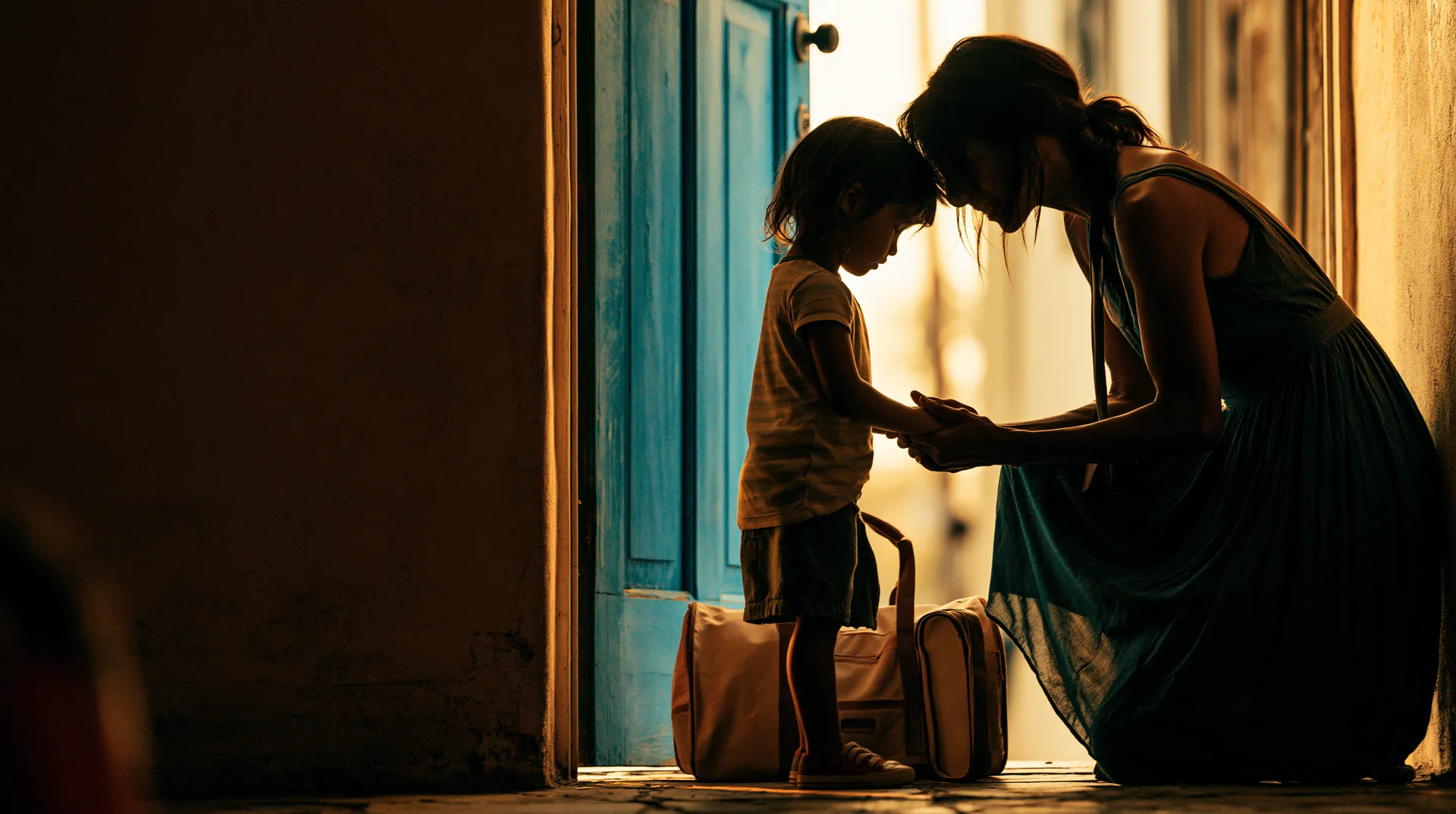
At the daycare door, at a relative's house, even when you go to the bathroom: he clings, cries, begs you not to leave. Every goodbye is a drama, and you leave with a tight heart and the doubt: are you leaving him well, or abandoning him?
His crying at goodbye breaks you and pits two opposite urges against each other: staying to comfort him «a little longer» (which drags out the agony) or vanishing without warning to avoid the scene (which teaches him you can disappear at any moment). Both, without meaning to, feed his distress. Breathe: that it's hard for him to let go of you isn't that he's spoiled or that you made him dependent — it's that he loves you and is still learning that when you leave, you come back.
Separate the fact from the judgment. Some separation anxiety is expectable and even healthy: it appears strongly around age one, reappears at every new stage (daycare, school, changes), and is the proof of a secure attachment — he protests because you matter to him. What calms it isn't that you stop leaving, but that he learns from experience that separations are safe and have an end: you go, time passes, you come back. It intensifies when there are changes (a move, a new sibling, the parents' separation, a scare) or when the child is tired or ill. The form shifts with age: the little one cries and clings; the older one complains of tummy aches, doesn't want to sleep over at other houses, or asks to call you all the time. The key is a balance: neither forcing the separation harshly nor avoiding it always — because avoiding it entirely confirms to him that there was something to fear.
Don't sneak off to spare yourself the crying — it works today and wrecks his trust tomorrow: he learns you can vanish without warning and gets more watchful. Don't drag out the goodbye with twenty hugs and turnbacks: the more it stretches, the more the distress grows; a warm, brief goodbye is kinder than an endless one. Don't ridicule him or compare him («look, the others don't cry»). Don't pass on your own guilt or doubt with a stricken face: he reads you, and if you doubt he'll be fine, so does he. And don't always give in by staying or never leaving him: without experiences of safe separation, the fear doesn't come apart.
No ranking, on purpose: no two children are alike, and yours isn't even the same as yesterday. Read which one fits your home, today — or combine them.
Invent a goodbye that's always the same, warm and brief: a kiss, a fixed phrase («I'm leaving you with the teacher, I'll pick you up after snack»), and you leave with confidence. Predictability calms; the phrase that anchors the return to something concrete («after…») gives him a map of time. Keep it always: trust is built by coming back when you said.
In calm, put into words what he feels and practice without pressure: «sometimes when I leave you feel sad, and that's okay; I always come back». You can play at goodbyes and returns, read stories about it, leave him something of yours to «keep him company» while you're gone. And celebrate each separation managed without overdoing it: «you stayed and had a good time, see?». His own evidence is worth more than your promise.
The fear of separating comes apart by letting go little by little, not all at once nor by always avoiding it: staying a short while with a trusted relative and raising the time, a first night away only if he wants to try. Each experience of «I separated and nothing bad happened, and they came back» is what truly heals him. Slipping back in a hard stage doesn't erase the progress.
The goodbye is cared for in the moment with calm and brevity; the conversation and the rehearsal are done beforehand, in a quiet while, not at the door with the clock on top. Choose well when to push a new separation: not the day he arrives exhausted, ill or after a big change. Align with whoever parents with you and whoever cares for him (the teacher, the grandparents) so everyone responds the same and keeps the promised return. And be patient with the ups and downs: separation anxiety comes and goes with the stages; that it's hard today doesn't mean a setback.
Some separation anxiety is normal and is accompanied at home with rhythm and patience. It's worth seeking guidance — pediatrician or child psychologist — when it's very intense and disproportionate for his age, when it drags on over time without easing, or when it starts to limit his life: he can't go to school, doesn't sleep anywhere, won't separate for a moment, has strong meltdowns or recurring physical aches (tummy, head) tied to separations, or lives anxious thinking something will happen to you. Also if it appeared suddenly after an event (a loss, a scare, a big change) and doesn't ease. A professional works very well with separation anxiety when it goes from an expectable stage to a disorder. This is peer commentary, not clinical advice: when in doubt, consulting early keeps the fear from settling in.
Everything in this house is peer commentary and suggestion — it does not replace professional help. It's every mother's and every father's responsibility to notice the situation and to seek it when it can serve. If you need a number, check the directory of helplines by country. The full disclaimer, here.
You've put her to bed, read to her, given her water. And ten minutes later she appears again at your door: 'I can't slee…
Every morning the same battle: he complains of a stomachache, dawdles on purpose, cries at the door, 'not today, please'…
At bedtime he drops the question that squeezes your chest: «are you going to die?», «am I going to die?». It's not a plo…