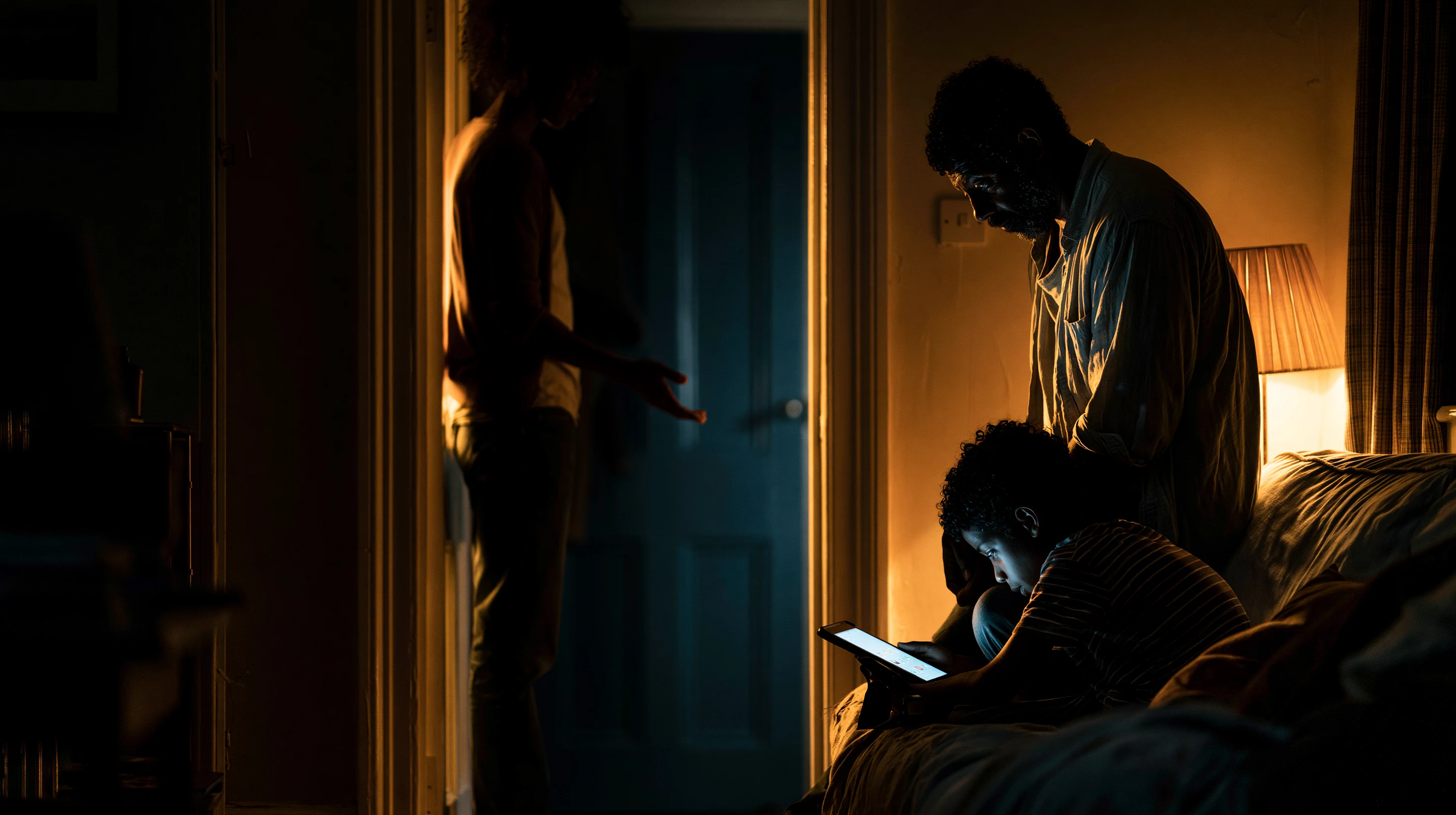
«Five more minutes» that turn into twenty, the tablet that won't be put down, the «coming!» that never comes. The same scene again at the same hour, and tonight you're both tired and short-fused. You feel like you're about to blow.
Tonight two things get mixed up in you: the irritation of the moment and the whole background sermon about screens you've been carrying for months. The urge is to unload the full lecture right here, hot, with the tablet as hostage. Name it inside: tonight you are NOT going to solve the family's screen model. Tonight you have one job — lower the temperature and get to bed without this becoming a war. The big conversation is for another day.
Separate the event from the structure, because confusing them is what makes the fight fester. The event is tonight: tiredness, a badly done transition, a rule that wasn't clear or that gets applied differently every day. The structure is the underlying model — how much, when, where, with what agreements — and that gets decided cool-headed, not at 8 at night with both of you irritated. The nighttime fight is almost never about the tablet: it's about the transition (nobody likes having something cut off short) and about the inconsistency (if yesterday it was thirty minutes and today ten, the fight is fair). Read the forecast: much of these fights are hunger, sleep and end-of-day disguised as a screen conflict.
Don't renegotiate the rules in the middle of the battle — any agreement wrenched out by shouting is born dead and teaches that the tantrum reopens the negotiation. Don't unload the background sermon now («this generation», «in my day», «you're becoming an addict»): hot-headed nothing gets in and it only drags the scene out. Don't cut it off short with no warning if you can avoid it — yanking the screen away all at once guarantees the blowup; the brain needs a bridge to get out. Don't threaten epic punishments you won't carry out tomorrow. And don't turn every night into the same standoff over who holds out longer: repetition with no change of structure is the sign that the problem isn't today's discipline, it's the underlying design.
No ranking, on purpose: no two children are alike, and yours isn't even the same as yesterday. Read which one fits your home, today — or combine them.
Tonight's goal is to land, not to win. A short, firm line without raising the stakes: «I know it's hard to let go. That's it for today; tomorrow we'll talk about how we do it.» You offer the bridge — a closing warning, save the game, one last agreed level — and you hold the end without arguing the substance. Lowering the temperature yourself first is half the job: you can't put out a fire by adding your own.
A good part of the fight is the abrupt cut: leaving an absorbing screen genuinely costs, it isn't a whim. Install a bridge that repeats: a «ten left / five left» warning, a natural closing point (end of level, end of episode), a routine of what comes next that's appealing. The bridge is agreed cool-headed but used every night; over time, the expected transition fights far less than the unexpected yank.
If this fight repeats, the problem isn't the night's discipline: it's that the structure needs review. But that's done at a good moment of the week, with no open case, two voices: what's reasonable at their age, where and when yes, what happens when it's time to cut off. An agreement made calmly — with their part and yours — holds on its own; one imposed by shouting has to be reimposed every night.
Tonight's business is tonight's: defuse, set the bridge, get to bed. No renegotiating rules now — hot-headed negotiation is the trap. The structure conversation is scheduled for a good moment, with the forecast in hand: full belly, day closed, both calm. And mind the clock: many of these fights get solved by moving dinner or bedtime earlier, not by hardening the screen rule. If there's another adult parenting, the underlying model is agreed between you so the rule doesn't change from one house to another — but that too cool-headed.
A screen fight at night is one of the most everyday things there is and doesn't call for professionals — it calls for structure and a good transition bridge. It's worth a closer look when the use stops being a routine conflict and starts eating everything else: if they drop friends, sleep, food or things they used to like in order to be on the screen; if cutting off brings disproportionate, sustained reactions they can't regulate; or if the screen became the only place where they're okay and everything outside it irritates them. There the issue is no longer the nighttime rule but what they're seeking or avoiding on the screen — and sometimes the school's or a professional's eye helps. This is peer commentary, not clinical advice: telling a normal fight over limits from use that covers something else is our responsibility as parents, and consulting early isn't overreacting.
Everything in this house is peer commentary and suggestion — it does not replace professional help. It's every mother's and every father's responsibility to notice the situation and to seek it when it can serve. If you need a number, check the directory of helplines by country. The full disclaimer, here.
You get up for water and see the line of blue light under the door. Your daughter has been awake for hours on her phone …
It wasn't in secret. You said no and he did it looking you in the eye: «I'm not doing it», «what are you going to do?», …
'Everyone in my class has it.' Your daughter wants to open an account on that network, and the platform's minimum age is…
Ten seconds before stepping in: did they sleep? did they eat? what kind of day are they carrying? Not to excuse everythi…
Enter their digital world as a squadmate — not an inspector. A controller in your hand changes the whole conversation ab…
The day of the first cell phone isn't a purchase, it's a ceremony. Before turning it on, write the house rules together …