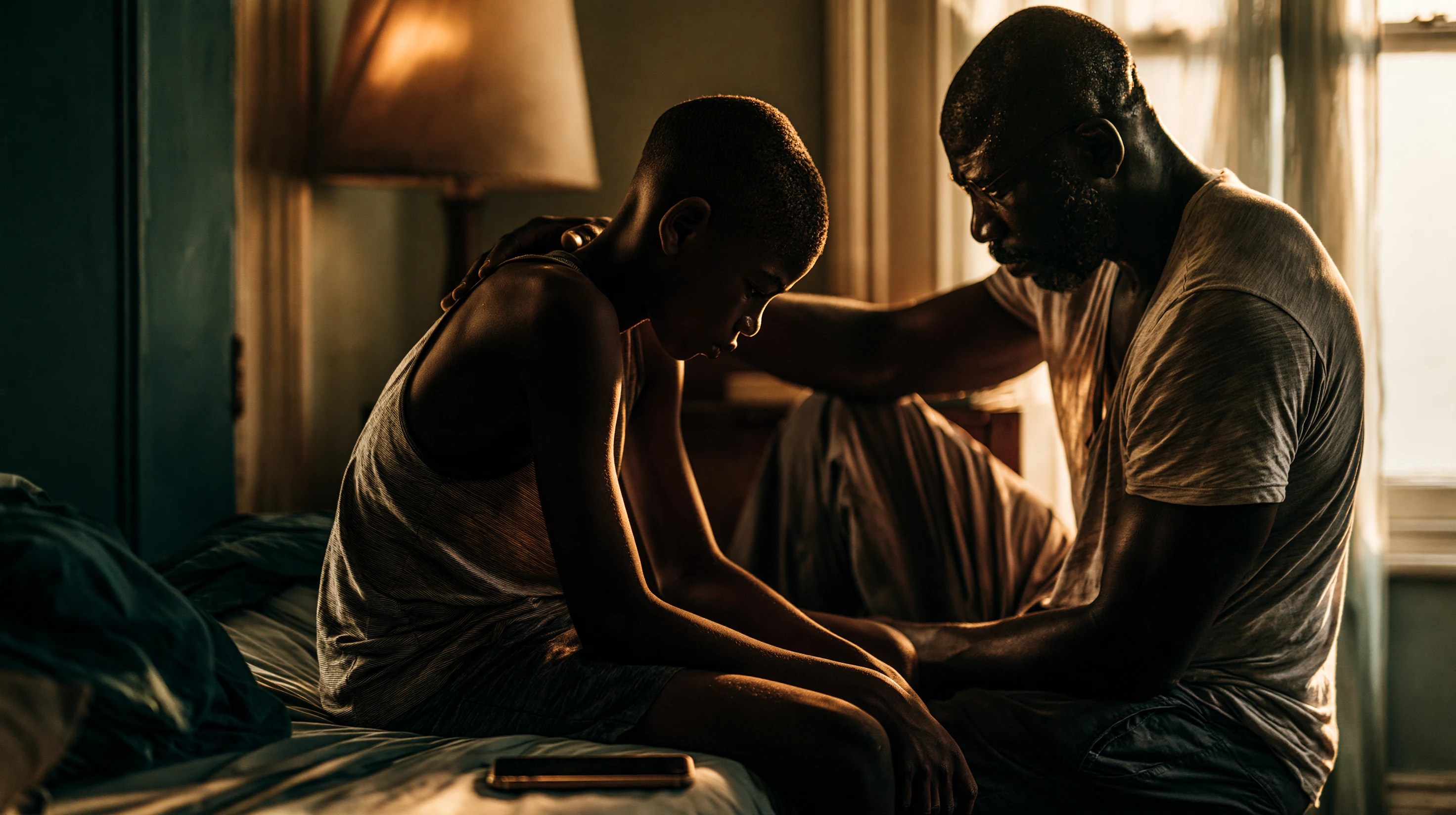
Your son comes home dimmed, or you find out yourself: a group where they humiliate him, comments that crush him, an image or nickname passed around to mock him. Someone was cruel to him online, before many, and he's living it alone.
The instinct to protect fires, turned into fury: the urge to find who's to blame, to write to their family, to fix it by force this very afternoon. Name that fury inside, because your son is reading your face: if he sees you overflow, he learns that telling you means managing YOUR reaction on top of his own pain, and next time he won't tell you. The first thing he needs isn't your rescue operation: it's to feel he's safe with you, that it isn't his fault, and that he won't face this alone.
Before acting, understand what makes this particular and read it well. Online cruelty has edges of its own: it gives no respite (it reaches his pocket at all hours, home stops being a refuge), it has an audience (humiliation before dozens weighs differently), it stays on record (it can be forwarded and resurface), and it usually happens where you can't see. Read the size: a one-off scrape or sustained harassment? From an acquaintance, the school group, an anonymous stranger? Does it include threats, spreading of intimate images, incitement to self-harm? That decides the register of the response. And read your son: kids often keep quiet about this out of shame or fear of losing the phone — the silence isn't that it doesn't hurt, it's that he can't find how to tell it.
Don't minimize it («ignore it», «it's internet stuff», «just block and move on») — playing down its weight teaches him that his pain doesn't fit in this house, and he stops telling you. Don't take the phone away as a first reaction: to him it usually reads as punishment for having told you, and it guarantees he'll keep it to himself next time; access is handled with care, not as a penalty. Don't delete everything hot-headed before saving proof — screenshots may be needed to report or for the school. Don't confront the other kid or his family yourself, in fury: it can escalate and take the handling away from you. Don't demand he «defend himself» or «not be so sensitive» — you leave him alone with the load. And don't treat it as a secret between the two of you if the school or the platform can stop it: this is rarely solved by keeping quiet.
No ranking, on purpose: no two children are alike, and yours isn't even the same as yesterday. Read which one fits your home, today — or combine them.
Before any logistics, your son needs to hear and believe three things: «This isn't your fault, you're not alone, and we'll solve it together.» No reproach for what he posted, whom he was talking to or for not telling you sooner — that, if it applies, is for much later. Sustained cruelty isolates and shames; your calm and your loyalty are the net. That he feels telling you was the right decision — and not one that brought him more problems — is what keeps open the door you're going to need.
The urge to delete it all so it disappears is understandable, but first you document: screenshots of the messages, the group, the images or nicknames, with date and who — before deleting or before the other person erases it. It's not to wallow in the damage; it's because reporting to the platform, talking with the school or, in serious cases, the authorities, almost always needs evidence. It's done with you, don't let him carry it alone. Once the proof is saved, then yes, block and clean up his space.
There are concrete levers beyond enduring. Reporting on the platform (almost all have channels for abuse and harassment, and to take content down), blocking those who harass, and — if the ones involved are from his school — going to the school, which usually has a protocol and can cut the social part the app can't reach. You decide with your son how much and how, so as not to take away control of his own situation, but knowing he doesn't have to stop this by his strength alone.
Stay alert to what shifts the register from delicate to urgent: threats of physical harm, spreading or extortion with intimate images (see «An intimate photo going around»), harassment from an adult or a persistent stranger, or — most important — signs in your own son that he can't take it: he isolates himself, stops eating or sleeping, talks of not being able to go on, of disappearing or of harming himself. There this stops being a matter of getting along and becomes one of safety — see the professional block, without delay.
The first minutes are the person's, not the logistics': first your son knows he's safe and blameless, then everything else moves. Saving proof and reporting runs soon — before the content is deleted or spreads further. The school part, calmly and without delay. The conversation about what to learn from all this comes much later, once the crisis is closed and the pain has come down. If there are signs your son can't take it, the time is now, not tomorrow. If there's another adult parenting, they're told soon and calmly: holding up a harassed child is done as a team, and he needs to see his people on his side.
Here the professional and institutional enter early, not as a last resort. It is URGENT — mental health right away and, if you fear for his life, your country's emergency services — if your son isolates himself deeply, stops eating or sleeping, talks of not being able to go on, of disappearing or of harming himself: sustained cruelty can take a kid to a very dark place, and there his safety rules over everything else. The authorities are in order (child protection, cybercrime) if there are threats of harm, extortion, spreading of intimate images, or an adult involved — inform yourself of your country's channels and don't confront alone. The school enters when the harassment comes from classmates. And seek psychological support even without an acute crisis if the damage left him with anxiety, fear of school or of screens, or his self-esteem struck: accompanying him to heal isn't dramatizing. This is peer commentary, not clinical or legal advice: recognizing when the harassment exceeded what a family handles alone and asking for help in time is our responsibility as parents, and doing it early isn't overreacting — it's protecting.
Everything in this house is peer commentary and suggestion — it does not replace professional help. It's every mother's and every father's responsibility to notice the situation and to seek it when it can serve. If you need a number, check the directory of helplines by country. The full disclaimer, here.
This time she's not the victim: she's the one who hurt. A comment that humiliated someone, a group mocking a classmate, …
Your son mentions a «friend» he's never seen in person: someone from a game, a chat, an app. He messages him a lot, defe…
The whole class is talking about Saturday's birthday party. Your daughter found out at recess that she's not on the list…
A fixed date, you and your teen, at the same table in the same café: no siblings, no agenda, no interrogation. One hour …
Want your son to open up emotionally? Show him how: don't answer «fine» on autopilot. If you're tired, say so — with the…
A child who can say "I'm frustrated" hits less than one who only knows how to scream. Naming emotions, day by day, hands…