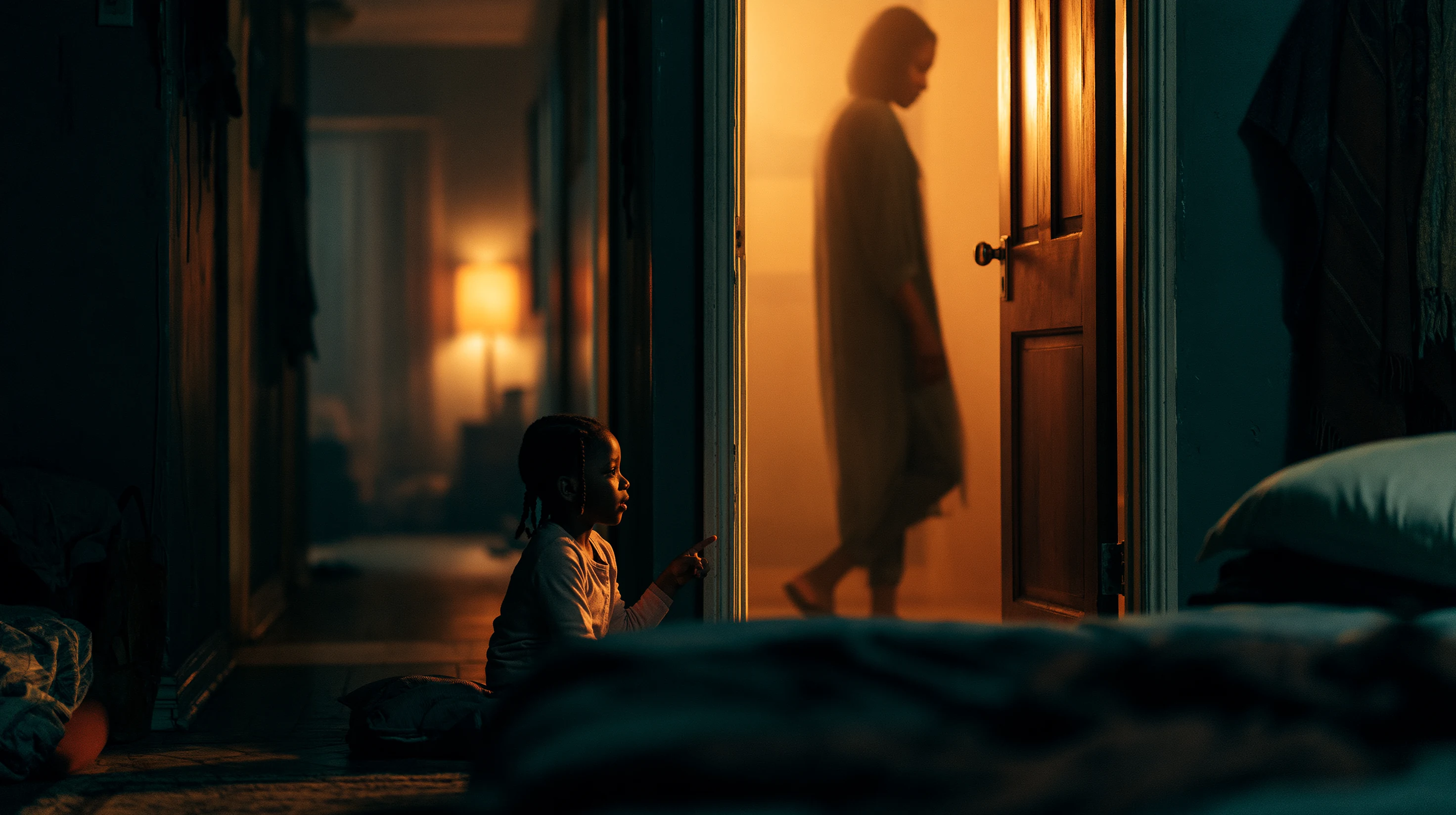
You turn off the light and the negotiation begins: the door a little more open, water again, «stay a little while». Your five-year-old daughter isn't afraid of the bed — she's afraid of what the dark lets her imagine.
At the end of a long day, the nighttime fear arrives just when you've got no battery left. Impatience fires («enough, there's nothing, go to sleep»), sometimes mixed with guilt for feeling it, and with the temptation to solve it fast by giving in to everything. Name it inside: your tiredness is real and legitimate, but it's a poor translator of her fear. The dark doesn't scare her because she's soft; it scares her because at that age the imagination has no off switch.
Fear of the dark is one of the most universal and expectable things of childhood — almost all children go through it, and it's usually a sign of an imagination moving faster than the capacity to tell the real from the possible. Before responding, read the context: is it the usual fear at this age, or did it appear suddenly in a girl who was sleeping calmly? Look at the home forecast: a girl who arrives without a nap, overstimulated by screens at nightfall or with a strange day behind her fears more and calms less. At 3-5 the fear is pure imagination territory (monsters, shadows); at 6-9 it becomes more concrete and arguable (burglars, noises, what she saw on a screen), and you can already talk about what's likely and what isn't.
Don't deny the fear («there's nothing, don't be a scaredy-cat») — to her the monster is real even if it doesn't exist, and denying it leaves her alone with what she feels instead of accompanied. Don't mock it or tell it as a funny anecdote in front of others: shame is the fastest way for her to stop telling you what she fears. Don't interrogate her hunting for the «cause» at midnight: the investigation is by day, in the light. And be careful about solving it by staying to sleep with her every night or putting her in your bed by default — it soothes today and takes away her chance to discover she can do it on her own, which is exactly what she needs to learn.
No ranking, on purpose: no two children are alike, and yours isn't even the same as yesterday. Read which one fits your home, today — or combine them.
Instead of you giving the light, let her have it: a flashlight of her own by the bed, with which she checks the corners with her own hands (see the activity «The flashlight for fears»). Going from victim of the fear to owner of the check is the whole change. Courage isn't having no fear — it's acting with it, and a concrete tool teaches her that without a sermon.
The night frightens less when it's predictable. The same order every time — story, check, the same line, the door to the same crack — gives the dark familiar edges. The calm jar or a dim light help bring the revs down. Repetition isn't rigidity: it's the map that tells her she already knows this territory.
Before solving, validate: «the dark is scary, right? It used to happen to me too». Putting a name to what she feels (with «The name of what I feel») turns the volume down on the fear, because what gets named is handled better than what is only felt. Acknowledging it isn't weakness — it's what lets her begin to let it go.
For the older child (6-9) who already argues, autonomy is accompanied in steps, not all at once: today the hallway light, this week just the flashlight, later on the room dark with the door open. Each conquered stage is named («you did it on your own») so the evidence is hers. Slipping back on a hard night doesn't erase the progress.
The fear is accompanied in the moment — at night it's not the time to investigate or give lessons, it's the time to calm and hold. The conversation about what's real and what isn't, the autonomy pacts and any adjustment to the ritual are done by day, in the light and without the fright on top. Choose the window with the forecast in hand: none of this talks well with a girl worn out at nine at night. And be patient with the pace: letting go of the fear of the dark is a matter of weeks and of relapses, not of one heroic night.
A little nighttime fear is a healthy part of development and doesn't call for professionals — it's worked at home with accompaniment and time. It's worth a closer look if the fear has spent weeks keeping her from sleeping night after night, if it's taking away her day (irritable, no energy, not wanting to go to school), if it comes with stomach or head aches with no cause, or if it appeared suddenly and strong in a girl who used to sleep calmly — sometimes a new, big fear is speaking of something else (a change, something she saw, something worrying her) and the sibling situation «Fear after a real scare» is worth it. What we offer here is peer commentary, not professional advice: reading when an expectable fear has become something that interferes with life is our responsibility as parents, and consulting early with the pediatrician or with counseling isn't overreacting — it's caring for her in time.
Everything in this house is peer commentary and suggestion — it does not replace professional help. It's every mother's and every father's responsibility to notice the situation and to seek it when it can serve. If you need a number, check the directory of helplines by country. The full disclaimer, here.
You've put her to bed, read to her, given her water. And ten minutes later she appears again at your door: 'I can't slee…
Again, at the same hour, the crying from his room. You arrive and your son is sitting up, sweaty, telling you in pieces …
It was a crash, a dog that lunged at him, an earthquake, a moment lost in a crowd. The danger passed, but your son is di…
The monster in the closet, the dark, the noises. Instead of denying the fear ("there's nothing there"), give him a tool …
A jar of water and glitter that, when you shake it, takes exactly as long to settle as a tantrum takes to pass. An ancho…
A child who can say "I'm frustrated" hits less than one who only knows how to scream. Naming emotions, day by day, hands…